
Ethereum's Trilemma Breakthrough: A Paradigm Shift in Blockchain Investment
The blockchain trilemma-balancing scalability, decentralization, and security-has long been a theoretical constraint for decentralized networks. For years, Ethereum's critics argued that its pursuit of decentralization and security inherently limited its scalability. However, the post-Merge era has upended this narrative. By leveraging a modular architecture, Layer 2 (L2) rollups, and protocol-level innovations like EIP-4844 (Danksharding), EthereumETH-- has not only mitigated the trilemma but redefined it. This article examines how Ethereum's technical and economic advancements position it as a unique value capture engine in the blockchain space, with long-term implications for investors.
The Trilemma Reimagined: Ethereum's Modular Architecture
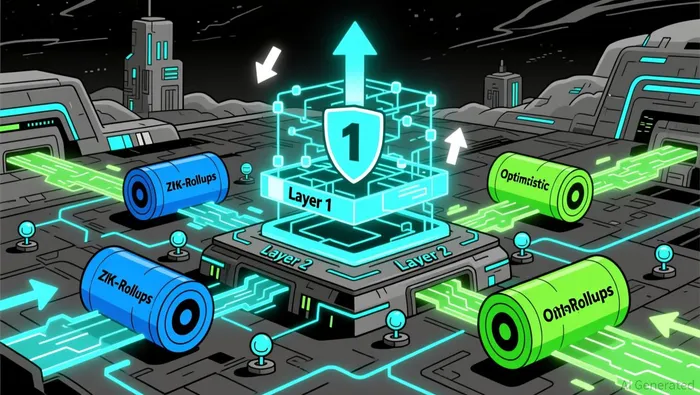
Ethereum's post-Merge roadmap has prioritized a "rollup-centric" future, where L2s handle the bulk of transaction throughput while the base layer (L1) focuses on security and data availability. This modular approach decouples scalability from decentralization, enabling Ethereum to scale without compromising its core principles.
Layer 2 solutions, particularly ZK-Rollups, have emerged as the dominant scaling mechanism. By bundling thousands of transactions into a single proof and posting only the compressed data to L1, ZK-Rollups reduce gas costs by 90% and achieve near-instant finality. As of late 2025, L2 TVL has surged to $49 billion, with daily transaction volumes surpassing Ethereum's mainnet. This growth is driven by consumer applications, gaming, and DeFi, where low fees and fast finality are critical.
The Dencun upgrade (April 2024) further accelerated this shift by introducing proto-danksharding, which optimizes data availability for rollups. By reducing the cost of blob transactions, Ethereum has made L2s more economically viable, enabling a 18% quarter-over-quarter increase in L2 activity. This modular design ensures that Ethereum's L1 remains a secure, decentralized settlement layer while L2s handle scalability, effectively solving the trilemma through specialization.
Economic Resilience: Staking Yields, MEV, and Capital Inflows
Ethereum's economic model has also evolved to reinforce its value capture. Post-Merge, staking yields have stabilized at ~3.7%, attracting institutional and retail capital. With 32 million ETH staked (worth ~$110,000 per validator), Ethereum's validator set exceeds 1 million, ensuring robust decentralization. This contrasts sharply with SolanaSOL--, which offers higher staking yields (4–8%) but relies on a validator count of just 1,500–4,500, raising centralization risks.
Meanwhile, Ethereum's approach to MEV (Maximum Extractable Value) is reshaping its economic dynamics. While spam bots and arbitrage activity consume 50% of gas on major rollups, Ethereum's ecosystem is experimenting with shared sequencing layers and based rollups to align MEV capture with L1 validators. These innovations reduce reliance on centralized sequencers and distribute MEV rewards more broadly, enhancing censorship resistance and long-term sustainability.
Investor confidence in Ethereum's economic model is evident in capital inflows. In Q3 2025, Ethereum ETFs attracted $10.04 billion in net inflows, outpacing BitcoinBTC-- ETFs and solidifying Ethereum's role in tokenized real-world assets (RWAs), which now hold $12.3 billion in value. Despite a 2025 price dip to $1,400 following the Bybit hack, Ethereum's TVL and L2 adoption continued to grow, demonstrating resilience in volatile markets.
Comparative Advantage: Ethereum vs. Solana and Cardano
Ethereum's trilemma breakthrough is best understood in contrast to its competitors. Solana, for instance, leverages a hybrid Proof of History (PoH) and Proof of Stake (PoS) consensus to achieve 65,000 TPS and sub-penny fees. However, its monolithic architecture prioritizes scalability at the expense of decentralization, with a validator set that pales in comparison to Ethereum's 1 million nodes. Solana's recent outages and centralization risks highlight the fragility of its trade-offs.
Cardano, meanwhile, offers a peer-reviewed, research-driven approach but lags in execution. While it processes 250 TPS with lower fees than Ethereum, its TVL remains near zero, and its ecosystem lacks the depth of DeFi and NFT platforms that drive Ethereum's value capture. Cardano's focus on academic rigor is admirable but insufficient to compete with Ethereum's first-mover advantage and developer ecosystem.
Ethereum's modular design, by contrast, allows it to scale through L2s while maintaining decentralization and security. Its L1 upgrades (e.g., Fusaka, Glasterdam) enhance data availability and throughput, ensuring the base layer remains a critical settlement infrastructure. This dual-layer strategy positions Ethereum to dominate both high-throughput use cases (via L2s) and institutional-grade security (via L1), a unique value proposition in the blockchain space.
The Investment Thesis: A Network That Scales Without Compromise
For investors, Ethereum's trilemma breakthrough represents a paradigm shift. Unlike traditional blockchains, which force trade-offs between scalability and decentralization, Ethereum's modular architecture enables simultaneous progress on all three fronts. This has translated into sustained capital inflows, with Ethereum leading blockchains in net capital inflows ($4.2 billion in 2025) and TVL growth.
Moreover, Ethereum's deflationary dynamics-driven by EIP-1559's fee burn mechanism and increased L1 usage-are restoring its value capture. As the Fusaka upgrade (December 2025) expands blob capacity and reduces validator data loads, transaction fees are expected to decline further, making Ethereum more accessible to mainstream users.
Conclusion
Ethereum's post-Merge innovations have not just solved the trilemma-they have redefined it. By decoupling scalability from decentralization through L2s and protocol upgrades, Ethereum has created a self-reinforcing ecosystem where security, efficiency, and value capture coexist. For investors, this represents a rare opportunity to back a network that is not only surviving the blockchain trilemma but thriving within it. As the 2026 roadmap unfolds, Ethereum's dominance in TVL, staking yields, and institutional adoption will likely cement its position as the preeminent value capture engine in the crypto space.






Comentarios
Aún no hay comentarios