
Ethereum's Transition to a Global World Ledger and Its Implications for Institutional Adoption
Network Utility: A Scalable, Secure, and Deflationary Infrastructure
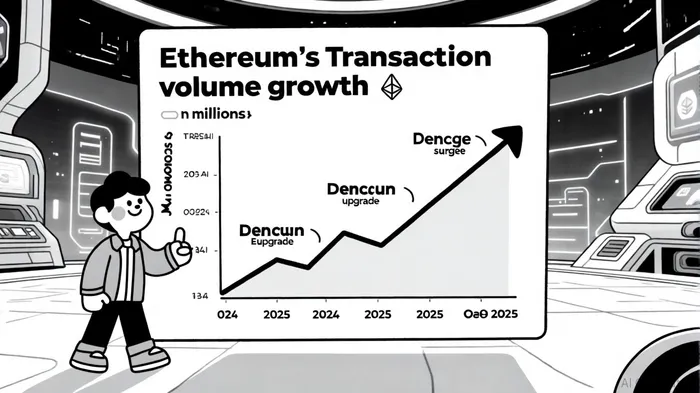
Ethereum's post-Merge upgrades have unlocked a new era of efficiency. Daily transaction volumes hit 1.74 million on August 5, 2025, while monthly volumes surged to 46.67 million in July 2025, driven by institutional demand for stablecoin settlements and DeFi liquidity, according to a CoinRank analysis. The Dencun upgrade, including EIP-4844 (Proto-Danksharding), slashed gas fees by 90%, making EthereumETH-- a cost-effective solution for high-frequency trading and asset tokenization, as noted in a Bitget analysis.
Stablecoin activity alone highlights Ethereum's dominance: $5 trillion in stablecoin transfers occurred on the network in Q3 2025, reported by Meme-Insider. This dwarfs Bitcoin's utility, which remains largely speculative. Meanwhile, Ethereum's $8.3 billion in tokenized RWAs-ranging from real estate to corporate bonds-demonstrates its role as a bridge between physical and digital assets, according to Crypto.com research.
The network's deflationary mechanics further bolster its value proposition. EIP-1559 burns and staking rewards have created a 0.5% annual supply contraction, contrasting with Bitcoin's zero-yield model. This scarcity dynamic, combined with reduced exchange-held ETH (now at a nine-year low of 14.88 million tokens), signals strong institutional accumulation, as noted by Bitget.
Institutional Adoption: From Skepticism to Strategic Integration
Institutional adoption of Ethereum has accelerated in 2025, fueled by regulatory clarity and yield-seeking capital. The U.S. Securities and Exchange Commission's (SEC) approval of in-kind creation and redemption mechanisms for Ethereum ETFs in July 2025 unlocked $9.3 billion in net inflows year-to-date, including a record $4 billion surge in July alone, according to CoinRank. By August, Ethereum treasury firms and ETFs controlled 7.4% of the total ETH supply, a testament to its growing role as a reserve asset, per CoinRank.
Corporate treasuries are also reallocating capital to Ethereum. 19 public companies now hold 2.7 million ETH for active yield generation, leveraging staking and DeFi protocols to earn 3–5% annualized returns, a trend highlighted by Bitget. This trend mirrors traditional finance's shift toward income-generating assets in a low-interest-rate environment.
Ethereum's compliance-focused innovations, such as ERC-3643 and zero-knowledge proofs (ZKPs), have further attracted institutional interest. These tools enable privacy-preserving transactions while maintaining regulatory transparency, aligning with anti-money laundering (AML) and know-your-customer (KYC) requirements, according to Crypto.com research. As a result, Ethereum is becoming the preferred infrastructure for tokenized securities, supply chain finance, and cross-border payments.
Investment Readiness: A Network Built for the Future
Ethereum's investment readiness is underscored by its technological and economic robustness. With over 1 million active validators, the network's security is unmatched, ensuring institutional confidence in its censorship resistance and finality, as noted by Crypto.com research. The introduction of EIP-4844 and Dencun has also positioned Ethereum as a scalable platform for enterprise-grade applications, with layer-2 solutions like ArbitrumARB-- and OptimismOP-- handling $320 billion in August 2025 transaction volume, reported in a Coinpaper article.
Looking ahead, the potential approval of staking functionality within spot Ethereum ETFs could unlock another wave of institutional participation. This would allow investors to earn yields directly through ETFs, further blurring the lines between traditional and decentralized finance, as highlighted by CoinRank.
Conclusion: Ethereum as the New Global Ledger
Ethereum's transition to a proof-of-stake (PoS) model has not only improved its environmental sustainability but also transformed it into a global settlement layer. With $88 billion in DeFi TVL, $5 trillion in stablecoin transfers, and $8.3 billion in tokenized RWAs, Ethereum's utility is no longer theoretical-it is operational and institutionalized, according to Crypto.com research.
For investors, the case is clear: Ethereum is no longer a speculative asset but a foundational infrastructure for the digital economy. Its deflationary dynamics, regulatory progress, and technological upgrades make it a compelling long-term investment, particularly in a world where capital seeks yield and TradFi seeks innovation.






Comentarios
Aún no hay comentarios