
Ethereum's Near-Term Correction Risk and Strategic Entry Points
Ethereum's price action in late September 2025 presents a nuanced interplay of technical and macroeconomic forces, creating both risks and opportunities for investors. With the price currently trading at $4,192, the asset faces critical junctures in its chart structure and institutional positioning. This analysis synthesizes technical indicators and macro market sentiment to evaluate near-term correction risks and identify strategic entry points.
Technical Analysis: A Bearish Consolidation with Structural Weakness
Ethereum's price has been confined within a descending resistance trendline between $4,192 and $4,500, a zone that has repeatedly repelled bullish attempts since late August 2025 [2]. The immediate support level at $3,800 and a stronger psychological barrier at $4,000 suggest a potential floor for short-term corrections [3]. However, the critical resistance at $4,680 remains untested, and a breakout above this level could trigger a short-term reversal toward $4,750 [5].
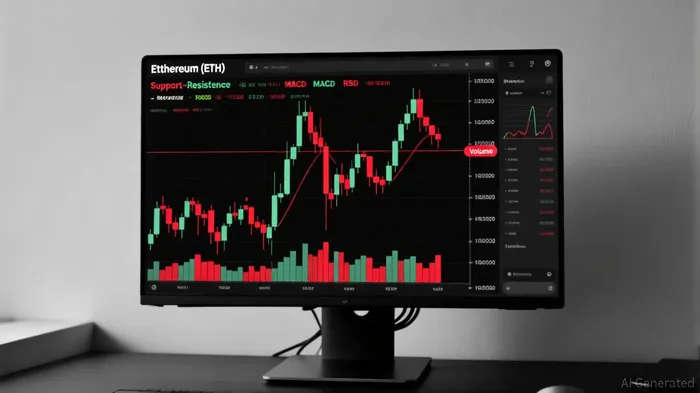
Technical indicators reinforce a bearish bias. The RSI (40–59) and MACD line below the signal line signal waning momentum, while the stochastic oscillator nearing 85 highlights overbought conditions and impending selling pressure [4]. Historically, overbought RSI conditions (RSI >70) have shown mixed results for Ethereum: a backtest of 238 overbought events from 2022 to 2025 reveals an average 30-day return of +3.96%, marginally outperforming the benchmark buy-and-hold return of +3.09% during the same windows. However, the win rate for such entries is only 52.36%, and the edge decays after the first two weeks, suggesting limited reliability as a standalone strategy [4]. Volume analysis further confirms bearish dominance, with red volume bars surging during the breakdown from the consolidation zone [2]. Meanwhile, the 50-day moving average (bullish) and 20-day SMA ($4,421.77) create a conflicting narrative, suggesting a tug-of-war between short-term bearishness and longer-term bullish trends [3].
Macro Market Sentiment: ETF Volatility and Institutional Divergence
The macroeconomic landscape for EthereumETH-- is equally complex. While institutional Ethereum ETFs have attracted over $13 billion in inflows since their July 2024 launch [1], recent data reveals significant volatility. On September 22, a $76 million outflow hit the market, driven by redemptions from BlackRock, Fidelity, and Bitwise [1]. This contrasts with a $17.9 million inflow into Grayscale's ETHEETHE-- on September 26, signaling potential stabilization [3].
The broader macroeconomic context adds layers of uncertainty. The Federal Reserve's 83–99% probability of a September rate cut has historically triggered short-term "risk-off" sentiment, as seen during the March 2020 emergency cut [1]. Meanwhile, the U.S. national debt surpassing $37 trillion has intensified Bitcoin's narrative as a hedge against fiat devaluation, indirectly pressuring Ethereum's relative appeal [1].
Institutional activity remains a double-edged sword. While ETF inflows and increased staking demand provide bullish support, large unstaking queues and token unlocks (e.g., $513 million in September) introduce downward volatility [1]. Whale activity, however, offers a counterbalance: a $100 million Ethereum purchase by a fresh whale and additional buys by Bitmine suggest strong conviction among large investors [4].
Strategic Entry Points and Risk Mitigation
For investors, the key lies in balancing technical triggers with macroeconomic signals. A breakdown below $4,000 could present a high-probability entry point, particularly if RSI and MACD confirm a bearish divergence. Conversely, a breakout above $4,680—supported by a surge in ETF inflows and positive whale activity—could signal a short-term reversal toward $4,750 [5].
Position sizing should account for the historical September weakness in Ethereum, with limited gains of 3.20% in 2024 and 1.49% in 2023 [4]. Investors should also monitor the Commodity Channel Index (CCI) and Net Unrealized Profit/Loss (NUPL) indicators, which currently suggest overbought conditions and potential profit-taking [4].
Conclusion
Ethereum's near-term trajectory hinges on its ability to break out of the $4,192–$4,500 consolidation zone and sustain institutional inflows. While technical indicators and macroeconomic factors point to a high correction risk, the asset's long-term fundamentals—bolstered by the upcoming Fusaka upgrade and growing corporate adoption—remain robust. Strategic entry points will emerge from a combination of price action confirmations and institutional sentiment shifts, offering opportunities for disciplined investors.





Comentarios
Aún no hay comentarios