
Ethereum's Technical Strength Post-$3,800 Support: A Case for Long-Term Resilience Amid Volatility and Layer-2 Innovation
Ethereum's recent price action has underscored its resilience amid a volatile macroeconomic climate, with the $3,800–$4,000 support zone emerging as a critical battleground for bulls. This range, which has withstood multiple tests since August 2025, reflects a confluence of on-chain strength, institutional demand, and structural improvements in the EthereumETH-- ecosystem. For long-term investors, the interplay between technical validation and Layer-2 adoption trends paints a compelling narrative of sustained value creation.
Technical Validation: A Foundation for Rebound
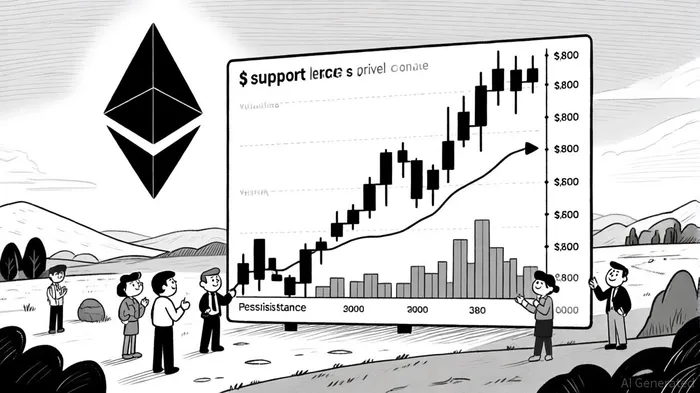
Ethereum's price has oscillated within a downtrend channel since mid-2025, but recent on-chain data suggests a potential reversal. According to a 4idiotz report, a breakout above the $4,800 resistance level with strong volume could trigger a rally toward $5,700–$7,500, validating a medium-term bullish trend. Crucially, the $3,800–$4,000 zone has shown robust buying interest, with analysts noting that sustained consolidation here could set the stage for a rebound to $6,200, according to a CABCD analysis.
Institutional activity further reinforces this thesis. Bitmine ImmersionBMNR-- Technologies' $480 million ETH acquisition in Q3 2025 signals confidence in Ethereum's long-term value, while BlackRock-led ETF inflows have surged, adding $3 billion in July alone, as reported by Analytics Insight. These flows mitigate short-term selling pressure and align with broader market sentiment. However, caution is warranted: a failure to hold above $3,800 could expose deeper support levels at $3,500–$3,400, prolonging bearish momentum, according to 4idiotz.
Layer-2 Adoption: Scaling the Future of Ethereum
While technical indicators provide a near-term roadmap, Ethereum's long-term investment case hinges on its Layer-2 (L2) ecosystem. In 2025, L2 networks like ArbitrumARB--, OptimismOP--, and zkSyncZK-- have transformed from scaling solutions into independent ecosystems. According to TheCryptotalks, these platforms processed over 35 million daily transactions in August 2025, driven by DeFi, gaming, and NFT activity; TheCoinomist similarly documents these usage trends in its coverage of L2 adoption, according to TheCoinomist.
Arbitrum leads in TVL ($10.7 billion) and developer activity, while Optimism's Superchain strategy has attracted integrations from Coinbase's Base and UniswapUNI--, a dynamic noted by TheCryptotalks. ZK-Rollups, including zkSync Era and StarkNetSTRK--, have also gained traction, offering cryptographic security and throughput of up to 10,000 TPS, per the CABCD analysis. The Dencun upgrade further reduced L2 fees by 95%, with simple transfers on Arbitrum costing as little as $0.04, according to the CABCD analysis. This cost efficiency is critical for mainstream adoption, particularly in DeFi and NFTs, where transaction costs historically deterred retail users.
Ecosystem Synergies: Institutional Confidence and Real-World Applications
The convergence of technical strength and L2 innovation is attracting institutional capital. BlackRock's tokenization of real-world assets on Ethereum has contributed $6.5 billion in TVL, while ETF inflows have surged amid growing confidence in Ethereum's utility, as reported by Analytics Insight. Meanwhile, on-chain metrics reveal a shift in ownership dynamics: large whale accounts are reducing holdings, while mid-sized wallets increase exposure, mitigating concentration risks, according to CoinJournal.
For investors, this ecosystem synergy creates a flywheel effect. Strong technical support at $3,800–$4,000 ensures price stability, while L2 networks enhance Ethereum's scalability and usability. As TheCoinomist notes, Arbitrum and Optimism's modular architectures-Arbitrum's Stylus and BOLD upgrades versus Optimism's Superchain-position them to capture significant market share in the $35 billion L2 TVL space.
Risks and Mitigants
Despite these positives, risks persist. Weak volume during breakouts could signal false momentum, and regulatory scrutiny of L2 projects remains a wildcard. However, Ethereum's institutional adoption and the maturation of its L2 ecosystem provide a buffer. For instance, the Pectra upgrade's EIP-4844 has already reduced gas fees by 100x, addressing a key barrier to adoption, according to Analytics Insight.
Conclusion: A Compelling Long-Term Case
Ethereum's technical strength post-$3,800 support, coupled with its Layer-2-driven innovation, positions it as a resilient long-term investment. While short-term volatility is inevitable, the interplay of institutional demand, on-chain resilience, and scalable infrastructure suggests a strong foundation for future growth. Investors who recognize this confluence may find Ethereum's current valuation-a blend of technical validation and ecosystem momentum-particularly attractive.





Comentarios
Aún no hay comentarios