
Ethereum's Surpassing of $400 Billion Market Cap: A Structural Shift in DeFi and Layer-1 Competition?
Ethereum's Resilience: Network Activity and DeFi Dominance
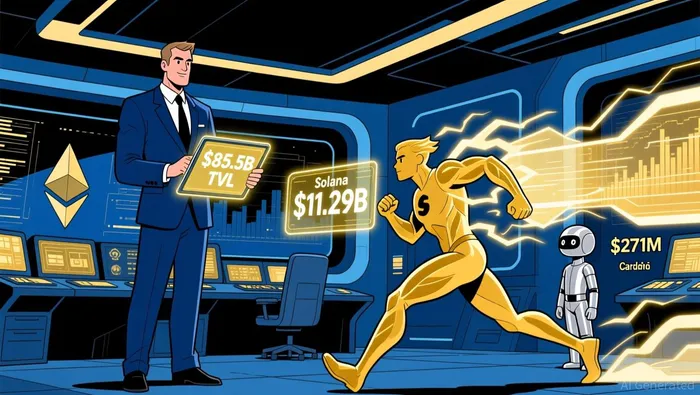
Ethereum's foundational strength lies in its network activity and DeFi infrastructure. Daily transaction volume averaged 1.65 million in Q4 2025, up from 1.16 million in 2024, with a peak of 1.74 million in August, according to SQ Magazine. This growth is fueled by Layer 2 solutions like ArbitrumARB-- and Base, which now process 58.5% of all Ethereum transactions, as noted by SQ Magazine. Gas fees have plummeted by 62% year-over-year to $0.39 per transaction, driven by EIP-4844 and the Dencun upgrade, per SQ Magazine. Meanwhile, DeFi TVL remains robust at $85.5 billion, dwarfing Solana's $11.29 billion and Cardano's $271 million, according to Coinotag.
However, Ethereum's TVL faced a 13% decline in Q4 2025 amid a broader DeFi rout triggered by the collapse of yield-bearing stablecoins like xUSDXUSD--. The sector's total TVL fell by $42 billion, with protocols like Ethena's Staked USDeUSDe-- losing 41% of its supply due to redemption pressures, per Coinotag. Despite this, Ethereum's staking model and Layer 2 innovations continue to anchor its value proposition.
Layer-1 Competition: Solana, Avalanche, and NEAR's Ascent
Ethereum's reign faces mounting challenges from Layer-1 rivals. Solana, with its $107.73 billion market cap, has leveraged high throughput (thousands of transactions per second) and low fees to attract institutional adoption, including CME-listed derivatives, as reported by YouHodler. NEAR ProtocolNEAR--, meanwhile, closed Q3 2025 with a $3.3 billion market cap, driven by cross-chain infrastructure like NEAR Intents, which processed $234.9 million in transaction volume, according to NullTX.
Avalanche's TVL surged to $2.23 billion post-October 2025's Octane upgrade, signaling potential for further growth if the Granite Upgrade delivers, as noted by SQ Magazine. CardanoADA--, though trailing with a $271 million DeFi TVL, is pivoting to BitcoinBTC-- integrations and real-world lending via partnerships like Midnight and RealFi, per Coinotag. These developments highlight a fragmented but competitive Layer-1 landscape.
DeFi's Structural Shifts: Risks and Opportunities
The DeFi sector's turbulence in Q4 2025 exposed vulnerabilities in yield-bearing stablecoins. The xUSD collapse-a $93 million loss-triggered a 24% drop in TVL, with protocols like MorphoMORPHO-- and Ethena's Staked USDe bearing the brunt, per Coinotag. Yet, this crisis also accelerated demand for safer assets like Sky Dollar (USDS), whose market cap rose 8% to $5.7 billion, per Coinotag.
Ethereum's Fusaka upgrade, scheduled for December 3, 2025, aims to address these risks by enhancing Layer 2 scalability through PeerDAS and blob-based data storage, as reported by NullTX. Analysts argue this could drive mass adoption by reducing costs for dApps and enterprises, per YouHodler.
The Road Ahead: Can Ethereum Sustain Its Lead?
Ethereum's ability to maintain its $400 billion threshold hinges on two factors: execution of the Fusaka upgrade and the broader crypto market's recovery. While Solana and NEAR are closing the gap, Ethereum's first-mover advantage in DeFi and its robust developer ecosystem remain unmatched.
However, the U.S. demand for Ethereum remains fragile, with the Coinbase Premium Index hitting -0.057-its lowest since April 2025, according to CoinDoo. This suggests that U.S. traders are no longer willing to pay a premium for ETH, a trend that could pressure its valuation unless institutional adoption accelerates.
Conclusion
Ethereum's $400 billion milestone is a testament to its resilience, but it is not a guarantee of long-term dominance. The rise of Solana, Avalanche, and NEAR, coupled with DeFi's structural risks, signals a shifting landscape. For investors, the key lies in balancing Ethereum's entrenched advantages with the disruptive potential of emerging Layer-1s. As the Fusaka upgrade looms and DeFi rebuilds post-crisis, Ethereum's ability to adapt will determine whether it remains the bedrock of decentralized finance-or cedes ground to a new generation of blockchains.






Comentarios
Aún no hay comentarios