
Ethereum's Surging Stablecoin Volume: A Catalyst for Long-Term Blockchain Adoption and Ecosystem Growth
The Infrastructure Revolution: Layer 2 and Dencun's Role
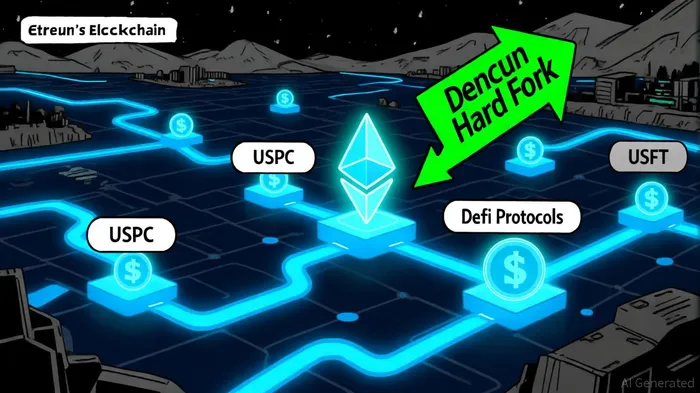
Ethereum's ability to handle this volume is underpinned by its Layer 2 (L2) ecosystem and the Dencun hard fork. Networks like ArbitrumARB--, Optimism, and Base have offloaded over 70% of stablecoin transactions from Ethereum's mainnet, reducing gas fees by 80% while maintaining security guarantees, according to a CoinOTag report. The Dencun upgrade, implemented in March 2025, further optimized data availability and interoperability, enabling seamless cross-chain interactions and real-time settlement for stablecoin-based applications.
For instance, Base-a L2 network co-built by Coinbase-has become a hub for stablecoin innovation, hosting 40% of new USDC issuance in 2025. This shift has allowed developers to deploy high-throughput DeFi protocols and payment gateways without compromising Ethereum's security model. As a result, stablecoins are no longer just "digital dollars" but the rails for a new financial infrastructure.
Stablecoins as the New Global Payment Layer
The rise of Ethereum's stablecoin ecosystem is reshaping cross-border payments. According to an FXCintel report, stablecoins now facilitate $12 billion in monthly cross-border transactions, outpacing traditional SWIFT transfers in speed and cost-efficiency. This growth is driven by platforms like Circle's USDC and EURC, which have expanded to 35 million users and a combined supply of $75 billion in 2025, according to CoinOTag.
Notably, USDC's integration into L2 networks has enabled real-world use cases such as:
- Merchant payments: Retailers in emerging markets now accept USDC via L2 gateways, reducing currency volatility and transaction costs.
- Yield farming: Stablecoin liquidity pools on Ethereum and L2s generate annualized returns of 4–8%, attracting institutional and retail capital.
- Tokenized assets: USDC is increasingly used to collateralize tokenized real estate and commodities, bridging traditional and digital finance.
The Long-Term Investment Thesis
Ethereum's dominance in stablecoin infrastructure positions it as a critical asset for investors seeking exposure to the next phase of blockchain adoption. Key metrics to monitor include:
1. Stablecoin velocity: The $184 billion supply on Ethereum is not just stored but actively transacted, signaling a shift from speculative hoarding to utility-driven demand.
2. L2 adoption rates: As Base and Arbitrum handle more stablecoin volume, Ethereum's role as a security layer becomes increasingly valuable, akin to a "blockchain operating system."
3. Regulatory alignment: The U.S. Treasury's 2025 framework for stablecoins has provided clarity, encouraging institutional participation and reducing fragmentation.
Critics may argue that competition from SolanaSOL-- and TronTRX-- threatens Ethereum's market share. However, Ethereum's first-mover advantage, coupled with its robust security and developer ecosystem, ensures it remains the default infrastructure for stablecoin-driven finance.
Conclusion
Ethereum's surging stablecoin volume is more than a technical milestone-it is a harbinger of blockchain's mainstream adoption. By combining scalable L2 solutions, protocol upgrades like Dencun, and real-world use cases, Ethereum has transformed stablecoins into the backbone of a decentralized financial system. For investors, this represents a long-term opportunity to capitalize on the infrastructure layer that will power the next decade of digital finance.





Comentarios
Aún no hay comentarios