
Ethereum's Surging Network Activity and Its Implications for Long-Term Value
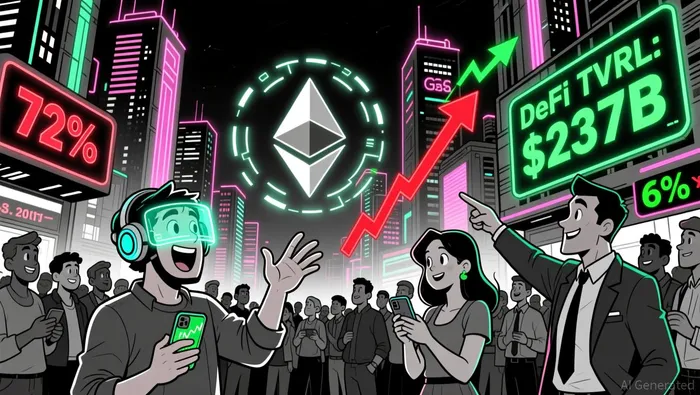
Ethereum's Q3 2025 performance has been nothing short of extraordinary, with the price surging 72% to breach $4,200 amid a confluence of macroeconomic tailwinds, regulatory clarity, and on-chain innovation. Yet, beneath the surface of this price action lies a compelling narrative of structural strength: rising DeFi usage, explosive Layer-2 adoption, and unprecedented institutional accumulation. These fundamentals suggest a growing disconnect between Ethereum's current valuation and its underlying ecosystem health-a divergence that may soon catalyze a revaluation of the asset.
On-Chain Fundamentals: A Network in Motion
Ethereum's on-chain activity in Q3 2025 reveals a network primed for sustained growth. Daily transactions averaged 1.56 million, a 9% quarter-over-quarter increase, driven by the full implementation of the Dencun hard fork, which slashed gas fees and unlocked scalability for layer-2 rollups like ArbitrumARB-- and Optimism. Total Value Locked (TVL) in DeFi surged 41% to a three-year high of $237 billion, with EthereumETH-- accounting for 49% of this total. While daily active wallets in DeFi declined by 22.4%, this metric masks a critical shift: institutional capital is increasingly prioritizing Ethereum's utility-driven infrastructure over retail speculation. For instance, Ether.fi's monthly active users skyrocketed from 3,300 to 29,400, signaling growing adoption of Ethereum-based staking and yield-generating protocols.
Gas fee dynamics further underscore Ethereum's resilience. Despite a 11% decline in fees paid in ETH, the nominal dollar value of fees rose 6% due to Ethereum's price appreciation, reflecting robust demand for network capacity. This trend is amplified by layer-2 activity, where weekly transaction volumes frequently exceeded 500,000, demonstrating the network's ability to scale without compromising security.
Institutional Accumulation: A New Era of Confidence
The most striking development in Q3 2025 was the surge in institutional accumulation. Ethereum-based spot ETFs recorded $10.04 billion in net inflows, outpacing BitcoinBTC-- ETFs by a wide margin. Notably, single-day inflows exceeded $1 billion, a testament to the growing institutional appetite for Ethereum's utility-driven ecosystem. Trend Research, a major institutional player, increased its holdings to 380,000 ETHETH--, while nearly 95% of public companies' ETH acquisitions occurred during the quarter. These figures highlight a broader rotation from Bitcoin-centric allocations toward Ethereum's staking yields, smart contract capabilities, and DeFi infrastructure.
On-chain data corroborates this trend. Over 60,000 active wallets participated in real-world asset (RWA) tokenization, and staking participation rates hit record highs. This institutional confidence is not merely speculative-it reflects a recognition of Ethereum's role as the backbone of Web3 innovation, from decentralized finance to tokenized real estate.
The Disconnect: Why the Market May Be Undervaluing Ethereum
Despite these fundamentals, Ethereum's price action has yet to fully reflect its ecosystem's strength. While the asset gained 22% in Q3 2025, outperforming Bitcoin, its valuation remains anchored to legacy metrics. For example, DeFi TVL grew 78% quarter-over-quarter to $11.51 billion, yet daily active wallets in DeFi declined. This dichotomy suggests that retail participation has waned, but institutional capital and developer activity are compensating.
The key to understanding this disconnect lies in Ethereum's transition from a speculative asset to a foundational infrastructure layer. Institutional investors are no longer buying Ethereum for its price volatility but for its role in enabling decentralized applications, tokenized assets, and programmable finance. This shift mirrors the early days of the internet, where infrastructure providers (e.g., routers, servers) were undervalued until their utility became indispensable.
A Buying Opportunity in the Making
The growing gap between Ethereum's fundamentals and its price presents a compelling case for long-term investors. Institutional accumulation, DeFi growth, and layer-2 adoption are creating a flywheel effect: stronger infrastructure attracts more developers and users, which in turn drives demand for ETH. Meanwhile, regulatory tailwinds-such as the approval of spot ETFs-have reduced barriers to entry for institutional capital, accelerating this cycle.
Critics may argue that Ethereum's price has already surged 72% in Q3 2025, but this overlooks the fact that its underlying metrics have improved at an even faster pace. For instance, TVL in DeFi grew 41% to $237 billion, while institutional inflows totaled $10 billion. These figures suggest that the market has yet to price in the full potential of Ethereum's ecosystem.
Conclusion
Ethereum's Q3 2025 performance is a microcosm of its broader trajectory: a network evolving from speculative hype to foundational infrastructure. While the price has risen sharply, the on-chain fundamentals-DeFi growth, layer-2 scalability, and institutional accumulation-are accelerating at an even greater rate. For investors, this divergence represents not a warning sign but an opportunity. As Ethereum's ecosystem continues to mature, the market will eventually recognize its true value, creating a revaluation that could outpace even the most bullish expectations.






Comentarios
Aún no hay comentarios