
Ethereum's Surging L1 Activity and Declining Gas Fees: Evaluating Long-Term Value Capture in a Post-Fee-Burn Era
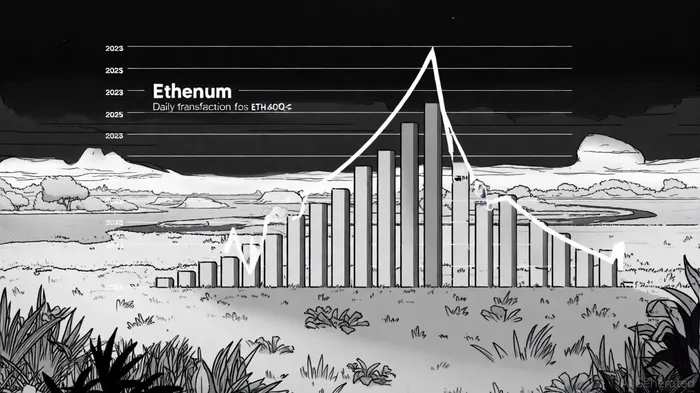
Ethereum's Layer 1 (L1) network has witnessed a remarkable surge in activity in 2025, with daily transaction volumes exceeding 1.74 million and active addresses hitting a record 674,000-a 55.13% year-over-year increase, according to Ethereum Daily Active Addresses. This growth, driven by decentralized finance (DeFi) expansion and institutional adoption, underscores Ethereum's enduring role as the backbone of Web3. However, the same period has seen gas fees plummet to historic lows, with the median transaction cost dropping to 1.9 gwei ($0.41 in July 2025) from $15.21 in 2023, per CoinLaw gas fees statistics. While these developments appear positive on the surface, they mask a deeper economic challenge: Ethereum's post-EIP-1559 deflationary model is under strain as Layer 2 (L2) solutions siphon transactional value away from the mainnet.
The Paradox of Growth and Deflation
EIP-1559, implemented in August 2021, introduced a dynamic base fee and optional priority fee structure, aiming to stabilize gas costs and create a deflationary mechanism by burning a portion of transaction fees, as explained in this EIP-1559 explained guide. By 2025, this mechanism had burned over 4.5 million ETH, reducing the network's supply by 3%, per a vTrader report. However, the recent surge in L1 activity has not translated into sustained fee revenue. Instead, the proliferation of L2 rollups-such as Arbitrum, Optimism, and Base-has offloaded 82% of EthereumETH-- transactions, reducing L1's fee burn rate to a record low of 53.07 ETH per day in October 2025, according to a CryptoRank report.
This divergence between usage and revenue highlights a critical tension: while Ethereum's L1 network is scaling in terms of user participation, its ability to capture value through fee burning is diminishing. For instance, Base, an Optimistic Rollup, generated $94 million in profits post-Dencun upgrade (March 2024) but paid only $4.9 million in blob fees to Ethereum, as noted in a CoinMetrics report. Such imbalances raise concerns that Ethereum risks becoming a "dumb security layer," where L2 operators retain most economic value while the mainnet's inflation rate rises due to reduced fee burns, a point argued in a Coin Gazette analysis.
The L2 Conundrum: Scalability vs. Value Accrual
Layer 2 solutions have undeniably enhanced Ethereum's scalability, reducing user costs and enabling mass adoption. EIP-4844 (Proto-Danksharding), part of the Dencun upgrade, slashed L2 transaction fees by up to 99%, with costs as low as $0.01 per transaction, according to an EIP-4844 guide. This efficiency has driven user migration to L2s, but it has also created a "value leakage" problem. As of Q3 2025, Ethereum's annual supply contraction rate has flipped to +0.76% inflation, eroding the deflationary tailwinds that once supported ETH's price, as reported by an NFTevening report.
The economic misalignment is further exacerbated by MEV (Maximal Extractable Value) dynamics. While L2s capture MEV through transaction ordering and arbitrage, Ethereum stakers receive minimal compensation. Proposals to address this include requiring L2 sequencers to stake ETH, redistributing L2 fees to stakers, and capturing MEV generated by L2s for the mainnet-ideas discussed in Coin Gazette's analysis. Vitalik Buterin has emphasized the need for interoperability and standardized tools to align L2 and L1 incentives, but concrete solutions remain in development, as outlined in a CCN article.
Future Outlook: Rebalancing the Economic Model
Ethereum's upcoming Pectra upgrade aims to double blob capacity, potentially reigniting demand for L1 activity and restoring fee burn rates, according to a Gate article. However, long-term sustainability will depend on resolving the value capture imbalance. A multidimensional fee market, proposed by Buterin, could unify EIP-1559 and EIP-4844 under a cohesive model, improving user experience while preserving economic efficiency-an idea summarized in a Buterin proposal. Additionally, institutional adoption of Ethereum's restaking mechanisms and the growth of DeFi TVL ($84 billion as of 2025) provide alternative value accrual channels, as examined in a CFC-StMoritz analysis.
Investors must weigh these factors carefully. While Ethereum's L1 activity and active addresses signal a robust ecosystem, the declining fee burn rate and L2 dominance pose risks to its deflationary narrative. The network's ability to adapt-through protocol upgrades, fee redistribution, or novel value capture models-will determine whether it maintains its position as the leading blockchain platform or cedes economic primacy to its L2 counterparts.






Comentarios
Aún no hay comentarios