
The Ethereum Surge: Institutional Capital Reallocation and the Reshaping of Crypto Portfolios in 2025
In 2025, the institutional crypto landscape has undergone a seismic shift. What was once a binary choice between BitcoinBTC-- and EthereumETH-- has evolved into a strategic reallocation favoring the latter. Ethereum's technological upgrades, regulatory clarity, and yield advantages have positioned it as the dominant asset in institutional portfolios, while Bitcoin's role as a store of value faces growing competition from a utility-driven ecosystem.
The Great ETF Migration: Ethereum's Institutional Takeoff
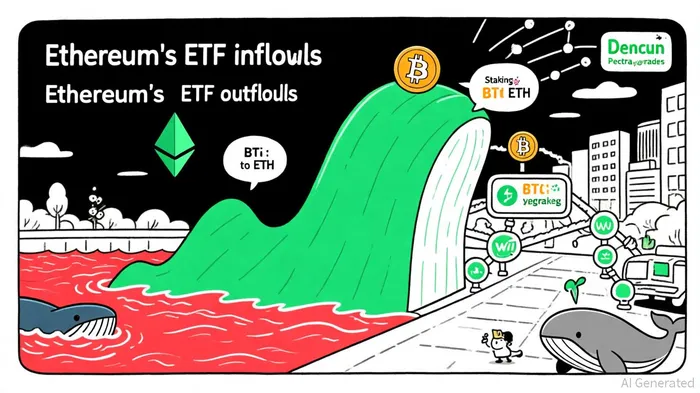
According to a BitGet report, Ethereum ETFs attracted $33 billion in inflows by July 2025, while Bitcoin ETFs faced outflows of $1.17 billion. This sixfold surge in the Ethereum/BTC ETF ratio to 0.12 underscores a broader trend: institutions are prioritizing assets that generate returns through staking and DeFi. Ethereum's proof-of-stake model offers staking yields of 4.8%, dwarfing Bitcoin's 1.8%, the BitGet report noted. Regulatory tailwinds further amplified this shift, as the U.S. SEC's informal commodity classification of Ethereum under the CLARITY Act normalized its use as a macroeconomic hedge, unlocking $27.6 billion in ETFs by August 2025, the BitGet analysis shows.
On-chain data reveals another layer of this reallocation. Over $5.42 billion in BTC-to-ETH transfers occurred in 2025, with 22% of Ethereum's supply now controlled by whales, according to the same BitGet report. These movements signal a structural transition from speculative Bitcoin hoarding to strategic Ethereum accumulation.
Corporate Treasuries: From Bitcoin to Ethereum and Beyond
Corporate adoption of Ethereum has accelerated as companies seek to optimize treasury strategies. SharpLink Gaming, for instance, allocated nearly all of its $425 million June 2025 fundraising to Ethereum, driving a 37% stock price surge, according to a Forbes article. BitMine ImmersionBMNR-- Technologies disclosed that 40–50% of its treasury is now in Ethereum, the Forbes piece reports, reflecting a broader trend of diversification. While Bitcoin remains a cornerstone-6.2% of its total supply is held by corporations, per the BitGet report-Ethereum's flexibility in DeFi, NFTs, and smart contracts has made it a preferred reserve asset.
This diversification extends beyond Ethereum. Companies are exploring altcoins like TRXTRX-- and BNBBNB-- to balance risk and reward, the Forbes article notes. By Q3 2025, 73% of institutions held altcoins for DeFi and Web3 innovation, according to a Coinreporter analysis, signaling a maturing market where crypto is no longer a speculative bet but a core component of asset management.
Bitcoin Miners: Adapting to a New Reality
Bitcoin miner profitability has benefited from Ethereum's rise. As Bitcoin's price hit $125,000 in October 2025, miner revenues surged, the Coinreporter analysis reported. However, the competitive landscape has shifted. Ethereum's Dencun and Pectra upgrades reduced Layer 2 fees and enhanced scalability, the BitGet report observed, while Bitcoin's dominance as a store of value faces challenges from Ethereum's utility-driven infrastructure.
Miners are diversifying their strategies in response. Some are staking Ethereum to capitalize on its 4.8% yield, as noted in the BitGet report, while others are exploring hybrid models that balance Bitcoin mining with Ethereum-based revenue streams. This adaptation highlights the broader industry shift: crypto is no longer a zero-sum game but a dynamic ecosystem where innovation and regulation drive value.
Conclusion: A New Era of Institutional Crypto Adoption
The 2025 reallocation from Bitcoin to Ethereum marks a pivotal moment in crypto history. Institutions are no longer passive observers but active participants in a market defined by yield, utility, and regulatory clarity. As Ethereum's deflationary supply dynamics and DeFi infrastructure mature, its role as a strategic asset will only strengthen. For investors, the lesson is clear: the future of institutional crypto portfolios lies notNOT-- in choosing between Bitcoin and Ethereum, but in embracing a diversified, utility-driven approach.





Comentarios
Aún no hay comentarios