
Ethereum's Sudden Decline and the Implications for Crypto Investors: A Deep Dive into Market Sentiment and Whale Behavior
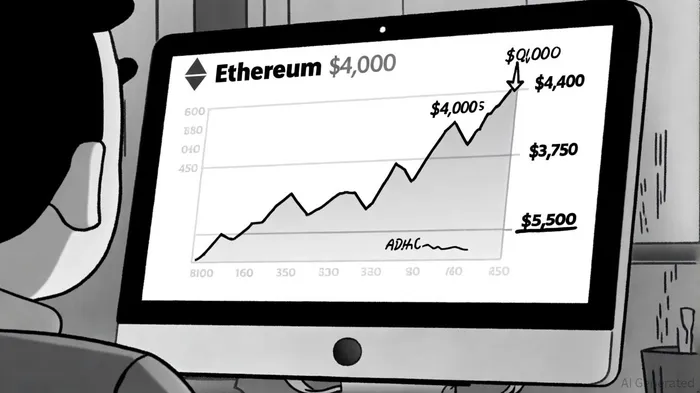
The recent collapse of EthereumETH-- (ETH) below $4,000 in September 2025 has sent shockwaves through the cryptocurrency market, exposing vulnerabilities in both retail and institutional positioning. This sharp decline, driven by a confluence of macroeconomic pressures and on-chain dynamics, underscores the critical role of market sentiment and whale behavior in shaping short-term trends. For investors, the episode offers a stark reminder of the volatility inherent in crypto markets—and the need to monitor leading indicators like whale activity and sentiment shifts.
Market Sentiment: A Perfect Storm of Liquidations and Outflows
The ETHETH-- price drop was precipitated by a cascade of liquidations, with over $134 million in long positions wiped out in a matter of days [2]. This was exacerbated by a $61.7 million outflow from spot Ethereum ETFs on September 16, led by BlackRockBLK-- and Fidelity [5]. Such outflows signal a loss of confidence among institutional investors, who often act as bellwethers for broader market sentiment.
Retail traders were also hit hard. A single whale lost $36.4 million in a liquidation event on Hyperliquid, illustrating the fragility of leveraged positions in a rapidly deteriorating market [4]. These developments reflect a shift from speculative optimism to panic selling—a classic hallmark of bearish momentum.
Whale Behavior: Mixed Signals in a Turbulent Market
Whale activity has further complicated the narrative. On-chain data reveals a paradox: while some whales dumped 90,000 ETH in just 48 hours, others began accumulating by withdrawing large amounts from exchanges like Kraken and Galaxy Digital OTC [2]. This duality suggests a divergence in strategies—some whales are capitalizing on the downturn to offload, while others view the price drop as a buying opportunity.
The mixed signals from whale behavior highlight the challenges of interpreting on-chain data. For instance, the $36.4 million liquidation by a whale on Hyperliquid [4] indicates extreme leverage and poor risk management, whereas the accumulation efforts point to long-term conviction. This duality complicates technical analysis, as it is unclear whether the selling pressure will persist or reverse.
Implications for Investors: Navigating Uncertainty
For crypto investors, the ETH selloff underscores the importance of risk management. Analysts caution that if Ethereum fails to hold the $4,400 level, it could face further declines toward $3,750 [3]. Conversely, a successful defense of $4,400 might trigger a rebound toward $5,500, particularly if whale accumulation continues [1].
However, historical data from 2022 to 2025 suggests caution when relying solely on support levels. A backtest of Ethereum's price behavior at confirmed support levels revealed that a simple buy-and-hold strategy underperformed the benchmark in most cases. Specifically, the median 10-day post-event return was –5.5% for support-level retests, compared to +0.9% for the broader ETH market [6]. This implies that while support levels are often cited as key psychological barriers, their reliability in predicting short-term rebounds may be limited. Investors should therefore treat such levels as part of a broader toolkit rather than standalone signals.
Investors should also remain vigilant about macroeconomic catalysts, such as the Federal Reserve's rate-cut timeline, which could influence capital flows into risk assets. In the short term, monitoring whale activity and ETF flows will be critical. For example, a sustained outflow from spot ETFs could signal deeper institutional skepticism, while a reversal in whale selling might indicate a bottoming process.
Conclusion: A Test of Resilience
Ethereum's September 2025 decline is a case study in the interplay between market sentiment and whale behavior. While the immediate outlook remains uncertain, the episode reinforces the need for disciplined risk management and a nuanced understanding of on-chain dynamics. For investors, the key takeaway is clear: in crypto markets, where sentiment can shift overnight, vigilance is not just a virtue—it is a necessity.





Comentarios
Aún no hay comentarios