
Ethereum's Strategic Resilience as a Long-Term Value Driver
In the volatile world of finance, resilience isn't just a virtue-it's a necessity. Over the past five years, Ethereum's decentralized infrastructure has repeatedly demonstrated its ability to withstand crises that would cripple centralized systems. From the 2020 market crash to the FTX collapse and the 2025 infrastructure stress test, Ethereum's design has proven its mettle in maintaining uptime, preserving value, and fostering investor confidence. This analysis explores how Ethereum's decentralized architecture outperforms centralized systems during crises, positioning it as a compelling long-term value driver.
1. Uptime and Transaction Continuity: The Bedrock of Resilience
Ethereum's decentralized nature ensures no single point of failure, a stark contrast to centralized systems like AWS or Facebook, which have experienced prolonged outages. During the 2020 market crash, Ethereum maintained uninterrupted operations for nearly a decade, while Facebook faced a 14-hour global outage and AWS Kinesis froze for 17 hours. This reliability stems from Ethereum's distributed network of validators and developers, who collectively maintain the protocol regardless of external disruptions.
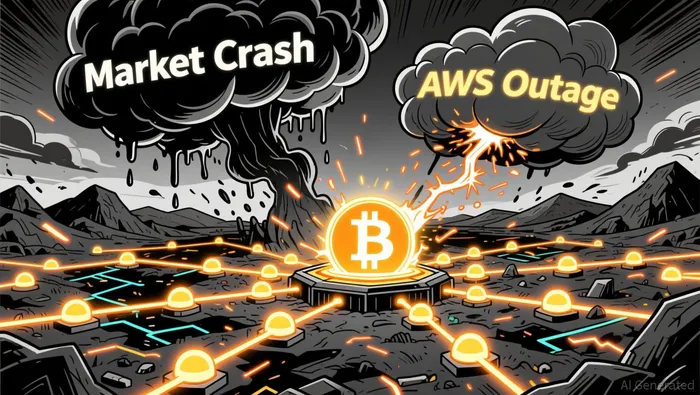
However, recent stress tests reveal vulnerabilities. In October 2025, a synchronized market crash and AWS outage exposed Ethereum's reliance on centralized cloud services for RPC endpoints and node operations, leading to latency spikes and partial outages. While the protocol's consensus mechanisms remained intact, this incident underscores the need to address infrastructure-level centralization risks.
2. Value Preservation: Ethereum's Edge in Crisis
Ethereum's ability to preserve value during financial shocks has outpaced both BitcoinBTC-- and traditional assets in recent years. In Q4 2025, Ethereum's short-term holders maintained a profit margin 73% above key cost bases, reducing selling pressure and stabilizing its price. In contrast, Bitcoin faced $1.3 billion in net realized losses, compared to Ethereum's $325 million according to KuCoin data. This divergence highlights Ethereum's growing appeal as a "safe haven" within crypto, particularly as institutional adoption and Layer 2 scaling solutions enhance its utility.
The FTX collapse in late 2022 further illustrates this dynamic. While both Bitcoin and EthereumETH-- initially fell over 20%, Ethereum's recovery rate post-crisis was significantly higher. A $29.7 million ETH withdrawal linked to investor Tom Lee signaled renewed confidence in Ethereum's long-term prospects. Meanwhile, centralized systems like FTX left creditors with recovery rates as low as 12% for SolanaSOL-- and 22% for Bitcoin, underscoring the fragility of trust-based models.
3. Crisis Containment: Decentralized Systems Limit Spillover Effects
The FTX collapse triggered a "flight to safety" within the Ethereum ecosystem, with users shifting to stablecoins and reducing transaction volumes by 20% in the immediate aftermath. Yet, these behavioral shifts remained contained within the crypto sector, with minimal spillover into traditional markets. This contrasts sharply with centralized systems, where crises like FTX's bankruptcy led to $20 billion in user withdrawals and a broader loss of confidence in crypto infrastructure according to Markets analysis.
Ethereum's composability and transparency also enable rapid adaptation. For instance, post-FTX, DeFi protocols saw increased usage of stablecoins like USDCUSDC-- and DAIDAI-- as users sought collateralized alternatives to centralized stablecoins like USDTUSDT--. This self-correcting mechanism-rooted in open-source code and decentralized governance-demonstrates how Ethereum's ecosystem can mitigate systemic risks without external intervention.
4. The Infrastructure Paradox: Decentralization vs. Centralized Dependencies
Despite its strengths, Ethereum's reliance on centralized infrastructure remains a critical vulnerability. The 2025 stress test revealed that a coordinated AWS outage could disrupt RPC endpoints and node synchronization, even as consensus mechanisms remained functional. This "infrastructure paradox" highlights the gap between protocol-level decentralization and operational dependencies on centralized services like cloud providers.
Addressing this challenge will require a shift toward decentralized infrastructure (DI) solutions, such as IPFS for data storage or Ethereum-native node hosting platforms. While still nascent, these innovations could reduce Ethereum's exposure to centralized points of failure, further solidifying its resilience.
Conclusion: Resilience as a Competitive Advantage
Ethereum's decentralized infrastructure has repeatedly outperformed centralized systems during crises, from maintaining uptime during the 2020 crash to preserving value post-FTX. Its ability to adapt through composability, transparency, and community-driven governance positions it as a long-term value driver in an increasingly unstable financial landscape. However, the 2025 stress test serves as a reminder that true resilience requires addressing infrastructure-level centralization. For investors, Ethereum's strategic resilience isn't just about surviving crises-it's about thriving in them.






Comentarios
Aún no hay comentarios