
Ethereum's Strategic Rebalancing: How BTC Whales Are Fueling a New Bullish Cycle
The cryptocurrency market in 2025 is witnessing a seismic shift as BitcoinBTC-- (BTC) whales—holders of large balances—systematically reallocate capital to EthereumETH-- (ETH). This whale-driven rebalancing, amplified by institutional-grade on-chain metrics, is reshaping market dynamics and fueling a new bullish cycle for Ethereum. The interplay between Bitcoin’s role as a store of value and Ethereum’s utility as a programmable asset is creating a dual-track narrative, with Ethereum emerging as the beneficiary of strategic capital flows.
Whale Activity and On-Chain Metrics: A Capital Exodus
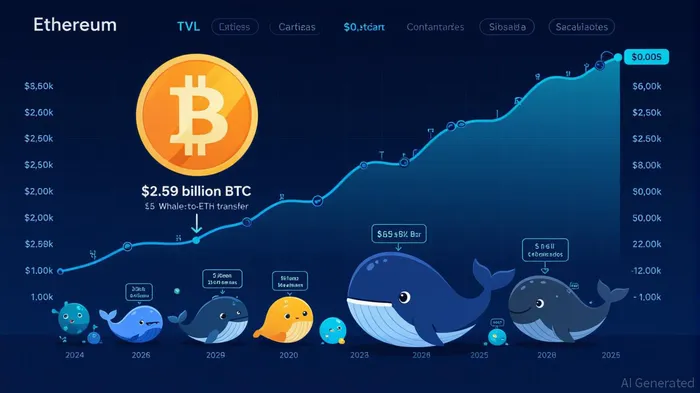
Bitcoin’s whale activity has long signaled macroeconomic sentiment, but in 2025, these movements have taken on a new dimension. A 7-year-old Bitcoin whale’s $2.59 billion BTC-to-ETH transfer in Q2 2025 alone reduced Ethereum’s circulating supply by 9.31%, a move that directly correlated with a 63% surge in Ethereum’s total value locked (TVL) in DeFi [1]. Such transactions are not isolated; on-chain data reveals a rising Gini coefficient of 0.4677 for Bitcoin, indicating growing institutional concentration, while Ethereum’s “Over 8 Years” UTXO bucket increased by 5%, reflecting long-term holder confidence [2].
The inverse relationship between Bitcoin’s price and the U.S. Federal Reserve’s policy rate (-0.65 over two years) has further incentivized whales to pivot to Ethereum, where staking yields of 3.8–6% APY offer a tangible return [2]. This shift is compounded by Ethereum’s Pectra and Dencun upgrades, which slashed Layer 2 gas fees by 90%, enabling 100,000+ transactions per second and attracting institutional portfolios seeking scalability [1].
Ethereum’s Structural Advantages: From Deflation to Institutional Adoption
Ethereum’s appeal lies in its structural innovations. Unlike Bitcoin’s static supply model, Ethereum’s deflationary mechanisms—driven by EIP-1559 and staking—have created a 30% staked ETH ratio, locking liquidity and reducing circulating supply [1]. This has pushed the ETH/BTC ratio to a 14-month high of 0.71, signaling a revaluation of Ethereum’s utility over Bitcoin’s store-of-value proposition [1].
Institutional adoption has been the catalyst. Ethereum ETFs attracted $29.22 billion in net inflows since July 2024, with corporate treasuries now holding 4.10 million ETH ($17.66 billion) [3]. Regulatory clarity, including the U.S. CLARITY and GENIUS Acts, has further streamlined institutional access, while platforms like AaveAAVE-- V3 have enabled whales to deploy capital in yield-generating DeFi protocols [1].
The Bullish Cycle: Whale Accumulation and Institutional Momentum
The interplay between bearish whale distribution and bullish institutional accumulation has created a volatile yet constructive environment for Ethereum. In Q3 2025, whale selling reached $1.8 billion in two weeks, triggering short-term dips below $4,300 [1]. However, this was offset by a $433 million BTC-to-ETH conversion by a Bitcoin whale and $27.6 billion in ETF inflows, pushing Ethereum’s price toward $4,800 and hinting at a potential $10,000 target [2].
On-chain metrics reinforce this optimism. Ethereum’s long-term holder (LTH) net unrealized profit/loss (NUPL) entered the “belief” zone, while its MVRV ratio indicated undervaluation [1]. These signals, combined with Ethereum’s dominance in DeFi (63% TVL), suggest a self-reinforcing cycle where institutional inflows and whale accumulation drive further adoption [1].
Investor Implications: Balancing Risk and Reward
For investors, the Ethereum bull case hinges on a core-satellite strategy. Allocating 60–70% to Bitcoin for macroeconomic stability and 30–40% to Ethereum allows participation in Ethereum’s yield-generating potential while hedging against volatility [1]. However, risks persist: Ethereum’s price remains sensitive to macroeconomic shifts, and regulatory scrutiny of DeFi could disrupt yield-generating strategies.
The key takeaway is that Ethereum’s strategic rebalancing is not a speculative fad but a response to structural advantages—staking, scalability, and institutional infrastructure—that position it as a cornerstone of the digital asset ecosystem.
**Source:[1] Unlocking the Institutional ETH Surge: On-Chain Signals [https://www.ainvest.com/news/unlocking-institutional-eth-surge-chain-signals-bitcoin-ethereum-divide-2508][2] A New Era of Institutional Accumulation and Inflation Hedging [https://www.bitget.com/news/detail/12560604933881][3] How High Can Ethereum Go? Expert Analysis Shows $25K Potential [https://yellow.com/research/how-high-can-ethereum-go-expert-analysis-shows-dollar25k-potential-as-institutional-adoption-surges]






Comentarios
Aún no hay comentarios