
Ethereum's Strategic Move into Real-World Asset (RWA) Tokenization: Capitalizing on Infrastructure Innovation and Market Timing
Ethereum's evolution from a speculative cryptocurrency to a foundational infrastructure for global finance has reached a pivotal inflection point in 2025. The blockchain's strategic foray into real-world asset (RWA) tokenization-enabling the digitization of tangible assets like real estate, Treasuries, and private credit-has been driven by a combination of infrastructure innovation, institutional partnerships, and favorable regulatory timing. As the tokenized RWA market surges toward $30 billion, Ethereum's dominance in this space underscores its potential to redefine traditional finance while offering investors a compelling long-term opportunity.
Infrastructure Innovation: The Bedrock of Ethereum's RWA Ecosystem
Ethereum's technical advancements have been critical to its leadership in RWA tokenization. The Dencun upgrade in March 2024, for instance, significantly enhanced scalability and reduced transaction costs through proto-danksharding and EIP-4844 (cancun) upgrades. These improvements addressed prior limitations in gas fees and throughput, making EthereumETH-- a viable platform for high-value, institutional-grade transactions. By mid-2025, Ethereum hosted a $9.2 billion tokenized asset portfolio, including U.S. Treasuries, real estate, and private credit, a testament to its ability to handle complex financial instruments with robust smart contract execution.
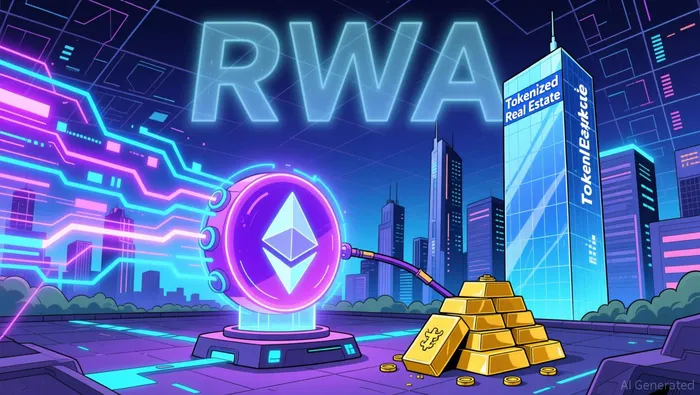 The blockchain's mature developer ecosystem further amplifies its appeal. Over 10,000 active developers contribute to Ethereum's infrastructure, enabling rapid iteration and integration with traditional finance systems. Platforms like Finexity and Centrifuge have leveraged Ethereum's programmability to tokenize real estate and facilitate fractional ownership, bridging the gap between on-chain and off-chain markets. This technical agility positions Ethereum as a preferred infrastructure for RWA projects, where security, transparency, and interoperability are paramount.
Institutional Partnerships: Scaling RWA Adoption
Ethereum's institutional partnerships have been instrumental in legitimizing RWA tokenization as a mainstream asset class. Major players like BlackRock and Franklin Templeton have launched tokenized funds on Ethereum, offering investors access to high-yield, stable assets. BlackRock's USD Digital Liquidity Fund (BUIDL), for example, tokenized $2.828 billion in assets by November 2025, while Franklin Templeton's BENJI fund holds $852 million in tokenized U.S. Treasuries. These initiatives demonstrate Ethereum's capacity to attract institutional capital, which is critical for scaling the RWA market.
The blockchain's role in private credit and real estate further highlights its versatility. Platforms like Maple and Centrifuge have enabled on-chain lending and borrowing, automating processes such as collateral management and interest rate calculations. By mid-2025, Ethereum's share of the RWA market had grown to 52.43%, with a $11.94 billion tokenized asset base. This growth is not merely speculative but rooted in tangible use cases that enhance liquidity and reduce friction in traditional markets.
Regulatory Timing: A Catalyst for Institutional Participation
Regulatory clarity has been a decisive factor in Ethereum's RWA expansion. The U.S. GENIUS Act, passed by the Senate in 2025, and the European MiCA regulation have provided a legal framework for tokenized assets, reducing compliance risks for institutions. These developments align with Ethereum's technical capabilities, creating a "virtuous cycle" where innovation and regulation reinforce each other. For instance, the GENIUS Act's provisions on digital asset custody and investor protections have enabled banks like JPMorganJPM-- and Goldman SachsGS-- to explore Ethereum-based RWA solutions.
Market Timing: Ethereum's Edge Over Competitors
While blockchains like SolanaSOL-- offer high-speed transactions, Ethereum's institutional-grade security and widespread adoption give it a unique edge in RWA tokenization. By early 2026, Ethereum held 68% of total DeFi TVL, reflecting its entrenched position in the ecosystem. Additionally, the approval of Ethereum ETFs in late 2025 has further bolstered confidence, with inflows from retail and institutional investors alike. Market timing also plays a role in Ethereum's competitive advantage. As 76% of firms plan to invest in tokenized assets by 2026, Ethereum's first-mover status in RWA infrastructure ensures it captures a disproportionate share of early-stage growth. Solana and other challengers may offer cost efficiencies, but Ethereum's proven track record in handling complex financial instruments-such as tokenized Treasuries and real estate-makes it the de facto standard for institutional players.
Conclusion: A Foundational Investment Opportunity
Ethereum's strategic move into RWA tokenization is a masterclass in leveraging infrastructure innovation and market timing. By combining technical upgrades like Dencun with institutional partnerships and regulatory tailwinds, Ethereum has positioned itself as the backbone of a $30 billion RWA market. For investors, this represents a rare opportunity to capitalize on a blockchain's transition from speculative asset to foundational infrastructure. As the line between traditional finance and blockchain continues to blurBLUR--, Ethereum's dominance in RWA tokenization is not just a technical achievement-it's a harbinger of a new financial paradigm.







Comentarios
Aún no hay comentarios