
Ethereum's Strategic Dip: A Buying Opportunity for Long-Term Investors
Ethereum's recent price correction has sparked renewed debate among investors about its long-term potential. While the cryptocurrency has retreated to key support levels, a combination of robust technical indicators and fundamentals suggests this dip could be a strategic entry point for patient investors.
Technical Analysis: A Validated Dip with Clear Pathways
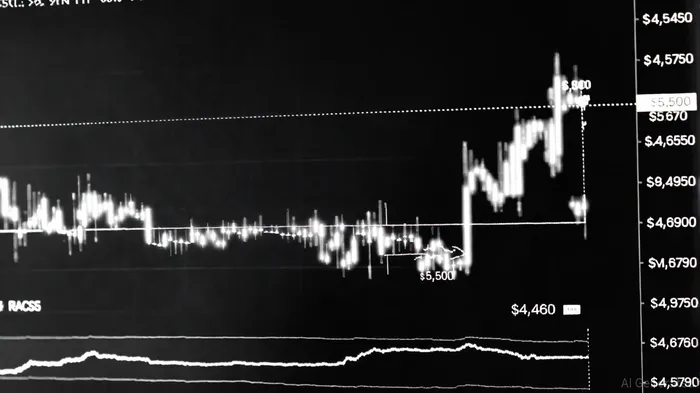
Ethereum's current price of approximately $4,470–$4,500 sits at a critical juncture. Immediate support is anchored at $4,460, with a breakdown below this level risking a pullback to $4,400, according to a price projection. Conversely, a clean breakout above the $4,495 resistance could propel the price toward $4,550, while a sustained move beyond $4,670 would validate a broader bullish trend, potentially pushing ETH toward $5,200–$5,500 within 4–6 weeks, as the same projection suggests.
The Relative Strength Index (RSI) at 57.27 indicates the asset is not yet overbought, leaving room for further upside. Meanwhile, the MACD histogram's reading of 36.36 signals accelerating positive momentum, reinforcing the likelihood of a sustained rally if key resistances are breached. These indicators collectively suggest the dip is part of a healthy consolidation phase rather than a bearish reversal.
Fundamental Catalysts: Upgrades and Adoption Fuel Growth
Ethereum's fundamentals in late 2025 are underpinned by transformative upgrades and surging adoption. The Pectra upgrade in May 2025, which merged the Prague and Electra forks, enhanced scalability by increasing blob inclusion targets, enabling Layer-2s to process transactions at lower costs, according to a 2025 outlook. Daily active addresses have surged to over 552,000-a 21% year-over-year increase-while DeFi Total Value Locked (TVL) has surpassed $150 billion, with EthereumETH-- dominating the ecosystem, the same outlook notes.
Institutional adoption has also gained momentum. The launch of U.S. spot Ethereum ETFs in 2025 injected over $1.5 billion in inflows by September 2025, reflecting growing institutional confidence, and regulatory clarity, such as the SEC's exemption of liquid staking tokens (e.g., stETH) from securities rules, further solidified Ethereum's legitimacy, as reported in that outlook.
Looking ahead, Ethereum's roadmap includes the Verkle Trees upgrade in 2026, which will compress the blockchain state, reducing node costs and enhancing decentralization, as detailed in the project's roadmap. The L1 zkEVM upgrade in early 2026 promises a 50% scalability boost by enabling native zk-rollups, while Full Danksharding aims to drive Layer-2 transaction costs near zero, unlocking mass-market use cases. These upgrades position Ethereum to maintain its dominance in a competitive landscape, even as alternatives like SolanaSOL-- gain traction.
Macroeconomic Tailwinds and Risks
While Ethereum's supply increased by 0.9% in the past year, institutional adoption has offset this with record staking activity-over 30 million ETH (25% of total supply) is now staked, according to an institutional adoption analysis. ETF inflows and regulatory progress, particularly in Europe's MiCA framework, have further bolstered institutional participation, the same analysis observes.
However, challenges persist. Network revenue declined 44% year-over-year, and Ethereum faces competition from faster blockchains. Security risks, such as cross-chain bridge vulnerabilities, also linger, the analysis warns. Yet, Ethereum's deep integration into DeFi, NFTs, and stablecoins-alongside its developer ecosystem-provides a durable foundation for long-term growth.
Conclusion: A Strategic Entry Point
Ethereum's current dip aligns with both technical and fundamental catalysts. The price correction has tested critical support levels without invalidating the bullish structure, while upgrades and adoption metrics reinforce its long-term trajectory. For investors with a 12–18 month horizon, this dip offers a disciplined opportunity to accumulate ETH at a discount to its projected $5,000–$10,000 range by late 2025, the 2025 outlook suggests.
As the network prepares for 2026's scalability milestones, Ethereum's ability to balance innovation with security will likely cement its role as the backbone of global digital finance.






Comentarios
Aún no hay comentarios