
Ethereum's Strategic $4,500 Entry Point: A Convergence of Institutional Demand, Protocol Upgrades, and Global Liquidity Expansion
In the evolving landscape of institutional crypto adoption, EthereumETH-- has emerged as a linchpin of structural bullishness. The confluence of regulatory clarity, technological innovation, and macroeconomic tailwinds has positioned the $4,500 level as a critical inflection point for medium-term investors. This analysis unpacks why Ethereum’s current price dynamics reflect a unique alignment of forces that could catalyze a sustained upward trajectory.
Institutional Demand: A New Era of Liquidity
Ethereum’s institutional adoption has reached unprecedented levels. The U.S. SEC’s 2025 reclassification of Ethereum as a utility token unlocked a flood of institutional liquidity, with Ethereum ETFs attracting $33 billion in inflows during Q3 2025—surpassing BitcoinBTC-- ETFs, which faced outflows [1]. This shift was amplified by the EU’s MiCA utility token framework, which reduced compliance risks and enabled seamless institutional participation through staking and DeFi-optimized wallets [1].
Whale activity further underscores this trend. Over $5.42 billion in BTC-to-ETH transfers occurred in Q3 2025, with 22% of Ethereum’s supply now controlled by whales [1]. Meanwhile, institutional investors staked 1.5 million ETH ($8 billion) by August 2025, reflecting a strategic pivot toward yield generation and long-term value capture [1]. These metrics suggest that Ethereum is no longer a speculative asset but a foundational component of institutional portfolios.
Protocol Upgrades: Scalability and Scarcity
Ethereum’s post-Shanghai upgrades have fundamentally altered its value proposition. The Pectra Upgrade in May 2025 reduced gas fees by 53% quarter-over-quarter, while Layer 2 total value secured (TVS) surged to $16.28 billion [1]. The upcoming Fusaka Upgrade in November 2025 promises further efficiency gains, solidifying Ethereum’s role as the backbone of decentralized finance and tokenized real-world assets [1].
Simultaneously, Ethereum’s deflationary mechanics have gained traction. A 1.32% annual burn rate, combined with 35.8 million ETH staked post-Pectra, has enhanced scarcity and institutional appeal [3]. These protocol-driven tailwinds create a self-reinforcing cycle: higher utility, lower fees, and increased demand for ETH as both a medium of exchange and a store of value.
Global Liquidity Expansion: A Structural Tailwind
The global liquidity expansion for Ethereum is another critical catalyst. ETF inflows reached $12.7 billion in August 2025, with corporate staking volumes and active addresses rising by 29.94% quarter-over-quarter [1]. This liquidity surge is not confined to the U.S.—the EU MiCA framework and emerging markets’ growing crypto infrastructure have broadened Ethereum’s addressable market [1].
Moreover, Ethereum’s role as a foundational infrastructure layer is expanding. Tokenized real-world assets (RWAs) and DeFi applications are driving utility-driven demand, positioning ETH as a bridge between traditional finance and Web3 [1]. This dual narrative—store of value and utility layer—strengthens Ethereum’s appeal in a maturing digital economy.
Technical Analysis: $4,500 as a Strategic Entry
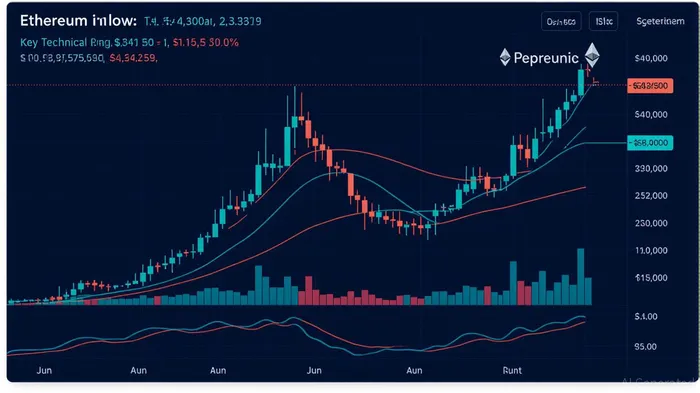
While Ethereum’s price has dipped below $4,500 in late August and early September 2025, the broader trend remains bullish. The cryptocurrency has gained 22.67% over the past month, with key support levels identified around $4,500–$4,600 [3]. Technical indicators are mixed: the RSI reading below 50 and bearish MACD momentum suggest short-term weakness, but the 20-day EMA at $4,377 and ascending channel patterns indicate resilience [5].
A sustained close above $4,530 could trigger a move toward $4,800 and eventually $5,000 [6]. Conversely, a breakdown below $4,500 risks testing the $4,200–$4,015 support cluster. However, on-chain metrics—such as declining exchange balances and whale accumulation—signal conviction among long-term holders [1]. Analysts like EtherNasyonaL argue that Ethereum’s current positioning mirrors its 2017 breakout, with a potential parabolic run on the horizon [6].
Conclusion: A Convergence of Forces
Ethereum’s $4,500 level is more than a technical threshold—it represents a convergence of institutional demand, protocol-driven utility, and global liquidity expansion. For medium-term investors, this price point offers a compelling entry opportunity, supported by structural tailwinds that transcend short-term volatility. As the Fusaka Upgrade looms and institutional adoption accelerates, Ethereum’s trajectory suggests a breakout beyond $5,000 is not only plausible but increasingly probable.
Source:
[1] Ethereum's Whale Accumulation and Institutional Inflows Signal $7,000 Breakout, [https://www.ainvest.com/news/ethereum-whale-accumulation-institutional-inflows-signal-7-000-breakout-2508]
[2] Ethereum's Institutional Adoption and Network Dominance, [https://www.ainvest.com/news/ethereum-institutional-adoption-network-dominance-2025-institutional-ownership-staking-infrastructure-eth-preferred-digital-asset-strategic-portfolios-2509/]
[3] The BTC-to-ETH Rotation: Institutional Whale Shifts Signal Ethereum Emerging Dominance, [https://www.ainvest.com/news/btc-eth-rotation-institutional-whale-shifts-signal-ethereum-emerging-dominance-2509/]
[4] Ethereum's On-Chain Renaissance: A Case for Institutional Exposure, [https://www.ainvest.com/news/ethereum-chain-renaissance-case-institutional-exposure-2025-2508]
[5] Ethereum Bulls Fail To Break $4500 Barrier, Setting Stage for Further Decline, [https://yellow.com/news/ethereum-bulls-fail-to-break-dollar4500-barrier-setting-stage-for-further-decline]
[6] Ethereum (ETH) Price Prediction: Analysts Watch $4,530 Breakout as ETH Eyes $5,000 in September, [https://coinedition.com/ethereum-eth-price-prediction-analysts-watch-4530-breakout-as-eth-eyes-5000-in-september/]






Comentarios
Aún no hay comentarios