
Ethereum Staking ETF Innovation and Its Implications for U.S. Crypto Markets
The launch of the REX-Osprey ETHETH-- + Staking ETF (ESK) marks a watershed moment in U.S. crypto markets, blending spot EthereumETH-- (ETH) exposure with protocol-level staking rewards in a regulated, tradable format. As the first U.S.-listed ETF to integrate staking yield generation directly into its structure, ESK challenges traditional notions of crypto investment vehicles and signals a broader shift toward institutional-grade blockchain participation. This analysis explores ESK's strategic innovation, regulatory alignment, and financial implications, while assessing its potential to reshape the U.S. crypto landscape.
Structural Innovation: A New Paradigm for Crypto ETFs
ESK's architecture is a masterclass in regulatory ingenuity. Unlike conventional crypto ETFs, which hold physical or futures-based assets, ESK is structured as a 1940 Act fund, a classification that distinguishes it from funds registered under the Securities Act of 1933[1]. This structure allows ESK to recognize tax liabilities within its Net Asset Value (NAV) and bypass the SEC's 19b-4 approval process for staking-related income[3]. By operating as a C-corporation, ESK avoids the complexities of grantor trust models, which are restricted under U.S. law for staking activities[3].
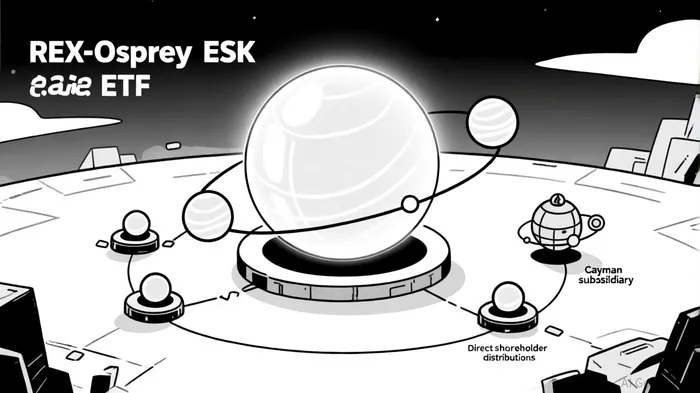
The fund's operational framework further leverages a Cayman Islands subsidiary to facilitate staking operations, circumventing domestic constraints while maintaining compliance[4]. This indirect staking model enables ESK to lock up Ethereum through institutional validators, generating yield without exposing investors to the liquidity risks of direct staking. Notably, 100% of staking rewards are distributed to shareholders monthly, with no retention by the fund manager[2]. This design mirrors traditional dividend-paying equities, offering investors a dual return stream: price appreciation from ETH and income from staking.
Regulatory Framework: Navigating SEC Clarity and Uncertainty
The SEC's May 2025 guidance on protocol staking was pivotal for ESK's launch. By clarifying that staking activities do not constitute securities transactions under federal law, the agency removed a critical regulatory barrier[1]. This framework legitimizes staking as a core blockchain function and paves the way for similar products. However, the SEC's delayed final approval of staking-enabled ETFs until October 2025 introduces lingering uncertainty[2]. ESK's proactive compliance with the 1940 Act structure positions it as a regulatory test case, potentially influencing future approvals for staking-linked instruments.
Financial Implications: Yield, Costs, and Portfolio Allocation
ESK's financial model balances yield generation with cost efficiency. With a total expense ratio of 0.75%[1], the fund is competitively priced relative to traditional crypto ETFs, which often charge 0.50–1.00% fees. The fund's 80% minimum allocation to Ethereum or ETH-linked instruments ensures direct exposure to the asset's price action, while its active management of validator partners optimizes staking performance[4].
The fund's current $625,000 in assets under management (AUM) with 25,000 shares outstanding[4] suggests early-stage growth potential. By diversifying its ETH holdings through WisdomTree and CoinShares physical staked Ethereum funds[1], ESK mitigates counterparty risk while maintaining liquidity. The monthly distribution of staking rewards further enhances investor appeal, particularly in a market where yield generation has historically required complex self-custody solutions.
Strategic Impact on U.S. Crypto Markets
ESK's launch democratizes access to Ethereum staking, a previously fragmented and technical process. By packaging staking rewards into a tradable ETF, REX and Osprey have created a bridge between retail investors and institutional-grade blockchain participation. This innovation could catalyze broader adoption of staking-enabled products, particularly as the SEC's October 2025 timeline brings clarity to the regulatory landscape[2].
Moreover, ESK's success may pressure traditional asset managers to innovate. The fund's hybrid model—combining spot exposure with yield generation—challenges the status quo of crypto ETFs, which have largely focused on price tracking. If ESK demonstrates strong performance and liquidity, it could spur a wave of similar products for other proof-of-stake networks, such as SolanaSOL-- (SOL) or CardanoADA-- (ADA), further diversifying the U.S. crypto market.
Risks and Challenges
Despite its innovation, ESK is not without risks. The use of a Cayman subsidiary introduces jurisdictional complexities and potential tax inefficiencies for U.S. investors. Additionally, the fund's active management of validators exposes it to operational risks, including validator misbehavior or network attacks[1]. Illiquidity during staking periods is another concern, as Ethereum's staking protocol requires locked-up assets for extended durations.
Regulatory shifts also pose a wildcard. While the SEC's May 2025 guidance provided clarity, future enforcement actions or policy changes could disrupt ESK's operations. Investors must weigh these risks against the fund's potential to deliver dual returns in a compliant framework.
Conclusion
The REX-Osprey ESK ETF represents a bold reimagining of crypto investment vehicles, merging spot exposure with protocol-level staking rewards in a regulated, accessible format. Its structural innovation, regulatory alignment, and financial efficiency position it as a trailblazer in the U.S. crypto market. While risks remain, ESK's success could catalyze a new era of staking-enabled products, reshaping how investors engage with blockchain networks. As the SEC's October 2025 timeline approaches, the market will closely watch whether ESK's model becomes the blueprint for the next generation of crypto ETFs.






Comentarios
Aún no hay comentarios