
Ethereum Staking Dynamics: Navigating Delays, Restaking, and ETFs in 2025
Ethereum's staking ecosystem is undergoing a seismic shift in 2025, driven by a confluence of record staking delays, surging exit demands, and the transformative rise of restaking protocols and ETFs. These forces are reshaping ETH's value proposition, creating both compounding risks and unprecedented opportunities for investors.
Staking Delays and Exit Bottlenecks: A Perfect Storm
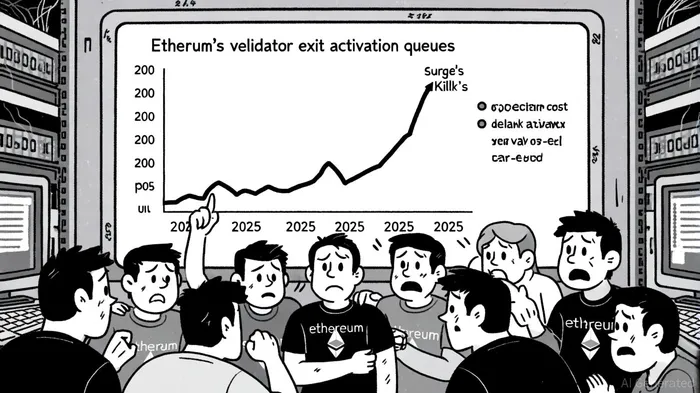
Ethereum's validator system is currently grappling with historic bottlenecks. As of Q3 2025, 2.5 million ETH—worth approximately $11.25 billion—is queued to exit the network, pushing wait times to 46 days, the longest in Ethereum's history [1]. This surge is partly due to infrastructure provider Kiln's voluntary exit of 1.6 million ETHETH-- in late August 2025, triggered by security incidents like the NPM supply chain attack and the SwissBorg breach [1].
The root cause lies in Ethereum's churn limit—a protocol design that restricts validator entry/exit to 256 ETH per epoch (roughly 6.4 minutes) to ensure network stability [1]. While this safeguard prevents instability, it has created a logjam as both exits and new validator activations surge. If 75% of the exiting ETH is restaked under new validators, up to 2 million ETH could flood the activation queue, extending wait times for new stakers to 129 days by year-end [1]. This dynamic highlights a critical tension: Ethereum's institutionalization is straining its capacity to scale, even as demand for staking grows.
Restaking: Amplifying Yields, Compounding Risks
Restaking protocols like EigenLayer are redefining Ethereum's staking landscape by enabling stakers to reuse their ETH or liquid staking tokens (LSTs) to secure additional protocols, from DeFi platforms to cross-chain bridges [2]. This innovation has unlocked 5–15% APY atop Ethereum's base staking rewards, depending on the adoption of Actively Validated Services (AVSs) [2]. For example, EigenLayer's TVL surpassed $10 billion in 2025, driven by institutional demand for yield [2].
However, restaking introduces new systemic risks. Cross-service slashing—where penalties from one protocol could affect Ethereum's base layer—poses a threat to network security. Smart contract vulnerabilities and over-reliance on Ethereum's validator network also raise concerns, as noted by co-founder Vitalik Buterin, who warned of potential misuse of social consensus mechanisms [2]. While EigenLayerEIGEN-- employs slashing mechanisms and governance tools to mitigate these risks, the long-term stability of restaking remains untested.
ETFs and Institutional Capital: A Double-Edged Sword
The approval of spot Ethereum ETFs in 2025 has catalyzed a $12.1 billion influx of institutional capital, with products like BlackRock's ETHA accounting for $5.6 billion in AUM alone [3]. These ETFs allow investors to gain exposure to EthereumETH-- while earning staking yields of 3–5% annually, creating a flywheel effect: higher demand for staking locks up ETH, reducing circulating supply and driving up prices [3].
This dynamic has already reduced Ethereum's liquidity on centralized exchanges to 16.2% of total supply, down from over 25% in 2023 [3]. While this scarcity model supports ETH's price (up 40% in July 2025), it also amplifies volatility. Regulatory clarity—such as the SEC's May 2025 statement that staking is not a security—has further legitimized Ethereum, but challenges persist. The SEC's scrutiny of staking-enabled ETFs and competition from regions like Hong Kong (which permits staking under strict conditions) could delay broader adoption [3].
The Future of ETH: Balancing Risks and Opportunities
Ethereum's value proposition in 2025 hinges on its ability to balance these competing forces. On one hand, technical upgrades like the Pectra and Dencun hard forks have improved scalability and reduced gas fees, enhancing Ethereum's utility as a base layer for DeFi and Layer 2 solutions [3]. On the other, regulatory uncertainty and competition from blockchains like Solana threaten to erode Ethereum's dominance.
Price forecasts for ETH range from $4,000 to $6,000 by year-end, contingent on successful execution of upgrades, sustained ETF inflows, and a favorable macroeconomic environment [3]. However, investors must also contend with liquidity risks (due to extended staking queues) and systemic risks from restaking. For instance, if activation delays exceed 129 days, new stakers may seek alternatives, diluting Ethereum's validator pool.
Conclusion: A Tipping Point for Ethereum Staking
Ethereum's staking dynamics in 2025 reflect a maturing ecosystem where institutional adoption, technological innovation, and regulatory clarity are converging. While staking delays and restaking risks pose challenges, they also underscore Ethereum's growing appeal as a yield-generating asset and a foundation for decentralized infrastructure. For investors, the key lies in hedging against liquidity constraints and protocol risks while capitalizing on Ethereum's deflationary design and institutional tailwinds.
As the network navigates this inflection point, one thing is clear: Ethereum's ability to adapt to these compounding forces will define its trajectory—and its value proposition—for years to come.







Comentarios
Aún no hay comentarios