
Ethereum's Stablecoin Supremacy: A Catalyst for ETH's Next Price Breakout
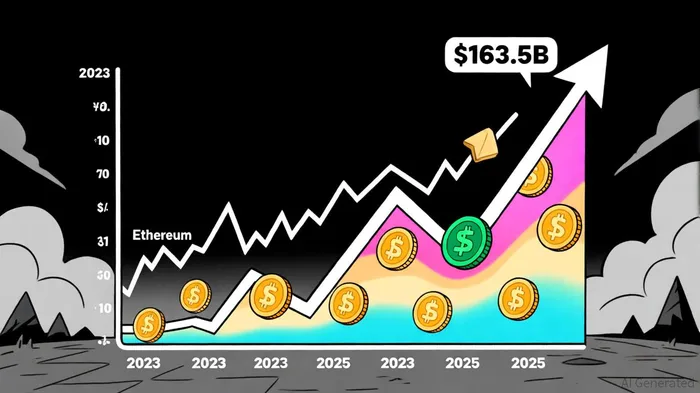
Ethereum's dominance in the stablecoin ecosystem is no longer a footnote—it's a seismic shift reshaping the crypto landscape. By August 2025, Ethereum-based stablecoins accounted for $102 billion of the global supply, with $67 billion in USDT and $35 billion in USDC[1]. This represents 50% of the total stablecoin market, a figure that underscores Ethereum's role as the backbone of blockchain-based finance. But the implications go far beyond market share. A surge in stablecoin supply—now approaching $163.5 billion when including lesser-known Ethereum-based stablecoins like DAI and FRAX—signals a critical inflection point for ETH's price trajectory.
The Stablecoin-ETH Flywheel
Stablecoins are the lifeblood of decentralized finance (DeFi), cross-chain transfers, and institutional on-ramps. Ethereum's capture of this infrastructure creates a self-reinforcing cycle: more stablecoins → more DeFi activity → higher demand for ETH as gas and collateral.
Consider the data: Ethereum's Total Value Locked (TVL) in DeFi protocols hit $45 billion in 2025[2], with platforms like Morpho amassing over $4 billion in TVL[3]. These figures aren't just metrics—they're proof of Ethereum's gravitational pull. Every dollar parked in a lending protocol or traded on an AMM requires ETH to function. As stablecoin supply grows, so does the network's utility, driving both transaction volume and demand for ETH.
Daily transaction volume on Ethereum's DeFi layer alone reached $11.7 billion in Q3 2025, a 14% year-over-year increase[2]. This activity accounts for 25% of Ethereum's total daily transactions, which exceeded 1.65 million per day[2]. The network's robust smart contract infrastructure, coupled with Layer 2 scaling solutions, has slashed gas fees by 60% since 2024[2], making it cheaper and faster to interact with stablecoins and DeFi. The result? A virtuous cycle where lower costs attract more users, who in turn drive more value into the ecosystem.
Why This Matters for ETH's Price
The connection between stablecoin supply and ETH's price is not abstract. Every stablecoin minted on EthereumETH-- creates implicit demand for ETH. For example:
- Collateral: Protocols like AaveAAVE-- and Compound require ETH as collateral for stablecoin loans.
- Gas Fees: Transferring or redeeming stablecoins burns ETH, directly increasing its utility demand.
- Network Effects: As stablecoins become the default medium for cross-chain swaps and institutional settlements, Ethereum's role as the “settlement layer” becomes irreplaceable.
A $163.5 billion surge in Ethereum-based stablecoins implies $163.5 billion of economic activity tied to ETH. This isn't just a store of value—it's a network effect. The more stablecoins flow through Ethereum, the more ETH is needed to power the system. And as DeFi expands into new use cases—like tokenized real-world assets and cross-chain bridges—this demand will compound.
The Cross-Chain Expansion Play
Critics argue that Ethereum's dominance could be challenged by layer-1 competitors like SolanaSOL-- or CosmosATOM--. But Ethereum's lead in stablecoins and DeFi creates a moat. Cross-chain bridges—like Wormhole and Stargate—rely on Ethereum-based stablecoins as the default liquidity source. Even as blockchains compete for user activity, Ethereum remains the settlement layer.
This dynamic is already playing out. In Q3 2025, $2.3 billion in stablecoins were bridged to non-Ethereum chains monthly[2]. While this might seem like a threat, it's actually a win for Ethereum: those stablecoins are still minted and governed on Ethereum, creating a “hub-and-spoke” model where Ethereum is the central hub. Every cross-chain transfer reinforces Ethereum's role, ensuring that ETH remains the asset most deeply embedded in the global financial system.
Conclusion: A Must-Hold Asset
Ethereum's dominance in stablecoins isn't just a technical advantage—it's a strategic one. The $163.5 billion surge in supply isn't a number; it's a network effect. As DeFi evolves and cross-chain activity accelerates, Ethereum's role as the settlement and governance layer will only strengthen. For investors, this means one thing: ETH is not just a token—it's the infrastructure underpinning the next phase of crypto adoption.
Hold Ethereum. It's not just the gateway to DeFi—it's the rails on which the future of finance is being built.






Comentarios
Aún no hay comentarios