
Ethereum Spot ETFs: A New Era of Institutional Adoption and Market Readiness
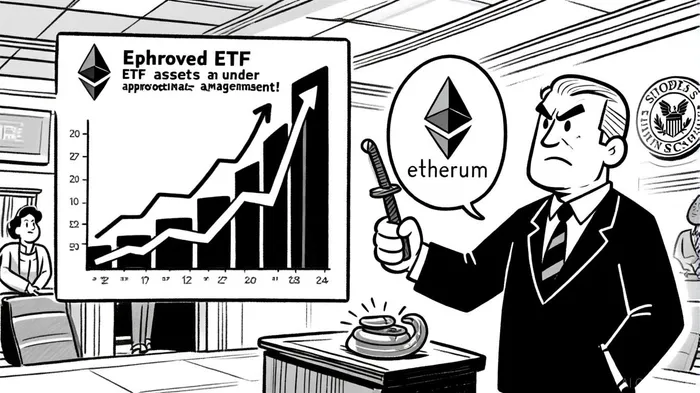
The approval of EthereumETH-- (ETH) spot exchange-traded funds (ETFs) in the United States has marked a transformative shift in the cryptocurrency market, signaling broader institutional acceptance and regulatory maturation. By mid-2024, the U.S. Securities and Exchange Commission (SEC) greenlit multiple Ethereum ETFs, including offerings from BlackRockBLK--, Fidelity, and Grayscale, providing investors with a regulated gateway to the second-largest cryptocurrency[4]. This milestone was followed by the SEC's April 2025 approval of options trading on these ETFs, further expanding hedging and trading strategies for institutional and retail participants[6].
Regulatory Progress and Global Expansion
While the U.S. has emerged as a leader in Ethereum ETF adoption, regulatory progress in other major markets remains uneven. In the European Union, crypto ETFs have been available since 2023, but these have primarily focused on Bitcoin[3]. Ethereum-specific products, however, are still in nascent stages. A multi-crypto fund like Grayscale's Digital Large Cap Crypto Fund has gained traction in Europe, but a dedicated Ethereum-only ETF has yet to receive approval[3]. Similarly, the United Kingdom has notNOT-- announced any Ethereum ETF-specific developments, with regulatory focus remaining on risk mitigation and investor protection[1].
The U.S. regulatory environment, by contrast, has become increasingly accommodating. The SEC's streamlined approval process—spurred by the CLARITY and GENIUS Acts of 2025—has reduced approval timelines and encouraged a surge of new crypto ETFs[1]. This legislative clarity has been pivotal in legitimizing Ethereum as an investable asset, particularly for institutional investors seeking compliance with traditional financial frameworks.
Institutional Adoption and Market Dynamics
Ethereum ETFs have attracted unprecedented institutional interest, with assets under management (AUM) reaching $27.66 billion by Q3 2025—equivalent to 5.31% of the circulating ETHETH-- supply[3]. This growth has been fueled by a combination of regulatory certainty, Ethereum's deflationary supply model, and its role in decentralized finance (DeFi). For instance, Ethereum's total value locked (TVL) surged to $223 billion in 2025, driven by technological upgrades like the Dencun and Pectra hard forks, which reduced gas fees by 90% and enhanced scalability[3].
Institutional inflows have also been bolstered by Ethereum's staking yields, which range between 3% and 6%, offering a compelling alternative to traditional fixed-income assets[3]. BlackRock's iShares Ethereum Trust (ETHA) has emerged as the largest Ethereum ETF, amassing over $12 billion in assets, while July 2025 saw record net inflows of $5.41 billion into Ethereum ETFs—surpassing BitcoinBTC-- ETFs during the same period[5]. Corporate treasuries are further deepening Ethereum's institutional footprint, with entities like Standard Chartered allocating roughly 10% of their ETH holdings to ETFs[5].
Technological and Market Enablers
Ethereum's institutional appeal is not solely tied to regulatory developments. Innovations in Layer-2 solutions have democratized access to the network, reducing transaction costs and enabling use cases like gaming, micropayments, and NFT transactions[5]. These advancements have created a flywheel effect: increased ETF inflows fund further technological development, which in turn attracts more institutional capital.
Moreover, Ethereum's proof-of-stake consensus model has positioned it as an energy-efficient alternative to proof-of-work cryptocurrencies, aligning with institutional ESG (Environmental, Social, and Governance) mandates[5]. The integration of Ethereum into real-world asset (RWA) tokenization projects has further expanded its utility, allowing institutions to programmatically deploy capital into DeFi lending and yield-generating protocols[3].
Outlook and Challenges
Despite the optimism, challenges persist. The SEC's delayed decisions on new Ethereum ETF applications in early 2025 underscore lingering regulatory uncertainties, particularly around market manipulation and asset classification[2]. Additionally, global regulatory divergence—such as the EU's cautious approach—could fragment market access for Ethereum ETFs. However, the precedent set by U.S. approvals and the growing demand for crypto exposure suggest that Ethereum ETFs will continue to gain traction in 2026.
Conclusion
Ethereum spot ETFs have transitioned from speculative novelty to a cornerstone of institutional crypto portfolios. Regulatory clarity in the U.S., coupled with Ethereum's technological evolution and robust staking yields, has created a self-reinforcing cycle of adoption. While global regulatory hurdles remain, the U.S. market's success provides a blueprint for future expansion. For investors, Ethereum ETFs now represent not just exposure to a digital asset, but a gateway to a maturing financial infrastructure that bridges traditional and decentralized markets.





Comentarios
Aún no hay comentarios