
Ethereum vs. Solana: Which Smart Contract Platform Will Outperform in 2026?
Network Scalability: The Architecture of Speed vs. the Modular Fortress
Ethereum and Solana represent divergent approaches to scalability. Solana's monolithic design, combining Proof of History (PoH) with Proof of Stake (PoS), enables a theoretical maximum of 65,000 TPS according to TokenMetrics, with real-world throughput averaging 2,000–4,000 TPS as reported by SwapZone. By contrast, Ethereum's base layer processes 15–30 TPS according to Messari, relying on Layer 2 (L2) solutions like ArbitrumARB-- and OptimismOP-- to scale. While some L2s claim up to 40,000 TPS in a detailed guide, Ethereum's modular architecture prioritizes security and decentralization over raw speed.
Solana's 2025 roadmap, however, is a game-changer. The Firedancer upgrade, a C++-based validator client, aims to push throughput beyond 1 million TPS by mid-2026 according to TechLoy, slashing validator costs by 50–80% as detailed in a blog. Complementing this, the Alpenglow consensus upgrade reduces finality times to 150ms and introduces deterministic execution according to BTCC. These upgrades position Solana to dominate high-frequency applications like institutional-grade DeFi and tokenized assets as described in a Solana upgrade guide.
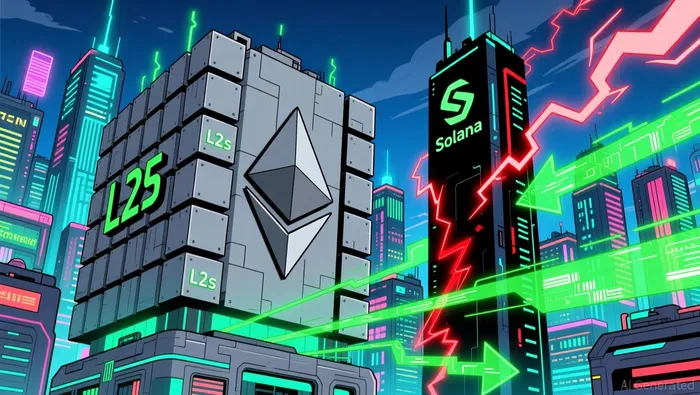
Ethereum's scalability hinges on Cancun-Deneb, a 2024–2025 upgrade that optimizes L2 data availability. While this will improve L2 efficiency, Ethereum's base-layer limitations mean it will remain a "foundation" layer, with scaling handled off-chain as per Messari. For applications requiring real-time processing (e.g., gaming, cross-border payments), Solana's base-layer performance is unmatched according to Ledger.
Developer Activity: Ethereum's Ecosystem vs. Solana's Velocity
Developer activity is a critical barometer of long-term success. As of late 2025, Ethereum maintains a 31,869 active developers, compared to Solana's 17,708 according to AmbCrypto. Ethereum's dominance in DeFi TVL is also stark: it holds $68.9 billion in TVL, representing 67.4% of the market as reported by The Fool, while Solana's TVL stands at $8.83 billion according to AmbCrypto. This gap reflects Ethereum's entrenched position in DeFi, stablecoins, and tokenized assets as noted in a report.
However, Solana's developer velocity is accelerating. Its low fees according to Messari ($0.00176 per transaction) and high throughput attract projects in DeFi, DePIN, and consumer apps. Protocols like Jupiter and Kamino have surpassed $2 billion in TVL as reported by DePinScan, while Double Zero (a DePIN project) drives further growth as noted in DePinScan. Solana's 2025 upgrades, including doubled block space and 25% more compute units per block, are designed to sustain this momentum according to BTCC.
Ethereum's strength lies in institutional trust. Over $6 billion in tokenized real-world assets (RWAs) now reside on Ethereum as reported by XBTO, with BlackRock, Deutsche Bank, and Sony leveraging its infrastructure as detailed by Inx. Meanwhile, Solana's partnerships with Western Union (for a 2026 USDPT stablecoin) and Jump Crypto (via Firedancer) highlight its appeal for enterprise-grade use cases according to Bitget.
Ecosystem Growth: Institutional Adoption vs. DeFi Innovation
Ethereum's institutional adoption is a key differentiator. By late 2025, 1 million ETH was held by Fortune 500 companies according to Monolith VC, with spot Ethereum ETFs driving inflows that outpaced BitcoinBTC-- as reported by Inx. Ethereum's staking yields (3–4%) according to Inx and tokenized asset infrastructure make it a "yield-generating" asset for institutions as noted in a report. Additionally, Ethereum's Layer 2 solutions (e.g., Arbitrum, Starknet) enable micropayments and large-value settlements, critical for enterprise adoption as described by Inx.
Solana's growth, meanwhile, is fueled by DeFi and staking. With 70% of circulating SOL staked according to DePinScan, its 7% annualized yields attract retail and institutional capital as reported by DePinScan. The network's DeFi TVL, though smaller than Ethereum's, is growing rapidly, driven by low-cost, high-speed applications as detailed in a report. Solana's ETFs (e.g., Bitwise's BSOL) also outperformed Bitcoin and Ethereum in Q4 2025 inflows according to Bitget, signaling confidence in its infrastructure.
2026 Outlook: A Tug-of-War Between Legacy and Velocity
Ethereum's security-first, modular architecture ensures it remains the de facto standard for DeFi and institutional infrastructure. Its tokenized asset ecosystem and regulatory clarity as per Inx will likely sustain its dominance in 2026. However, Ethereum's base-layer limitations mean it will cede real-time applications to Solana.
Solana's 2025–2026 upgrades (Firedancer, Alpenglow) position it to capture high-frequency use cases and institutional partnerships. If these upgrades deliver on their promises, Solana could challenge Ethereum's TVL share in DeFi and cross-border payments. Yet, its reliance on a monolithic design and validator monoculture risks long-term decentralization as noted in a roadmap.
Conclusion: A Dual-Track Future
In 2026, Ethereum and Solana will likely coexist in separate niches. Ethereum will anchor institutional infrastructure and tokenized assets, while Solana will dominate real-time applications and DeFi innovation. For investors, the key is to diversify exposure-Ethereum for its security and institutional tailwinds, and Solana for its scalability and velocity. The winner? Not one, but both-each excelling in their respective domains.







Comentarios
Aún no hay comentarios