
Ethereum's Short-Term Volatility and Whale Dynamics: A Macro and Sentiment Analysis
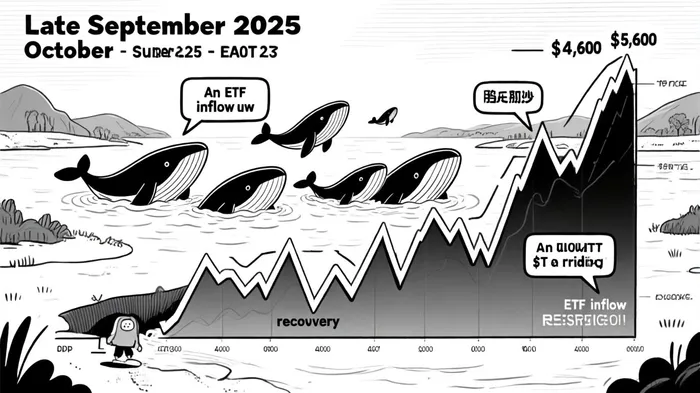
Ethereum's price action in late September and early October 2025 has underscored the interplay between short-term volatility, whale behavior, and macroeconomic forces. As the asset navigated a sharp correction below $4,000, market participants observed a complex dance between institutional confidence and speculative selling. This analysis dissects the dynamics at play, focusing on how whale activity and macro positions are shaping Ethereum's near-term outlook.
Short-Term Volatility and Whale Accumulation
Ethereum's plunge in late September 2025-triggering over $178.5 million in liquidations-exposed the fragility of leveraged positions in derivative markets, according to a Daily Breeze report. However, the same period revealed a critical divergence in whale behavior. While some large holders liquidated or shorted ETH, others seized the dip as a buying opportunity. On September 25 alone, whales accumulated 406,000 ETH (worth $1.6 billion), signaling conviction in Ethereum's long-term value proposition, the Daily Breeze reported. This accumulation intensified in early October, with 870,000 ETH (~$4 billion) added in 24 hours, coinciding with a price rebound to $4,500–$4,700, according to FXLeaders. Such activity suggests that whales are increasingly viewing volatility as a mechanism to acquire undervalued assets, rather than a systemic risk.
Macroeconomic Catalysts and Institutional Inflows
Beyond whale behavior, Ethereum's trajectory is being shaped by macroeconomic tailwinds. The rapid approval of EthereumETH-- ETFs by the U.S. Securities and Exchange Commission has unlocked institutional capital flows, with spot ETFs and corporate treasuries now holding 12.48 million ETH-10.31% of the circulating supply, according to CryptoSlate. October 2025 saw ETF inflows surge to $621.4 million, more than double September's figures, as firms like BlackRock injected $92.6 million in a single day, Deseret News reported. These inflows, coupled with Ethereum's proof-of-stake mechanism locking ETH in staking pools, are reducing circulating supply and creating upward price pressure.
Whale Activity and Market Sentiment
Whale movements have become a barometer for market sentiment. In October, large holders moved over $200 million from exchanges like Binance and Kraken to cold storage or staking pools, indicating a shift toward long-term holding, FXLeaders reported. Conversely, entities like Grayscale liquidated ETH on exchanges, reflecting bearish macro bets, the Daily Breeze noted. This duality highlights a maturing market where whales act as both stabilizers and destabilizers. On-chain metrics further reinforce this duality: reduced exchange reserves and rising decentralized exchange (DEX) volumes suggest growing confidence in Ethereum's utility beyond speculative trading, Deseret News observed.
Institutional Confidence and Regulatory Clarity
The institutional Ethereum landscape is evolving rapidly. Companies such as SharpLink Gaming have added 839,000 ETH to their balance sheets, treating the asset as a yield-bearing treasury tool, the Daily Breeze reported. Meanwhile, Ethereum's role in DeFi and Web3 ecosystems-bolstered by the Dencun upgrade-has enhanced its appeal as a foundational asset. Analysts draw parallels between Ethereum's current trajectory and gold's 2020–2025 rally, projecting price targets as high as $12,000–$15,000 by year-end if inflows persist, according to Brave New Coin. However, risks remain, including retail underparticipation and inflationary pressures from reduced network fees post-Dencun, FXLeaders warned.
Outlook: Balancing Bulls and Bears
Ethereum's October price action-trading between $4,500 and $4,700-reflects a tug-of-war between bullish fundamentals and lingering volatility. Technical indicators suggest a potential breakout above $4,600 could propel ETH toward $5,000, with ETF inflows and whale accumulation as key drivers, Brave New Coin suggested. Yet, the market remains sensitive to macroeconomic shifts, such as U.S. interest rate decisions and equity market performance. Retail traders, meanwhile, face a cautionary landscape: 62% of Ethereum holders are in profit, but leveraged positions remain vulnerable to sharp corrections, FXLeaders added.
Historical backtesting of Ethereum's resistance-level breakouts since 2022 reveals a nuanced picture. Across 87 breakout events, a simple buy-and-hold strategy yielded an average cumulative excess return of +3.4 percentage points (6.42% vs. 3.00% benchmark) over 30 trading days. While the edge was statistically modest, the win rate gradually climbed to ~60% by day 30, with performance improving meaningfully after the first week. These findings suggest that sustained bullish momentum post-breakout-particularly when aligned with macroeconomic tailwinds-can generate meaningful returns, albeit with inherent volatility.
In conclusion, Ethereum's short-term volatility is a double-edged sword-testing retail resilience while offering whales and institutions opportunities to rebalance portfolios. As macro positions solidify and whale activity diversifies, the asset's long-term trajectory hinges on its ability to sustain institutional adoption and regulatory momentum.






Comentarios
Aún no hay comentarios