
Ethereum's Short-Term Correction and the Rise of Next-Gen Blockchains
Ethereum's 2025 journey has been a rollercoaster of resilience and recalibration. After a brutal Q1 slump that saw prices plummet to $1,400, the network rebounded with a vengeance in Q3, reclaiming $4,000 by August 2025. This resurgence was fueled by a perfect storm of institutional adoption-spot ETFs alone injected $1.02 billion in a single day on August 11-and a DeFi ecosystem that saw Total Value Locked (TVL) surge to $270 billion in July, according to an InvestingCube report. Yet, as the calendar flipped to October, EthereumETH-- found itself in a holding pattern, struggling to break past $5,000 despite a 9-year low in exchange supply and a 47% surge in DEX volume, per a CoinCentral prediction.
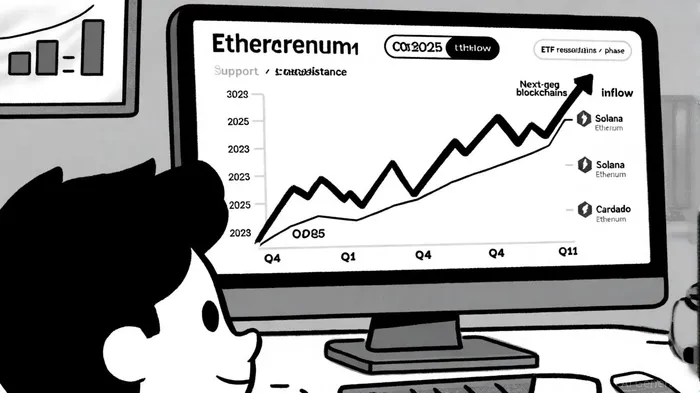
The question now is whether this consolidation is a temporary pause or a structural shift in crypto portfolio reallocation. The answer lies in Ethereum's unresolved scalability challenges and the meteoric rise of next-gen blockchains like SolanaSOL--, CardanoADA--, and PolkadotDOT--.
Ethereum's Scalability Bottleneck: A Short-Term Headwind
Ethereum's core issue remains its throughput. At 10–62 transactions per second (TPS), it lags far behind Solana's 65,000 TPS or Cardano's 250 TPS, as explained in a CoinMonks analysis. Layer-2 solutions like ArbitrumARB-- and OptimismOP-- have mitigated some pain, but they're stopgaps, not silver bullets. The Dencun upgrade, which slashed Layer-2 data costs, is a step forward, but Ethereum's monolithic architecture still limits its ability to compete with modular chains like Polkadot, which theoretically supports 1 million TPS via parallel processing, according to an AllInCrypto comparison.
This isn't just a technical debate-it's a capital allocation problem. As of October 2025, Ethereum's dominance has dipped to 57.2% from 65% in early 2025, signaling a quiet but significant shift in investor sentiment, per Binance Research. While Ethereum's TVL remains robust at $270 billion, next-gen chains are eating into its market share. Solana, for instance, boasts 57 million monthly active users and a $107 billion FDV, while Cardano's formal verification model and Polkadot's cross-chain interoperability are attracting developers and institutions seeking alternatives, according to a Cointelegraph ranking.
The Next-Gen Blockchains: A New Era of Competition
The rise of next-gen blockchains isn't accidental-it's a response to Ethereum's limitations. Solana's sub-second block times and near-zero fees have made it the go-to platform for DeFi and NFTs, while Cardano's research-driven approach to formal verification appeals to risk-averse investors. Polkadot's heterogeneous multi-chain architecture, meanwhile, offers a blueprint for cross-chain collaboration, a critical advantage in a fragmented crypto landscape.
Aptos and other Move-based chains are also gaining traction, particularly in AI integration and gaming. These blockchains aren't just faster; they're redefining what's possible. For example, CoinCentral reported Solana's recent 47% surge in DEX volume, and Binance Research highlighted Cardano's $39.9 billion TVL in AaveAAVE--, both of which underscore growing utility across alternatives. Investors are taking notice: Binance Research also notes that over $28 billion in ETF inflows have shifted toward altcoins as Bitcoin's dominance wanes.
Strategic Reallocation: Balancing Ethereum's Legacy and Next-Gen Potential
For crypto investors, the key is balancing Ethereum's institutional tailwinds with the disruptive potential of next-gen chains. Ethereum's ecosystem-bolstered by regulatory clarity, stablecoin growth, and the Fusaka upgrade-still offers a floor. If it holds above $3,900, it could test $5,000 or higher, particularly if the Fed pauses rate hikes, as reported by InvestingCube. However, its long-term ceiling is capped by scalability and competition.
Next-gen blockchains, on the other hand, represent asymmetric upside. Solana's TVL growth, Cardano's governance model, and Polkadot's interoperability are all compelling narratives for risk-tolerant investors. The challenge is discerning which chains can sustain their momentum. For example, while Solana's 57 million active users are impressive, its reliance on a single validator node introduces systemic risks (as noted in the Cointelegraph ranking). Similarly, Cardano's academic rigor is a strength, but its slower iteration pace could leave it behind in a fast-moving market.
The Path Forward: Diversification in a Fragmented Market
The 2025 crypto landscape is defined by duality: Ethereum's enduring influence and the disruptive force of next-gen blockchains. For strategic investors, the answer isn't an either/or bet but a nuanced reallocation. Ethereum's ETF-driven inflows and DeFi resilience justify a core holding, but satellite positions in high-conviction next-gen chains-Solana for speed, Cardano for security, Polkadot for interoperability-can amplify returns.
As Citigroup and Standard Chartered project Ethereum to hit $4,300 and $7,500 by year-end, the broader market is already shifting. Prediction markets like Polymarket price a 91% chance of Ethereum closing 2025 above $5,000, but the real action may lie in the underdogs. After all, in a world where capital flows to innovation, Ethereum's correction isn't a death knell-it's an opportunity to rethink the crypto portfolio.






Comentarios
Aún no hay comentarios