
Ethereum's Shifting Staking Dynamics and Their Implications for 2026 Outperformance
Ethereum's staking ecosystem is undergoing a transformative shift, driven by maturing infrastructure, institutional adoption, and evolving capital reallocation patterns. As the blockchain transitions from a speculative asset to a foundational pillar of institutional-grade finance, its staking dynamics are poised to redefine long-term value accrual in 2026. This analysis examines the interplay between Ethereum's staking rates, total value locked (TVL), and institutional-grade infrastructure, while projecting how these factors position EthereumETH-- for outperformance against alternative blockchains.
Q4 2025: Stabilization and Rebalancing in Staking Dynamics
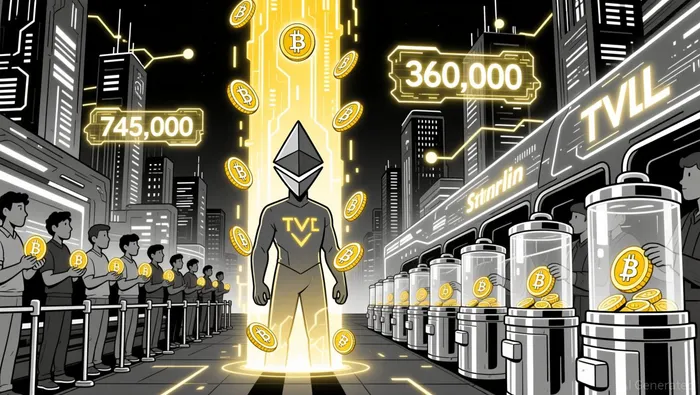
By late 2025, Ethereum's staking rates had stabilized between 3-4%, reflecting a more competitive and mature environment as validators adjusted to market conditions. A critical development was the reversal in validator queue dynamics: 745,000 ETH awaited staking, while only 360,000 ETH were queued for withdrawal, signaling renewed demand for staking participation despite a broader market correction. Concurrently, Ethereum's TVL surged from 25 million to 31 million ETH, underscoring sustained interest in DeFi protocols. This growth highlights Ethereum's ability to attract capital even during price volatility, driven by its role as a hub for institutional-grade security and execution quality.
Institutional Adoption: From Experiment to Operational Necessity
Looking ahead to 2026, institutional staking is expected to become an operational necessity rather than an experimental strategy. A report by Zodia Custody notes that Ethereum's transition to Proof-of-Stake (PoS) and advancements in custody technology have enabled institutions to stake assets securely and transparently, aligning with regulatory expectations. By 2026, Ethereum's TVL could surge tenfold as institutional participation deepens, fueled by demand for compliant, risk-adjusted returns. Protocols like AaveAAVE-- and EtherFi are further enhancing institutional readiness by integrating real-time transaction monitoring and KYC systems, addressing global compliance standards. This shift is not merely about asset accumulation but also about deploying capital into active DeFi strategies such as lending and derivatives, creating a flywheel of yield generation.
Comparative Advantage: Ethereum vs. Alternative Blockchains
While SolanaSOL-- and CardanoADA-- remain competitive in staking participation rates, Ethereum's ecosystem is uniquely positioned to accommodate large-scale capital inflows. As of late 2025, Ethereum retained ~68% of total DeFi TVL, compared to Solana's ~$9.19B TVL, despite the latter's rapid growth in trading and liquid staking. The key differentiator lies in Ethereum's regulatory clarity and institutional infrastructure. The CLARITY Act's classification of Ethereum as a digital commodity has paved the way for products like spot ETFs and tokenized assets, bridging traditional and decentralized finance. Meanwhile, Solana and Cardano face challenges in scaling institutional-grade security and compliance frameworks, limiting their ability to attract large-cap capital.
2026 Outlook: Capital Reallocation and Long-Term Value Accrual
Ethereum's staking dynamics are set to catalyze a broader reallocation of institutional capital. With over $110 billion in assets staked globally, the network is enabling institutions to convert static holdings into productive assets while maintaining on-chain exposure. This trend is amplified by liquid staking derivatives, which eliminate the trade-off between staking and DeFi participation, further solidifying Ethereum's role as a capital-efficient ecosystem. As DeFi TVL grows, Ethereum's dominance in institutional-grade infrastructure-coupled with its first-mover advantage in regulatory alignment-positions it to outperform alternative blockchains in 2026.
Conclusion
Ethereum's staking environment is evolving into a cornerstone of institutional capital reallocation, driven by stable yields, regulatory clarity, and scalable infrastructure. While alternative blockchains like Solana offer compelling use cases, Ethereum's ecosystem remains the most robust for large-scale, compliant capital deployment. For investors, this suggests a strategic tilt toward Ethereum-based staking and DeFi protocols in 2026, as the network's ability to attract and retain institutional capital strengthens its long-term value accrual trajectory.






Comentarios
Aún no hay comentarios