
Ethereum's Scaling Breakthrough and Implications for ETH Price Action
Network Throughput Expansion: A New Era of Scalability
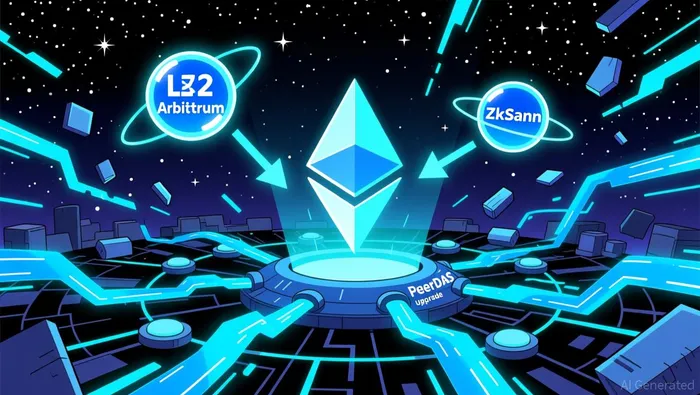 The Fusaka upgrade introduces PeerDAS, a protocol that allows validators to verify only small portions of data from other nodes, drastically reducing bandwidth and storage requirements. This innovation enables L2 networks like ArbitrumARB-- and zkSyncZK-- to process tens of thousands of transactions per second (TPS), a stark contrast to Ethereum's Layer 1 (L1) throughput of ~15–30 TPS according to technical reports. Additionally, the block gas limit has been increased from 45 million to 150 million gas units, directly addressing network congestion and enabling higher throughput.
Layer 2 adoption metrics underscore the urgency of these upgrades. By 2025, L2 networks processed 1.9 million daily transactions, with stablecoins accounting for over 70% of activity according to industry analysis. Platforms like Arbitrum reported 1.37 million daily active wallets in early November 2025, reflecting a 35% reduction in average gas fees due to off-chain processing and data compression. The Dencun upgrade in 2024 further catalyzed this trend, slashing L2 transaction costs by over 90% and reducing mainnet fees to as low as $0.01 per transaction. These metrics highlight a self-reinforcing cycle: lower costs attract more users, which in turn drives network growth and value accrual.
Utility-Driven Demand: The Bullish Case for ETH
The Fusaka upgrade's impact extends beyond technical efficiency. By introducing a minimum fee for Layer 2 data recording, it aligns Ethereum's economic model with long-term value capture for ETHETH-- holders. Bitwise CIO Matt Hougan argues this could 5-10X network revenue, creating a flywheel effect where increased L2 usage translates into higher demand for ETH as a settlement layer according to market analysis. Fidelity Digital Assets further emphasizes that Fusaka represents Ethereum's "most cohesive and value-driven roadmap to date," with scalability and economic intent at its core according to industry commentary.
Institutional adoption is another critical driver. With 16,000 new developers joining Ethereum's ecosystem in the first nine months of 2025, the network's dApp and DeFi infrastructure has matured according to development reports. Total Value Locked (TVL) across Ethereum L2s now exceeds $43.3 billion, a 36.7% year-over-year increase. Meanwhile, Ethereum's dominance in DeFi remains unchallenged, with $119 billion in TVL (49% of the sector's total) according to market data. These fundamentals are increasingly attracting institutional capital, as evidenced by whale activity and treasury purchases according to market observation.
Price Action and Analyst Predictions: A Confluence of Factors
The correlation between Ethereum's scaling progress and price performance is evident. As of November 2025, analysts project a bullish trajectory for ETH, with price targets ranging from $2,988.48 to $9,000 by December 2025. The most optimistic forecasts hinge on a smooth Fusaka rollout and favorable macroeconomic conditions, with some predicting ETH could reach $14,000 by Q1 2026 according to market projections.
This optimism is grounded in historical patterns. For instance, the Dencun upgrade in 2024 drove L2 adoption and reduced gas fees, directly correlating with Ethereum's price surge. Similarly, the Fusaka upgrade's focus on economic sustainability-via PeerDAS and data fee mechanisms-positions Ethereum to capture a larger share of the global financial infrastructure market according to industry analysis.
Conclusion: A Scalable Future for Ethereum
Ethereum's scaling breakthroughs are not merely incremental improvements; they are foundational shifts that address the network's most persistent challenges. The Fusaka upgrade, combined with robust L2 adoption, is creating a virtuous cycle of lower costs, higher throughput, and increased utility. For investors, this translates into a compelling case for ETH: a digital asset whose value is increasingly tied to real-world usage and institutional demand. As the December 2025 rollout approaches, Ethereum's ability to execute on its roadmap will likely determine whether it solidifies its position as the leading smart contract platform-or faces renewed competition from alternatives.







Comentarios
Aún no hay comentarios