
Ethereum's Scaling Breakthrough and Its Impact on Layer 2 Ecosystems
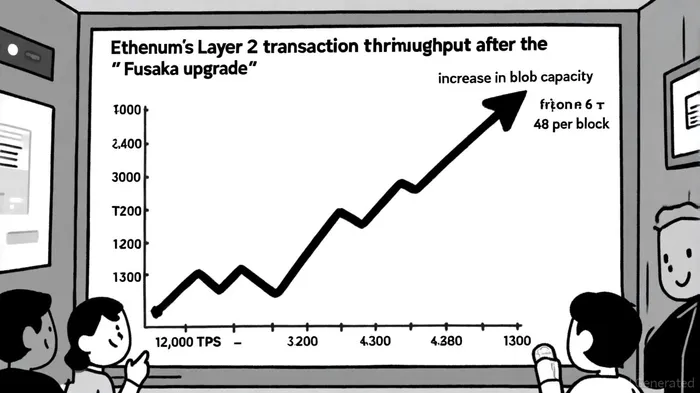
The EthereumETH-- network is on the cusp of a transformative scaling breakthrough with the Fusaka upgrade, scheduled for late 2025. This hard fork, which bundles 11-12 Ethereum Improvement Proposals (EIPs), is poised to redefine the economics and efficiency of Layer 2 (L2) ecosystems. For investors, the implications are profound: reduced transaction costs, increased throughput, and a more sustainable model for decentralized applications (dApps) could catalyze a new wave of adoption and capital inflows.
Technical Foundations of the Fusaka Upgrade
At the heart of the Fusaka upgrade is EIP-7594 (PeerDAS), a data availability sampling mechanism that allows nodes to verify only a fraction of the data in a block rather than storing entire blobs. This innovation reduces the bandwidth and storage burden on validators by up to 90%, enabling Ethereum to process 48–72 blobs per block—a tenfold increase from the current 6–9 blobs [1]. Coupled with EIP-7892, which introduces "Blob Parameter Only" (BPO) forks, the upgrade ensures scalable, incremental growth in data capacity without requiring major hard forks [2].
The economic impact is equally significant. EIP-7918 stabilizes blob fees by tying them to execution costs, preventing market volatility and ensuring predictable pricing for L2 operators [3]. These changes are expected to reduce L2 transaction fees by up to 92%, making Ethereum's rollups competitive with high-speed blockchains like SolanaSOL-- and BNBBNB-- [4].
Investment Implications for L2 Ecosystems
The Fusaka upgrade directly enhances the viability of L2 projects, which are already the backbone of Ethereum's scalability. Platforms like Arbitrum, Optimism, and Base have demonstrated robust growth in 2025, with ArbitrumARB-- leading in developer activity and Optimism's Superchain initiative attracting over 750,000 daily active wallets [5]. Post-Fusaka, these networks are projected to handle 12,000 transactions per second (TPS), a 17x improvement over pre-upgrade benchmarks [6].
For investors, this translates to:
1. Increased Total Value Locked (TVL): Lower fees and higher throughput will drive mass adoption, particularly in DeFi and NFTs. Current TVL across L2s stands at $63.4 billion, with projections of a 30% annual growth rate post-upgrade [7].
2. Project Valuations: L2 platforms with strong infrastructure (e.g., zkSyncZK-- Era, Starknet) are likely to see valuation multiples expand as they capture a larger share of Ethereum's transaction volume.
3. Institutional Inflows: Ethereum's spot ETFs, which hold $24.23 billion in assets under management as of September 2025, could see further inflows if staking is approved for these funds, unlocking an additional $2.8 billion in annual yield [8].
Market Projections and Strategic Considerations
The Fusaka upgrade aligns with Ethereum's broader roadmap to achieve 100,000 TPS by 2030 through a combination of L1 and L2 improvements [9]. This trajectory is supported by real-world adoption metrics:
- Daily Active Users (DAUs): L2 networks like Base and Arbitrum have already surpassed 1 million DAUs, with potential to scale to 10 million post-upgrade [10].
- Gas Savings: Users are projected to save over $1.2 billion annually in transaction fees due to L2 optimizations [11].
However, risks remain. Fragmentation among L2s and liquidity distribution challenges could hinder interoperability. Investors should prioritize projects with strong developer ecosystems and partnerships (e.g., Base's integration with Coinbase) to mitigate these risks.
Conclusion
The Fusaka upgrade represents a pivotal moment for Ethereum's L2 ecosystems. By addressing scalability bottlenecks and reducing costs, it creates a fertile ground for innovation and investment. For those positioned to capitalize on this shift, the rewards could be substantial—both in terms of network value and the broader adoption of decentralized technologies.







Comentarios
Aún no hay comentarios