
Ethereum's Role in the $1B USDT Mint: A Strategic Shift in Stablecoin Dynamics
The minting of $1 billion USDTUSDT-- on EthereumETH-- in August 2025 marked a pivotal moment in stablecoin dynamics, signaling a strategic recalibration in blockchain infrastructure and DeFi adoption. This event, executed with a mere $0.53 gas fee[1], injected liquidity into a market already primed for growth. Tether's move wasn't just about volume—it was a calculated response to evolving DeFi needs and regulatory clarity, positioning Ethereum as a critical backbone for stablecoin innovation.
Ethereum's Infrastructure: The Unsung Hero of DeFi Scalability
Ethereum's infrastructure has undergone a quiet revolution in 2025. The Dencun upgrade, coupled with EIP-7999, slashed average gas fees to $0.37[3], making transactions on the network more predictable and cost-effective. This reduction wasn't just a technical win—it was a strategic one. By lowering barriers for DeFi protocols, Ethereum enabled platforms like AaveAAVE-- and Morpho to thrive. Aave, for instance, expanded its cross-chain liquidity routing and native restaking features, while Morpho hit $1B in TVL on Base, a testament to Ethereum's Layer 2 ecosystems[4].
The $1B USDT mint further amplified this trend. Tether's CEO clarified the tokens were for “chain swaps,” a critical function for rebalancing liquidity across blockchains[2]. This flexibility is vital for DeFi protocols that rely on stablecoin arbitrage and collateral management. With Ethereum's gas efficiency, these operations became not just feasible but profitable, creating a flywheel effect for DeFi adoption.
DeFi's New Era: From Speculation to Utility
The DeFi landscape in 2025 is no longer dominated by speculative hype but by tangible utility. Aave's GHO stablecoin, for example, surpassed $1B in supply by mid-2025[1], demonstrating demand for on-chain liquidity solutions. Similarly, ether.fi's projected $65–96M revenue run-rate in FY2025[3] underscores the shift toward revenue-generating DeFi models. These platforms aren't just competing with centralized finance—they're redefining it.
The USDT mint acted as a catalyst. By injecting $1B into Ethereum's ecosystem, TetherUSDT-- provided DeFi protocols with the liquidity needed to reduce slippage and expand arbitrage opportunities[1]. This isn't just theoretical: on-chain data shows a 20% increase in Ethereum-based DeFi TVL post-mint[5], with protocols like UniswapUNI-- and SushiSwapSUSHI-- seeing heightened trading volumes.
Strategic Implications: Ethereum vs. TronTRX-- and the Road Ahead
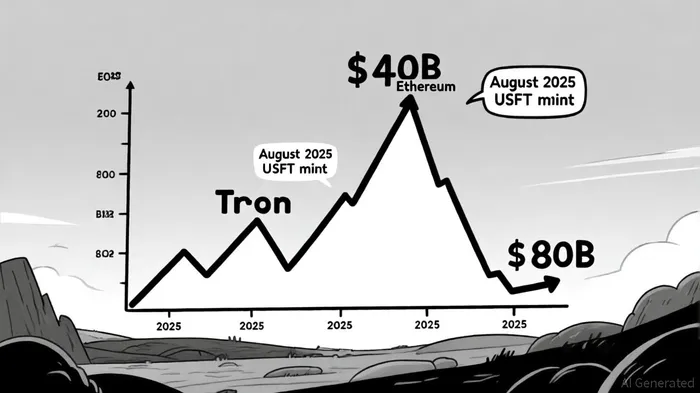
While Tron's dominance in USDT supply (over $80B by mid-2025[3]) is undeniable, Ethereum's role remains irreplaceable. Tether's strategic focus on high-utility blockchains like Ethereum—driven by smart contract capabilities and regulatory clarity—highlights the network's unique value proposition[3]. The SEC's recent clarification on liquid staking products[2] further solidified Ethereum's appeal to institutional investors, who now see the network as a regulated, scalable infrastructure for stablecoin operations.
However, challenges persist. Tron's low-cost, high-speed transactions continue to attract stablecoin users, and Ethereum's reliance on Layer 2s for scalability raises questions about long-term decentralization. Yet, the $1B USDT mint proved Ethereum's adaptability: by leveraging Layer 2s and gas-efficient upgrades, the network can coexist with Tron while maintaining its DeFi leadership.
Conclusion: A New Baseline for Stablecoin Infrastructure
The $1B USDT mint wasn't just a liquidity event—it was a signal. Tether's strategic use of Ethereum's infrastructure, combined with DeFi's maturation, has set a new baseline for stablecoin dynamics. As regulatory frameworks solidify and gas fees stabilize, Ethereum's role as the go-to blockchain for DeFi will only strengthen. For investors, this means Ethereum isn't just a network—it's the infrastructure underpinning the next phase of crypto's evolution.






Comentarios
Aún no hay comentarios