
Ethereum's Road to $5,000: Is October the Breakout Moment?
Market Fundamentals: A Confluence of Bullish Drivers
Ethereum's path to $5,000 in October 2025 is underpinned by a convergence of macroeconomic and on-chain factors. Institutional adoption has surged, with over $31.9 billion in Ethereum-based assets under management as of September 2025, driven by inflows into U.S. spot ETFs and corporate integrations, according to a Benzinga article. This trend is amplified by Ethereum's technical setup: the 50-day moving average has crossed above the 200-day moving average-a classic "bullish crossover"-signaling upward momentum, as noted in a Brave New Coin analysis.
Macroeconomic tailwinds further bolster the case. The Federal Open Market Committee (FOMC) meeting in October 2025 is expected to announce a 25-basis-point rate cut, reducing the cost of capital and incentivizing risk-on assets like crypto, as Brave New Coin observes. Meanwhile, Ethereum's dominance in decentralized finance (DeFi) and non-fungible tokens (NFTs) ensures its relevance in a maturing crypto ecosystem.
Network Upgrades: The Fusaka Hard Fork as a Game Changer
Ethereum's Fusaka hard fork, scheduled for November 2025, represents a pivotal upgrade to address scalability and efficiency. This upgrade bundles 11 EthereumETH-- Improvement Proposals (EIPs), including PeerDAS (Peer Data Availability Sampling) via EIP-7594, which reduces bandwidth and storage demands for validators by 40%, according to a Crypto.com guide. By enabling nodes to sample data rather than download full blobs, PeerDAS enhances Layer-2 (L2) throughput, lowering transaction costs during peak demand, as explained in a Foreck comparison.
The gas limit will also increase from 30 million to 150 million units, allowing for a 400% surge in transaction capacity, according to a BeInCrypto article. These improvements position Ethereum to compete with high-speed blockchains like SolanaSOL--, which currently processes 65,000 transactions per second (TPS) at sub-penny fees, as Foreck notes. While Solana's native performance advantages remain, Ethereum's post-Fusaka infrastructure upgrades could narrow the gap, particularly for enterprise and institutional use cases, as the Benzinga article suggests.
Altcoin Competition: Can Ethereum Retain Its Crown?
The rise of altcoins in Q3 2025 has intensified competitive pressure on Ethereum. Solana (SOL) and CardanoADA-- (ADA) are gaining traction with their focus on speed, sustainability, and real-world utility, as Brave New Coin reports. For instance, Solana's Alpenglow and Firedancer upgrades aim to refine its high-performance architecture, while Cardano's energy-efficient proof-of-stake model appeals to eco-conscious investors, according to Foreck.
However, Ethereum's institutional credibility and DeFi ecosystem provide a moat. As of September 2025, 80% of top altcoins outperformed BitcoinBTC--, but Ethereum ETFs saw a net inflow of $639 million, reflecting sustained institutional demand, BeInCrypto reported. The Fusaka upgrade's focus on scalability could attract alt-season capital flows-typically directed to high-beta tokens-by reinforcing Ethereum's role as the "settlement layer" for DeFi and NFTs, a point Brave New Coin highlights.
The $5,000 Target: A Realistic Outlook
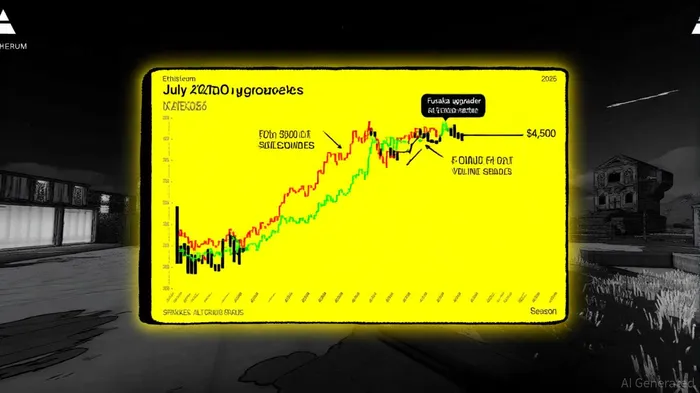
Ethereum's price trajectory hinges on its ability to break above key resistance levels. On-chain data indicates a consolidation phase around $4,500, with a critical breakout above $4,957 potentially propelling the asset toward $5,000, according to BeInCrypto. This scenario assumes successful execution of the Fusaka upgrade and favorable macroeconomic conditions, such as the FOMC rate cut.
Historical backtesting of resistance-level breakouts (2022–2025) reveals that Ethereum has historically generated an average cumulative return of ~6.2% within 30 days of breaking above its prior 50-day high, outperforming the 3% benchmark, per BeInCrypto. The win rate for such breakouts improves steadily, reaching ~64% by day 30. While these results suggest a positive bias for post-breakout rallies, the lack of statistical significance in daily excess returns underscores the need for caution, as noted in the same BeInCrypto analysis.
Regulatory clarity also plays a role. Recent legislative moves, including potential approvals for Ethereum staking ETFs, have bolstered investor confidence, according to Brave New Coin. Meanwhile, Ethereum's 96.13% holder retention rate underscores long-term conviction in its roadmap, as BeInCrypto reports.
Conclusion: October as the Inflection Point
Ethereum's journey to $5,000 is far from guaranteed, but the confluence of institutional inflows, network upgrades, and macroeconomic tailwinds creates a compelling case. The Fusaka hard fork in November 2025 will be a litmus test for Ethereum's ability to retain its leadership amid altcoin competition. If the upgrade delivers on its promises of scalability and cost efficiency, October 2025 could mark the breakout moment investors have been waiting for.






Comentarios
Aún no hay comentarios