
Ethereum's Record Smart Contract Deployments as a Catalyst for Long-Term Value Growth
Ethereum's ecosystem has reached a pivotal inflection point. In Q4 2025, the network achieved a record 8.7 million smart contract deployments, marking the highest quarterly total in its history. This surge, driven by institutional adoption, DeFi innovation, and the expansion of Layer 2 (L2) solutions, underscores Ethereum's evolving role as both a programmable blockchain and a foundational settlement layer. For investors, this data signals a maturing ecosystem where developer activity-a leading indicator of adoption-is reshaping the network's value proposition.
Developer Activity as a Leading Indicator
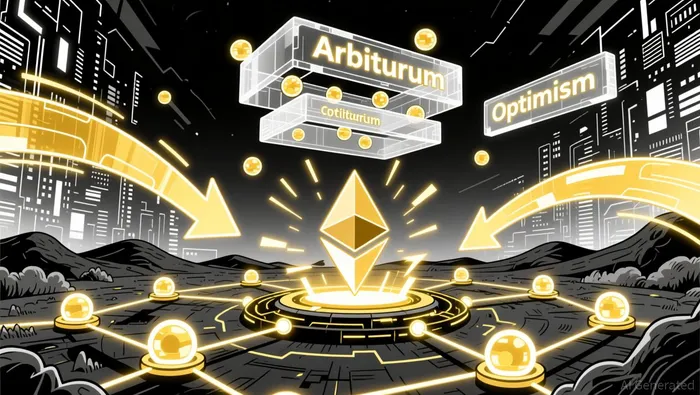
Smart contract deployments are a critical metric for gauging blockchain adoption. According to a report by Mitrade, Ethereum's 30-day moving average of new contracts reached 171,000 in Q4 2025, reflecting sustained developer confidence. This growth is not merely quantitative but qualitative: standardized libraries, factory contracts, and reduced development friction have accelerated deployment cycles. For context, the approval of ETH ETFs in late 2025 catalyzed DeFi adoption, as institutional capital flowed into decentralized financial protocols. Meanwhile, L2 solutions like Arbitrum and Optimism slashed gas fees, enabling developers to experiment with novel applications.
Layer 2s: The Unsung Heroes of Scalability
While the 8.7 million figure is headline-grabbing, the role of L2s in enabling this growth cannot be overstated. Data from MEXC highlights that L2s like Base and ArbitrumARB-- reduced transaction costs by up to 90%, making EthereumETH-- accessible to a broader range of developers and users. This scalability has been a game-changer for Ethereum's enterprise adoption. Companies deploying tokenized assets or real-world asset (RWA) protocols on L2s now face lower barriers to entry, accelerating the integration of blockchain into traditional finance.
DeFi's Resurgence and Institutional Validation
Decentralized finance remains a cornerstone of Ethereum's innovation. The Q4 2025 surge in deployments coincided with a 27.6% decline in ETH's price, yet developer activity continued to rise. This decoupling of price and fundamentals suggests that Ethereum's value is increasingly driven by utility rather than speculative demand. The approval of ETHETH-- ETFs, for instance, spurred DeFi protocols to optimize for institutional-grade security and compliance. As stated by KuCoin, active Ethereum addresses nearly doubled year-to-date, rising from 396,439 to 610,454, signaling robust user engagement across DeFi, NFTs, and gaming.
Enterprise Adoption: Beyond the Hype Cycle
Ethereum's enterprise use cases are no longer niche. Tokenized real-world assets, supply chain automation, and decentralized identity solutions are now mainstream applications of smart contracts. Institutional interest, particularly in tokenized bonds and real estate, has further solidified Ethereum's role as a settlement layer. While the exact percentage of enterprise-driven deployments remains unspecified in available reports, the growth in RWA protocols and corporate partnerships indicates a shift toward practical, real-world utility.
Implications for ETH Fundamentals and Investor Positioning
The 8.7 million deployments in Q4 2025 are more than a technical milestone-they are a testament to Ethereum's resilience and adaptability. Despite ETH's price correction, the network's fundamentals remain strong: increased developer activity, institutional validation, and a maturing ecosystem all point to long-term value creation. For investors, this means Ethereum's role as a settlement layer is becoming increasingly defensible. As Phemex notes, the surge in active addresses and contract deployments suggests that Ethereum is transitioning from a speculative asset to a foundational infrastructure protocol.
In conclusion, Ethereum's Q4 2025 performance highlights a critical truth: blockchain adoption is driven by utility, not just hype. With L2s enabling scalability, DeFi protocols attracting institutional capital, and enterprises embracing tokenization, Ethereum's ecosystem is poised for sustained growth. For long-term investors, this is a compelling case to position for Ethereum's next phase of evolution.






Comentarios
Aún no hay comentarios