
Ethereum's Q3 Rally and the Emerging Opportunities in Undervalued Altcoins
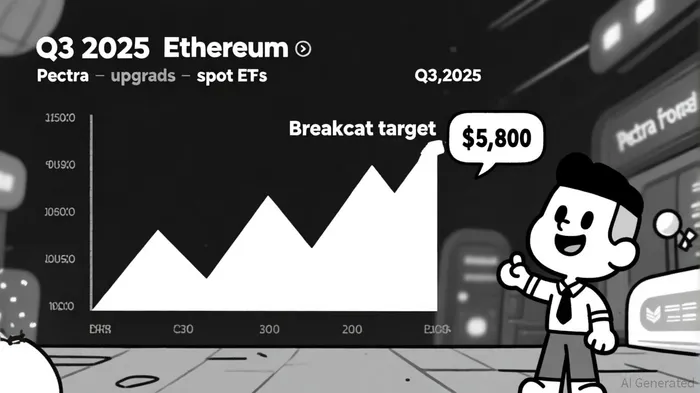
In Q3 2025, EthereumETH-- (ETH) has emerged as a cornerstone of the crypto market's resurgence, driven by a confluence of technical upgrades, institutional adoption, and macroeconomic tailwinds. The price of ETHETH-- surged 56% in July alone, fueled by $5.4 billion in net inflows from spot ETFs and the activation of the Pectra upgrade in May, which streamlined staking and boosted institutional participation[1]. As of June 19, 2025, ETH traded at $2,520, consolidating within a range that analysts suggest could break out to $5,800 by year-end if key resistance levels are breached[1]. Historical backtesting of these resistance levels from 2022 to 2025 reveals that breakouts above $2,750 and $3,068 occurred 28 times. However, post-breakout performance showed an average 30-day gain of +1.8%, slightly below the +3.0% return of a passive hold, with a win rate of approximately 50%. These results suggest that while breaking these levels may indicate momentum, they do not guarantee outperformance and should be considered within a broader strategy. This rally is not just speculative-it's underpinned by Ethereum's structural deflationary dynamics, growing DeFi activity, and a TVL of $270 billion in July, signaling robust on-chain utility[2].
The Catalysts Behind Ethereum's Q3 Rally
Ethereum's resurgence is rooted in three pillars: network upgrades, institutional capital flows, and macroeconomic alignment. The Pectra upgrade, which increased validator stake limits from 32 ETH to 2,048 ETH, reduced staking complexity and attracted large institutional players[1]. Meanwhile, the approval of spot ETH ETFs in July 2025 unlocked $12 billion in institutional capital, with weekly inflows averaging $500 million[3]. This influx reduced exchange reserves and tightened ETH's supply, creating upward pressure on price[1].
Macroeconomic factors further amplified Ethereum's appeal. With U.S. inflation stabilizing near 2.4% and bond yields declining, risk assets like Ethereum gained traction. Ethereum's 0.77 correlation with the S&P 500[1] and its role as a "digital gold" alternative positioned it to benefit from broader market optimism. Additionally, the upcoming Fusaka upgrade in December 2025, which will expand Layer 2 (L2) throughput, is already priced into ETH's valuation, with analysts projecting a 12,000+ TPS target by 2026[1].
Undervalued Altcoins in the Ethereum Ecosystem
While Ethereum dominates headlines, its ecosystem harbors undervalued altcoins with strong fundamentals and growth potential. These projects are poised to capitalize on Ethereum's momentum while offering diversification and niche utility:
- Arbitrum (ARB): As a leading L2 solution, Arbitrum's Stylus upgrade in Q3 2025 enhanced smart contract flexibility, driving DeFi and gaming adoption. ARB's TVL grew 40% quarter-over-quarter, with whale accumulation suggesting long-term bullish sentiment[4].
- Polygon (MATIC/POL): Transitioning to zero-knowledge rollups under Polygon 2.0, MATIC's rebrand to POL reflects improved tokenomics and institutional partnerships. Its TVL surged 65% in July, driven by cross-chain DeFi activity[4].
- Chainlink (LINK): As Ethereum's critical oracleADA-- infrastructure, LINK's Cross-Chain Communication Protocol (CCIP) gained traction in real-world asset (RWA) tokenization, with TVL increasing 30% in Q3[4].
- MAGACOIN FINANCE: A niche DeFi protocol, MAGACOIN FINANCE saw a 300% TVL growth in Q3 2025, leveraging viral branding and institutional-grade risk management to attract capital[4].
These projects exemplify Ethereum's ecosystem-driven innovation, where L2 scalability, interoperability, and DeFi utility create compounding value.
Capital Allocation Strategies for a Surging Market
Balancing Ethereum's dominance with altcoin exposure requires disciplined capital allocation. Here's how investors can structure their portfolios:
- Core-Satellite Framework: Allocate 15–20% to Ethereum as a core holding, leveraging its deflationary dynamics and institutional adoption. The remaining 80–85% can be distributed across a satellite portfolio of altcoins, prioritizing projects with strong TVL growth and Ethereum integration[5].
- Sector Diversification: Spread investments across Ethereum's key verticals:
- Layer 2s (e.g., ARB, POL): 30% allocation to benefit from scalability demand.
- DeFi Infrastructure (e.g., AAVEAAVE--, LINK): 25% for yield-generating protocols.
- AI/Utility Tokens (e.g., RNDR, MAGACOIN FINANCE): 20% to capture innovation-driven growth.
- Stablecoins: 10–15% as a buffer for liquidity and rebalancing[5].
- Risk Mitigation: Use stop-loss orders and regular rebalancing (quarterly) to manage volatility. For example, Bybit's Q3 2025 report showed institutional investors reduced stablecoin exposure from 42.7% in April to 25% in August, reallocating to high-beta tokens like XRPXRP-- and SOL[6].
A case study from Bybit's asset allocation report illustrates this strategy: investors who shifted 10% of their stablecoin holdings to ARB and LINK in July 2025 saw a 25% return by August, outperforming a purely ETH-focused portfolio[6].
The Road Ahead: Balancing Hype and Fundamentals
Ethereum's Q3 rally and the rise of undervalued altcoins present a unique opportunity for investors. However, success hinges on avoiding emotional decisions and adhering to disciplined strategies. As Michael Van de Poppe notes, a $7,000+ ETH target by year-end is plausible if the $3,500 resistance is breached[1]. For altcoins, projects like MAGACOIN FINANCE and ARB offer asymmetric upside, but their risks-regulatory uncertainty, competition from faster blockchains-must be weighed against Ethereum's foundational strength[5].
Conclusion
Ethereum's Q3 2025 rally is more than a price surge-it's a structural shift in how institutions and retail investors perceive crypto. By pairing Ethereum's deflationary and scalable infrastructure with undervalued altcoins, investors can build portfolios that balance growth and risk. The key lies in strategic allocation, sector diversification, and a focus on projects that align with Ethereum's long-term vision. As the Fusaka upgrade looms and macroeconomic conditions stabilize, the stage is set for a new era of crypto investing.






Comentarios
Aún no hay comentarios