
Ethereum's Q3 2025 Price Correction: Institutional Investor Behavior and On-Chain Resilience
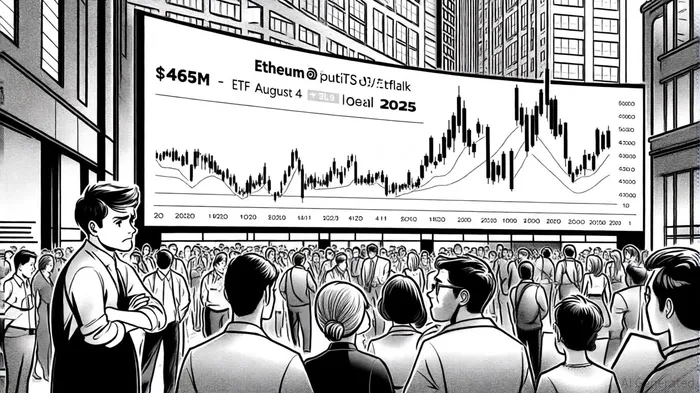
Ethereum's 24% price correction in Q3 2025, from an all-time high of $4,946 to $4,414, has sparked renewed scrutiny of institutional investor behavior and on-chain dynamics. While short-term volatility has raised concerns, the underlying fundamentals—driven by deflationary mechanisms, Layer 2 adoption, and strategic institutional accumulation—suggest a nuanced narrative. This analysis examines the interplay between cost basis thresholds, on-chain activity, and institutional positioning to assess Ethereum's trajectory.
Institutional Outflows and Cost Basis Thresholds
The most significant catalyst for Ethereum's Q3 pullback was a $465 million single-day outflow from BlackRock's ETHA fund on August 4, 2025 [1]. This marked the first major reversal in a 20-day inflow streak that had injected $5.43 billion into EthereumETH-- ETFs in July [3]. Analysts attribute the outflow to profit-taking and macroeconomic caution rather than a loss of institutional confidence. BlackRock's ETHA fund still holds $9.3 billion in assets, while Fidelity's FETH fund added $2.2 billion in cumulative inflows during the quarter [1].
The price drop to $4,414 has brought Ethereum closer to critical cost basis thresholds for institutional investors. Historical data from the Cost Basis Heatmap reveals a concentration of 2 million ETH wallets at $4,579, a level that could trigger renewed buying pressure if breached [5]. Conversely, a breakdown below $4,156—a support level coinciding with the 2025 all-time high's 38.2% Fibonacci retracement—could exacerbate selling pressure.
On-Chain Resilience Amid Volatility
Despite the price correction, Ethereum's on-chain activity remains robust. Daily transactions surged to 1.7 million in September 2025, driven by Layer 2 networks like Base and ZKsyncZK--, which reported 3 million monthly active users [5]. The Dencun upgrade (EIP-4844) further reduced layer-2 fees, fueling DeFi growth and smart contract adoption [1].
Ethereum's deflationary structure has also proven resilient. The network achieved its first net negative issuance rate since March 2025, with 29% of the total supply staked [4]. This has created a supply squeeze, as institutional treasuries added 2.2 million ETH (1.8% of total supply) over two months [5]. Whale activity reinforces this trend: 14 new wallets accumulated 856,554 ETH since July 9, signaling long-term confidence [1].
Derivatives and Sentiment Indicators
Derivatives data paints a mixed picture. Ethereum's futures premiums have shifted to a neutral-to-bearish outlook, with traders adopting cautious strategies as the price consolidates between $3,600 and $3,800 [3]. However, the NUPL (Net Unrealized Profit/Loss) metric for long-term holders hit a three-month high in September, historically preceding corrections of over 10% [5]. This suggests profit-taking may intensify if the price fails to break above $4,579.
Institutional demand, however, remains a stabilizing force. Strategic reserves for Ethereum grew to $10 billion in Q3, reflecting commitments to network security and development [1]. Meanwhile, Ethereum's dominance in TVL (Total Value Locked) continues to outpace rivals like BNBBNB-- Chain and SolanaSOL--, despite increased competition [3].
Outlook: Structural Strengths vs. Short-Term Headwinds
While September has historically been a weak month for Ethereum—averaging 3.20% gains in 2024 and 1.49% in 2023 [5]—the current environment is distinct. Institutional adoption, regulatory progress, and supply constraints create a floor for the price. If Ethereum breaks above $4,579 and sustains volume above 1.5 million transactions daily, a move toward $4,956 becomes plausible [5]. Conversely, a breakdown below $4,156 could trigger a test of the $3,800 psychological level, a critical support zone identified by JPMorgan analysts [3].
In the long term, Ethereum's structural advantages—ETF adoption, EIP-1559's deflationary model, and the Pectra upgrade—position it for a potential breakout. Goldman Sachs and cryptocurrency research firms project prices ranging from $6,500 to $15,000 by 2025, contingent on macroeconomic conditions and institutional inflows [1][2].
Conclusion
Ethereum's Q3 correction reflects short-term profit-taking and macroeconomic caution but does not undermine its long-term fundamentals. Institutional investors remain net buyers, with ETFs and staking activity reinforcing Ethereum's supply constraints and utility. While cost basis thresholds and derivatives sentiment introduce volatility, the network's on-chain resilience and institutional backing suggest a credible case for a late-2025 breakout. Investors should monitor key resistance levels and ETF flows as leading indicators of the next phase in Ethereum's cycle.





Comentarios
Aún no hay comentarios