
Ethereum's Privacy Overhaul and Its Impact on Decentralized Finance (DeFi) Growth
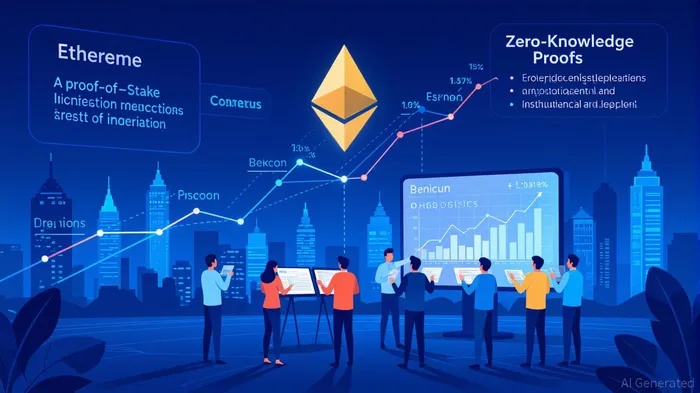
Ethereum's ongoing evolution into a privacy-centric blockchain has positioned it as a critical infrastructure layer for decentralized finance (DeFi). As institutional investors increasingly seek secure, scalable, and compliant environments to deploy capital, Ethereum's privacy protocols—particularly zero-knowledge proofs (ZKPs) and zk-SNARKs—have emerged as a linchpin for unlocking broader adoption. These advancements, coupled with the Dencun upgrade's proto-danksharding framework, are reshaping the landscape for DeFi, addressing long-standing barriers like high gas fees and data transparency.
The Privacy Imperative: ZKPs and zk-SNARKs as Institutional Enablers
Zero-knowledge proofs (ZKPs) and their cryptographic variant, zk-SNARKs, allow users to validate transactions without exposing sensitive data. For institutions, this means maintaining confidentiality in trading, lending, and asset management while complying with regulatory requirements. According to a report by Investopedia, Ethereum's integration of these protocols has enabled “a higher degree of privacy in blockchain transactions,” a feature critical for enterprises wary of public ledger exposure.
The Dencun upgrade, activated in March 2024, further accelerated this shift by introducing proto-danksharding—a mechanism that reduces data storage costs and improves scalability. This upgrade laid the groundwork for layer 2 solutions (e.g., rollups) to leverage ZKPs, enabling DeFi platforms to process transactions at near-zero cost while preserving privacy. For example, platforms like zkSync and StarkNet have already begun deploying ZKP-based architectures, attracting institutional liquidity by mitigating the risks of front-running and data leakage.
Regulatory Hurdles and Technical Complexity
Despite these strides, institutional adoption remains constrained by two key challenges. First, regulatory frameworks in jurisdictions like the U.S. and EU have yet to clarify how private transactions align with anti-money laundering (AML) and know-your-customer (KYC) requirements. Second, the technical complexity of implementing ZKPs and zk-SNARKs—requiring specialized cryptographic expertise—has slowed deployment for traditional financial institutions.
However, Ethereum's transition to proof-of-stake (The Merge, 2022) has created a more energy-efficient and scalable foundation, reducing operational costs for validators and developers. This shift has incentivized innovation in privacy tools, with projects like Aztec and Zcash's Sapling protocol gaining traction as bridges between public blockchains and institutional-grade confidentiality.
Quantifying the Impact: TVL and Transaction Volumes
While specific data on post-Dencun TVL (Total Value Locked) and transaction volumes is scarce, the upgrade's focus on cost efficiency and scalability is expected to drive long-term growth. Yahoo Finance notes that Ethereum's dominance in DeFi—accounting for over 60% of TVL in 2024—stems from its robust ecosystem and network effects. By reducing gas fees and enabling private transactions, the Dencun upgrade could further solidify this lead, attracting institutions that previously avoided EthereumETH-- due to cost or transparency concerns.
Conclusion: Privacy as a Catalyst for Ethereum's Long-Term Value
Ethereum's privacy overhaul is not merely a technical upgrade but a strategic pivot toward institutional adoption. By addressing scalability, cost, and confidentiality, the network is creating a fertile ground for DeFi to mature into a mainstream financial infrastructure. While regulatory and technical hurdles persist, the Dencun upgrade and ZKP-based solutions represent a critical inflection point. For investors, this signals a long-term value proposition: Ethereum's ability to balance transparency with privacy will likely cement its role as the backbone of the next-generation financial system.






Comentarios
Aún no hay comentarios