
Ethereum's Price Surge and the Role of Gaming Ecosystems in Driving Long-Term Value
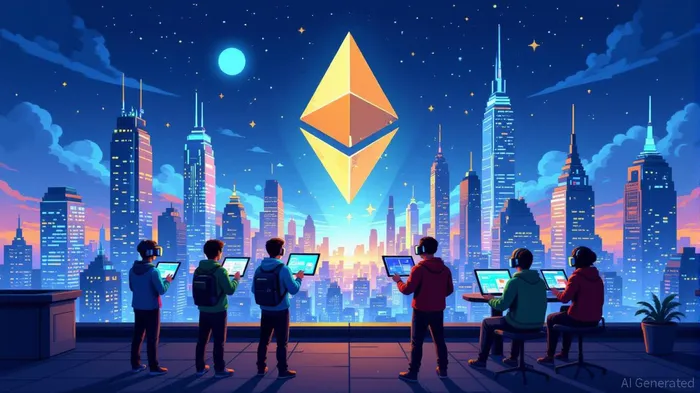
Ethereum's 2025 price surge has sparked renewed interest in its long-term value proposition, with blockchain gaming ecosystems emerging as a critical catalyst. As institutional adoption of tokenized assets accelerates, games like Eternium are proving that decentralized platforms can drive transaction demand and NFT adoption in ways traditional applications cannot. This analysis explores how gaming's unique blend of utility, community, and tokenization creates a flywheel effect for Ethereum's growth—and why investors should prioritize this sector now.
The In-Game Economy: A Microcosm of Ethereum's Value Chain
Blockchain gaming thrives on scarcity, ownership, and interoperability—principles that align perfectly with Ethereum's design. Eternium, a mobile RPG with a robust crafting and progression system, exemplifies this. Its economy revolves around time, gems, and rare in-game items like the Mark of the Oracle, which is required to craft high-tier Legacy Gear such as The Liberator shield [1]. These mechanics mirror real-world tokenization strategies, where scarcity (e.g., limited-edition NFTs) and utility (e.g., in-game advantages) drive demand.
While Eternium itself does not explicitly operate on EthereumETH--, its design reflects broader trends in blockchain gaming: players are incentivized to treat in-game assets as tradable, tokenized goods. If such systems were migrated to Ethereum-based platforms, they could generate consistent transaction volumes through NFT trading, staking, and cross-game interoperability. According to a report by the World Economic Forum, asset tokenization is streamlining financial processes and enabling new economic participation models—trends that gaming ecosystems amplify by embedding value creation into daily user interactions [2].
Tokenization Models: From Virtual Items to Real-World Value
The tokenization of in-game assets is not just a theoretical concept; it's a proven driver of Ethereum's transaction demand. Eternium's introduction of Spiritstones and Legacy Gear—items that grant strategic advantages—demonstrates how developers can layer complexity and value into virtual economies [3]. These systems could be tokenized on Ethereum, allowing players to trade, lend, or even fractionalize ownership of assets via NFTs.
For example, a rare Mark of the Oracle could be minted as an NFT, with its value tied to both in-game utility and secondary market demand. This mirrors Ethereum's broader shift toward tokenized real-world assets (RWAs), where physical and digital value converge. As stated by the World Economic Forum, tokenization reduces friction in asset exchange and unlocks liquidity—benefits that gaming platforms can leverage to create self-sustaining economic loops [4].
Community Engagement: The Human Element of Growth
Sustained user engagement is the lifeblood of any blockchain ecosystem. Eternium's active forums, seasonal updates, and player-driven strategies highlight the importance of community in driving long-term adoption [5]. When combined with Ethereum's infrastructure, these dynamics become even more powerful.
Consider a scenario where Eternium integrates Ethereum-based NFTs for in-game items. Players could trade these assets on decentralized marketplaces, earning real-world value from their gameplay. This creates a virtuous cycle: increased NFT adoption drives Ethereum transaction volumes, while Ethereum's scalability and security enhance the gaming experience. Data from 2025 shows that blockchain games with strong community ties see higher retention rates and transaction activity—a trend that aligns with Ethereum's vision of decentralized, user-owned economies .
Strategic Investment: Why Ethereum Gaming is a 2025–2026 Must-Have
The convergence of Ethereum's infrastructure and gaming's mass-market appeal presents a unique investment opportunity. Unlike speculative plays on individual NFT projects, Ethereum-based gaming infrastructure—such as scalable smart contracts, cross-chain bridges, and decentralized marketplaces—offers long-term, defensible value.
Investors should prioritize platforms that:
1. Enable tokenized in-game economies (e.g., NFTs for rare items).
2. Foster community-driven governance (e.g., DAOs for game updates).
3. Leverage Ethereum's Layer 2 solutions to reduce transaction costs and increase accessibility.
As institutional capital flows into tokenization and decentralized finance (DeFi), gaming ecosystems will act as a gateway for mainstream adoption. The key is to act now: Ethereum's price surge in 2025 is not just a market event—it's a signal that the future of value creation is being rewritten by blockchain-based games.






Comentarios
Aún no hay comentarios