
Ethereum's Price Outlook for End-of-Year 2025: A Convergence of Institutional Adoption and Macroeconomic Catalysts
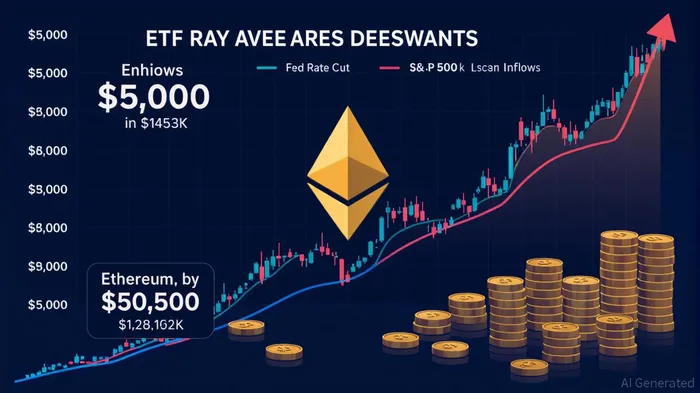
Ethereum's 2025 price trajectory has been nothing short of transformative, driven by a perfect storm of institutional adoption and macroeconomic tailwinds. As we approach the end of the year, the interplay between these forces is creating a compelling case for EthereumETH-- to break through critical resistance levels and potentially reach $6,400–$12,000 by December 2025.
Institutional Adoption: The New Gold Standard
Ethereum's institutional adoption has reached unprecedented levels, with spot Ethereum ETFs recording $533.87 million in net inflows on July 22, 2025 alone[1]. BlackRock's ETHA led this surge, attracting $426.22 million in a single day, pushing total ETF assets to $19.85 billion—4.44% of Ethereum's total market cap[1]. This trend is not isolated to ETFs: corporate treasuries are now treating Ethereum as a strategic reserve asset. SharpLink GamingSBET--, chaired by Ethereum co-founder Joseph Lubin, has become the largest corporate holder, acquiring 79,949 ETH in a recent period and now holding 360,807 ETH (valued at $1.33 billion) to generate staking yields[1]. TeslaTSLA-- and MicroStrategy have also joined the fray, signaling a shift toward Ethereum as a core treasury asset[4].
Technological upgrades are amplifying this adoption. The Dencun upgrade reduced Layer-2 fees by 10–100x, enabling cheaper data availability and unlocking $13 billion in tokenized real-world assets (RWAs)[3]. Meanwhile, Ethereum's dominance in DeFi—$79.15 billion in TVL and a 59.25% market share as of August 2025—further cements its role as the backbone of programmable finance[5].
Macroeconomic Catalysts: Fed Policy and Inflation Dynamics
The Federal Reserve's dovish pivot is a game-changer. The September 17, 2025 rate cut (25 bps) has already triggered a 15% surge in Ethereum following dovish remarks from Fed Chair Jerome Powell[4]. With the Fed expected to cut rates further by year-end, the opportunity cost of holding non-yielding assets like BitcoinBTC-- and Ethereum is declining, making them more attractive to institutional investors seeking inflation hedges[3].
Ethereum's beta of 4.7—significantly higher than Bitcoin's 2.8—positions it as a more macro-sensitive asset[1]. This is evident in its strong correlation with the S&P 500 (0.77), reflecting its integration into traditional financial markets[1]. Regulatory clarity, such as the GENIUS Act in July 2025, has further normalized Ethereum as a macroeconomic hedge, unlocking $27.6 billion in ETFs by August[1].
Price Volatility and Structural Strengths
While Ethereum's price has experienced volatility—a 10% drop in early September due to ETF outflows and geopolitical tensions—its structural advantages remain intact[2]. The deflationary supply model, driven by EIP-1559 and reduced ETH availability on exchanges, has shrunk the circulating supply on centralized exchanges to 16.2% of total supply (down from 25% in 2023), creating a supply-demand imbalance that amplifies price swings[2].
However, Ethereum's staking yields (4.5–5.2% annually) and upcoming Pectra upgrade (enhancing scalability and security) are attracting institutional capital[3]. The potential approval of staking-enabled ETFs by late 2025 could further catalyze adoption, as yield incentives attract capital[1].
Future Outlook: A Bullish Case for Year-End 2025
The convergence of institutional adoption and macroeconomic tailwinds paints a bullish picture. Ethereum's price is projected to break above $6,400 by October 2025, with a potential surge to $12,000 if macroeconomic conditions align[1]. Key drivers include:
- Continued ETF inflows: Ethereum ETFs outperformed Bitcoin ETFs in Q3, with $281 million in inflows for Ethereum versus $129 million outflows for Bitcoin[5].
- Regulatory clarity: The U.S. SEC's informal commodity classification under the CLARITY Act has normalized Ethereum as a macroeconomic hedge[1].
- Global adoption: Ethereum-based stablecoins and tokenized assets are gaining traction in countries with unstable fiat currencies, such as Argentina and Nigeria[4].
Risks and Considerations
While the case for Ethereum is strong, risks remain. Macroeconomic headwinds—such as delayed Fed rate cuts or a trade war—could trigger a pullback. Additionally, regulatory scrutiny of staking derivatives and tokenized assets may introduce friction[2]. However, Ethereum's structural strengths—deflationary supply, technological upgrades, and institutional validation—position it to outperform in a risk-on environment.
Conclusion
Ethereum is at a critical juncture in 2025. The combination of institutional adoption, macroeconomic tailwinds, and technological innovation creates a compelling case for a year-end price target of $6,400–$12,000. As the Fed's dovish pivot and regulatory clarity continue to unfold, Ethereum's role as a cornerstone of the digital economy—and a hedge against inflation—will only strengthen. For investors, the message is clear: Ethereum is not just a crypto asset—it's a macroeconomic inevitability.







Comentarios
Aún no hay comentarios