
Ethereum's Potential as the DeFi Infrastructure Leader: A “Google Moment” Analogy and Its Implications for Institutional Adoption and Token Value Capture
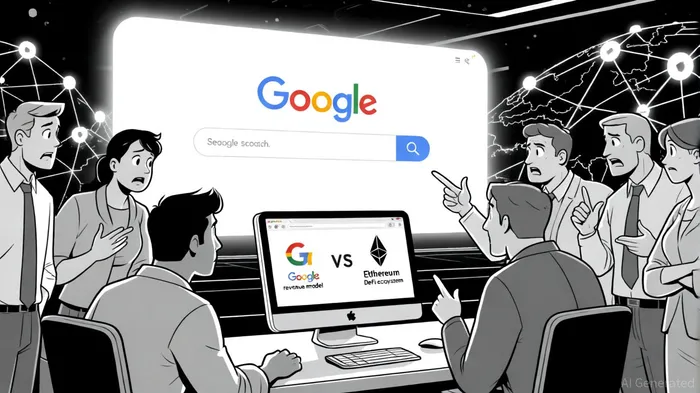
Ethereum's evolution in 2025 has positioned it as a potential cornerstone of decentralized finance (DeFi), with its infrastructure increasingly resembling a “Google Moment”—a foundational, low-risk revenue engine that aligns with the platform's core values of decentralization and innovation. This analogy, popularized by EthereumETH-- co-founder Vitalik Buterin, draws parallels between Google's dominance in search and advertising and Ethereum's growing role in powering secure, permissionless financial tools[2]. Unlike speculative DeFi experiments such as NFTs or memecoins, low-risk DeFi—encompassing payments, savings, and collateralized lending—offers real-world utility and stability, making it a compelling long-term value proposition[2].
Institutional Adoption: Ethereum as the “Settlement Layer” of DeFi
Institutional investors have increasingly embraced Ethereum as a trusted settlement layer, driven by its battle-tested security and regulatory compatibility. According to a report by The Currency Analytics, Ethereum ETF approvals in 2025 catalyzed $12 billion in institutional inflows during Q2 alone, with over $5.41 billion flowing into Ethereum ETFs in July 2025[1]. This surge has made ETHETH-- a preferred asset over BitcoinBTC-- in several metrics, including the ETH/BTC ratio, which reached a 2025 high[1].
Major financial institutions, such as Standard Chartered, now treat Ethereum as a digital treasury asset, with the bank holding roughly 10% of all ETH locked in institutional treasuries[1]. This institutional preference is notNOT-- merely speculative but rooted in Ethereum's ability to provide reliable, auditable infrastructure for large-scale transactions. As stated by CoinDesk, Ethereum's security and compliance advantages make it an ideal platform for institutional DeFi, even if it means paying higher fees for large trades[3].
Low-Risk DeFi: A Sustainable Revenue Engine
The “Google Moment” analogy gains traction when examining Ethereum's shift toward low-risk DeFi. Unlike the volatile yield farming and speculative lending models of 2020–2021, today's DeFi protocols prioritize stability and real-world utility. Platforms like AaveAAVE-- and MakerMKR-- offer competitive rates on stablecoins, enabling users to earn yields on USD-pegged assets while minimizing exposure to crypto volatility[2].
This shift is critical for Ethereum's long-term viability. As Buterin noted, low-risk DeFi aligns economic incentives with Ethereum's mission by enabling global, permissionless access to financial services while reinforcing ETH's role as collateral[3]. For instance, the total value locked (TVL) in Ethereum's DeFi ecosystem stands at $91 billion in 2025, despite ETH hitting record price highs[3]. This divergence suggests that institutional inflows and macro positioning are driving ETH's price, while retail DeFi activity remains subdued—a trend that could normalize as low-risk DeFi matures[3].
Technological Upgrades and Scalability
Ethereum's transition to proof-of-stake (PoS) and the implementation of layer-2 solutions like ArbitrumARB-- and Optimism have addressed key scalability challenges. These upgrades reduced gas fees and increased transaction speeds, enabling real-world applications such as micropayments and gaming economies[3]. However, layer-2 solutions sometimes create isolated ecosystems that compromise Ethereum's original principles of composability and interoperability[1].
Despite these challenges, Ethereum's composability remains a unique advantage. Users can seamlessly integrate DeFi applications—such as swapping tokens on UniswapUNI-- and lending them on Aave—within a single transaction[6]. This interoperability, combined with Ethereum's growing TVL ($200 billion as of 2025[3]), positions it as a robust infrastructure for advanced financial tools like undercollateralized lending and prediction markets[3].
Token Value Capture and Future Implications
Ethereum's token value capture is increasingly tied to its role in DeFi. The Shanghai upgrade in 2023 enabled flexible staking and unstaking of ETH, reshaping its distribution and usage patterns[2]. Meanwhile, Ethereum's security has improved significantly, with better audit frameworks and bug bounty programs reducing vulnerabilities[6]. These factors, coupled with institutional adoption, have made ETH a critical asset in global decentralized finance.
Looking ahead, Ethereum's “Google Moment” could redefine its role in the financial ecosystem. As traditional finance faces instability in certain regions, DeFi's transparent, automated systems are gaining traction[3]. This shift is not without risks—high fees and fragmented liquidity persist—but Ethereum's institutional backing and technological resilience suggest it is well-positioned to dominate DeFi infrastructure in the long term[1].
Conclusion
Ethereum's “Google Moment” is not a metaphor but a strategic shift toward sustainable, low-risk DeFi. By aligning with institutional demand for security and real-world utility, Ethereum is evolving into a foundational layer for global digital finance. While challenges like scalability and fragmentation remain, the platform's technological upgrades and composability provide a strong foundation for long-term growth. For investors, Ethereum's role in DeFi infrastructure—and its ability to capture value through token economics—positions it as a key asset in the next phase of crypto adoption.






Comentarios
Aún no hay comentarios