

Ethereum's Post-Upgrade Momentum: Network Efficiency and Institutional Adoption Drive Growth in 2025
Network Efficiency: A New Baseline for Scalability
The Dencun upgrade introduced EIP-4844 (Proto-Danksharding), which revolutionized Ethereum's data handling by enabling "blob" transactions. These blobs temporarily store data for layer-2 (L2) rollups, drastically reducing the burden on node storage and slashing costs. By early 2025, major rollups like StarkNetSTRK-- and OptimismOP-- reported over 90% reductions in data posting fees, with average transaction fees on Ethereum's mainnet dropping to as low as $0.39. Layer-2 solutions, now processing 58.5% of total Ethereum transactions, further amplified this efficiency, with platforms like ArbitrumARB-- and Base handling billions of transactions annually according to CoinLaw statistics.
Energy consumption metrics also underscore Ethereum's sustainability gains. Post-Merge, the network's energy use plummeted by 99.95%, with annual electricity consumption now at ~0.0026 TWh/year-a stark contrast to its proof-of-work (PoW) era, which consumed ~21 TWh/year according to SQ Magazine. Per-transaction energy use has fallen from 84,000 Wh (84 kWh) under PoW to 20–35 Wh (0.02–0.03 kWh) under proof-of-stake (PoS) according to Oak Research. This shift has not only aligned Ethereum with global environmental standards but also made it a viable platform for large-scale enterprise adoption.
Institutional Adoption: From Yield to Infrastructure
Institutional interest in Ethereum has surged post-Dencun, driven by 3–4% annual staking yields and the legitimization of Ethereum as a yield-generating asset. Over 35.7 million ETH (~29.8% of the total supply) is now staked, reinforcing network security while offering institutions a reliable income stream. This trend is mirrored in corporate treasuries, where companies like BitMine Immersion Technologies and SharpLink Gaming have allocated significant portions of their holdings to Ethereum. SharpLink, for instance, stakes 95% of its ETH to optimize treasury yields. 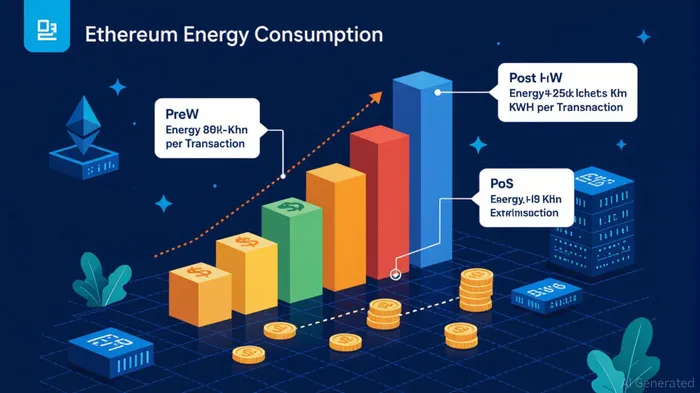
Regulatory milestones have further accelerated adoption. The approval of spot-ETH ETFs in the U.S. in 2025 marked a watershed moment, with these funds collectively holding over 5% of the total ETH supply by mid-2025. This institutional validation has been complemented by Ethereum's expanding DeFi ecosystem, which now supports $166 billion in TVL and $45 billion in L2 TVL according to Dropstab research. Protocols like Uniswap and Aave have driven this growth, with UniswapUNI-- reporting $2.1 billion in daily trading volume.
Infrastructure developments in Q3 2025 also highlight Ethereum's institutional appeal. Daily transaction volumes surged to 1.74 million in August 2025, with L2 networks handling the majority of activity according to Oak Research. Meanwhile, 14 listed companies disclosed Ethereum holdings totaling 4.36 million ETH, leveraging staking and restaking strategies to generate returns. These moves reflect a broader shift: Ethereum is no longer viewed solely as a speculative asset but as a productive infrastructure layer for institutional-grade financial tools.
Risks and the Road Ahead
Despite its momentum, Ethereum faces challenges. Regulatory shifts, DeFi exploits, and macroeconomic volatility remain risks for institutional investors. However, upcoming upgrades like Fusaka and the next Dencun iteration in early 2026 are expected to address these concerns by further enhancing scalability and cost predictability according to BitGet analysis.
Conclusion
Ethereum's post-upgrade trajectory in 2025 underscores its dual role as a highly efficient blockchain and a trusted institutional asset. With network costs at historic lows, energy consumption aligned with global sustainability goals, and institutional capital flowing into staking and DeFi, Ethereum is well-positioned to dominate the next phase of blockchain innovation. For investors, the combination of technical progress and institutional adoption offers a compelling case for long-term exposure to the Ethereum ecosystem.






Comentarios
Aún no hay comentarios