
Ethereum’s Post-Merge Evolution and the Path to Scalability: A Long-Term Investment Thesis
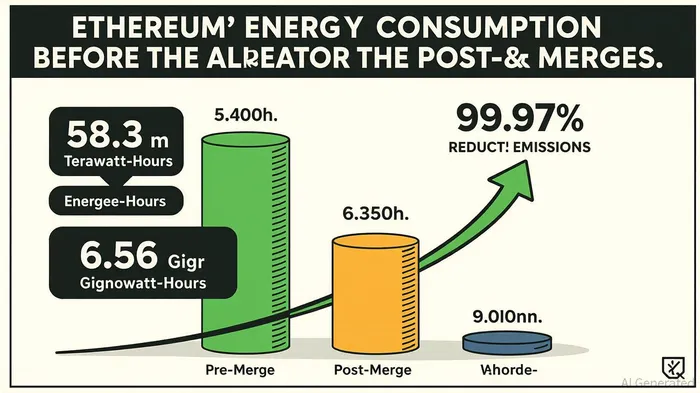
The EthereumETH-- blockchain’s transition to a proof-of-stake (PoS) consensus mechanism in September 2022—dubbed The Merge—marked a watershed moment in the cryptocurrency industry. By eliminating energy-intensive proof-of-work (PoW) mining, Ethereum reduced its annual electricity consumption by over 99%, from 58.3 terawatt-hours to a mere 6.56 gigawatt-hours [2]. This shift not only addressed longstanding environmental criticisms but also repositioned Ethereum as a scalable, sustainable infrastructure for decentralized finance (DeFi) and real-world asset (RWA) tokenization. For long-term investors, the post-Merge Ethereum represents a unique confluence of technological innovation, institutional adoption, and environmental responsibility.
Energy Efficiency and Sustainability: A New Baseline
The Merge’s impact on Ethereum’s energy footprint is unprecedented. According to the Cambridge Centre for Alternative Finance (CCAF), the network’s greenhouse gas emissions dropped by 99.97% post-Merge, even as validator and node counts increased by 57% and 23.2%, respectively [3]. This efficiency gain stems from the PoS model, which replaces computational mining with token staking, requiring validators to lock up Ether (ETH) as collateral rather than expend energy on cryptographic puzzles.
Critically, Ethereum’s energy mix has also evolved. While 52% of its post-Merge energy still comes from fossil fuels, the network now sources 48% from sustainable energy—including 32% renewables and 16% nuclear—outpacing Bitcoin’s estimated 35% renewable energy usage [3]. This trend is likely to accelerate as institutional staking pools and ESG-focused investors prioritize green energy for validator operations. For investors, Ethereum’s decoupling of security from energy waste aligns with global regulatory and market demands for sustainable finance.
Economic Model Reinvention: Scarcity and Yield
The Merge was not merely an environmental upgrade but a fundamental reengineering of Ethereum’s economic model. The introduction of EIP-1559 in 2021, which burns a portion of transaction fees, created a deflationary mechanism that reduces ETH supply over time. Combined with PoS staking yields, this has transformed ETH into a scarce, yield-bearing asset. As of Q3 2025, institutional inflows into Ethereum-focused ETFs have outpaced Bitcoin’s, driven by demand for assets that offer both capital appreciation and passive income [1].
This dual appeal is further amplified by Ethereum’s role as the dominant smart contract platform. Over 3,000 decentralized applications (dApps) now operate on Ethereum, underpinning a $24 billion RWA tokenization market by June 2025 [4]. Tokenizing real-world assets—from real estate to corporate bonds—enables fractional ownership and 24/7 trading, attracting institutional capital seeking diversification and liquidity. For investors, Ethereum’s network effects and first-mover advantage in DeFi and RWA position it as a foundational infrastructure asset, akin to cloud computing in the early 2000s.
Scalability: The Dencun and Verge Upgrades
While the Merge addressed energy efficiency, Ethereum’s scalability remains a focus. The Dencun and Verge upgrades, implemented in 2024 and 2025, introduced innovations like proto-danksharding and verkle trees, reducing gas fees by 90% and enabling 100,000 transactions per second [2]. These upgrades, coupled with Layer 2 rollups (e.g., Arbitrum, Optimism), have made Ethereum the most energy-efficient blockchain for high-throughput applications.
For long-term investors, scalability is a critical factor. A network that can process transactions at near-zero cost while maintaining security and decentralization is essential for mass adoption. Ethereum’s roadmap—targeting 1 million transactions per second by 2030—suggests a trajectory toward becoming the “operating system” for global finance, further solidifying its value proposition.
Risks and Considerations
Despite its progress, Ethereum faces challenges. While its energy efficiency is unmatched, the network still relies on 52% fossil fuels, a metric that lags behind niche green blockchains like AlgorandALGO-- or CardanoADA--. Additionally, competition from Layer 1 alternatives (e.g., SolanaSOL--, Avalanche) and regulatory scrutiny in jurisdictions like the EU could impact adoption. However, Ethereum’s entrenched developer community, $24 billion RWA market, and first-mover advantage in DeFi create a formidable moat.
Conclusion: A Decentralized Future, Built on Efficiency
For investors with a 5–10 year horizon, Ethereum’s post-Merge evolution represents a rare alignment of technological, economic, and environmental progress. Its transition to PoS has not only resolved energy concerns but also unlocked new value propositions—deflationary supply, institutional-grade infrastructure, and scalable utility. As the world moves toward regulated, sustainable digital finance, Ethereum’s role as a foundational asset is likely to grow.
In a market increasingly defined by ESG criteria and institutional participation, Ethereum’s post-Merge trajectory offers a compelling case for long-term investment. The question is not whether Ethereum will dominate—it already does—but how much further it can scale while maintaining its decentralized ethos.
**Source:[1] Ethereum Is Outperforming BitcoinBTC-- in 2025 [https://yellow.com/research/why-ethereum-is-outperforming-bitcoin-in-2025-key-drivers-and-future-outlook][2] On-Chain Data and Sentiment Converge as Altcoin... [https://www.bitget.com/news/detail/12560604940263][3] Ethereum Validator and Node Growth Leads to Emissions... [https://blockworks.co/news/post-merge-ethereum-climate-impact][4] Real-World Assets in Onchain Finance Report [https://blog.redstone.finance/2025/06/26/real-world-assets-in-onchain-finance-report/]






Comentarios
Aún no hay comentarios