
Ethereum's Post-Crash Recovery and Path to $4,500: Technical Resilience and Institutional Adoption
Ethereum's journey in 2025 has been one of resilience. After a tumultuous year marked by sharp price corrections and macroeconomic headwinds, the network's technical upgrades and institutional adoption trends are now aligning to create a compelling case for recovery. With EthereumETH-- trading near $4,379 as of October 2025, the path to $4,500-and beyond-hinges on two pillars: technical resilience through post-Dencun and Fusaka upgrades, and institutional adoption driven by scalable infrastructure and real-world use cases.
Technical Resilience: From Dencun to Fusaka
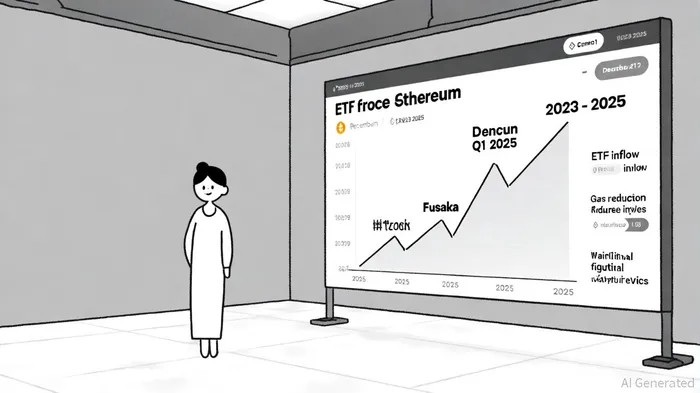
Ethereum's post-Dencun (March 2024) and Fusaka (December 2025) upgrades have fundamentally reshaped its scalability and cost structure. The Dencun upgrade introduced proto-danksharding (EIP-4844), which reduced Layer-2 (L2) transaction fees by up to 99% through the use of "blobs" for temporary data storage, according to a Markets analysis. This innovation notNOT-- only slashed costs for users but also enabled L2s like Base and ArbitrumARB-- to process transactions at near-zero fees, attracting a surge in decentralized finance (DeFi) and tokenized asset activity, as noted in a Kenson report.
The Fusaka upgrade, set for December 3, 2025, builds on this foundation. Key components like PeerDAS (EIP-7594) reduce bandwidth and storage demands for validator nodes by enabling peer-to-peer data availability sampling, according to a Crypto.com guide. Additionally, the gas limit increase from 30 million to 150 million units allows for more transactions per block, directly enhancing throughput without compromising security, as discussed in a Cryptoexchangers article. These upgrades are part of Ethereum's long-term roadmap to achieve modular scalability, where rollups handle execution while the base layer ensures data availability, as explained in an Axon analysis.
Institutional Adoption: ETFs, Tokenization, and Enterprise Partnerships
The Dencun upgrade's efficiency gains have made Ethereum the preferred infrastructure for institutional-grade applications. The launch of U.S. spot Ethereum ETFs in early 2025 catalyzed a wave of inflows, with total holdings reaching 6.7 million ETH-nearly doubling since Ethereum's price surpassed $4,000, according to a Markets report. These ETFs have also reduced exchange-held ETHETH-- supplies, tightening the market and supporting price stability, as noted in an Incrypthos insight.
Institutional interest is further amplified by Ethereum's role in tokenized real-world assets (RWAs). Platforms like Base and OptimismOP-- now host over $1.2 billion in tokenized treasuries and private credit instruments, leveraging Ethereum's security and L2 cost efficiencies, as highlighted in Crypto.com research. For example, tokenized U.S. Treasury bonds issued on Ethereum have attracted institutional investors seeking yield in a low-interest-rate environment, as reported in a Chainup blog.
Enterprise partnerships are also expanding. Major corporations, including those in logistics and supply chain, are adopting Ethereum-based solutions for cross-border payments and asset tokenization, citing the network's interoperability and regulatory clarity, as noted in Axon's "Ethereum in 2025: Network, Usage, and Upgrades."
Price Recovery: Technical Indicators and Institutional Confidence
Despite mid-2025's volatility-where Ethereum fell to $3,400 amid ETF outflows and geopolitical tensions-technical indicators suggest a potential rebound. Derivatives data, including negative funding rates and a rising taker buy ratio, points to a short squeeze scenario, according to a BeInCrypto analysis. If key support levels like $3,430 hold, Ethereum could reclaim $4,280, with $4,500 as a near-term target, per Currency Analytics.
Historical backtesting of Ethereum's price behavior around support levels reveals mixed signals. Between 2022 and 2025, Ethereum's price touched or breached its 200-day SMA 687 times. Over a 30-day window, average excess returns were modest (~0.2-3.2%) and statistically insignificant, with a win rate hovering near 50%, as BeInCrypto reported. This suggests the 200-day SMA acted as a weak support rather than a reliably bullish trigger during this period. Investors should therefore treat such levels as probabilistic rather than deterministic signals.
Institutional confidence is a critical tailwind. BlackRock's $148.8 million inflow into its Ethereum Trust in mid-2025, alongside whale purchases totaling $230 million, signals long-term belief in Ethereum's fundamentals, according to Shine Magazine. Meanwhile, Ethereum's deflationary mechanisms-burning 0.5% of its supply annually-add scarcity value, further supported by increased staking activity and corporate treasury strategies, as detailed in a Gate analysis.
The Road Ahead: $4,500 and Beyond
Ethereum's path to $4,500 is not without risks. Geopolitical tensions and interest rate uncertainty could reintroduce volatility. However, the network's technical upgrades and institutional adoption trends are creating a flywheel effect: improved scalability attracts more dApps and users, which in turn draws institutional capital, reinforcing price resilience.
By December 2025, the Fusaka upgrade's full implementation will likely unlock even greater throughput, potentially reducing L2 fees further and enabling mass adoption of tokenized assets. If Ethereum's price stabilizes above $4,000, the next phase of growth-driven by ETF inflows and macroeconomic tailwinds-could see it breach $5,000 by year-end, as the Markets analysis argued.
Conclusion
Ethereum's post-crash recovery is a testament to its technical ingenuity and institutional appeal. The Dencun and Fusaka upgrades have laid the groundwork for a scalable, efficient network, while ETFs and tokenized assets are anchoring its value proposition in the real economy. For investors, the combination of these factors presents a compelling case: Ethereum is not just a speculative asset but a foundational infrastructure for the next era of digital finance.






Comentarios
Aún no hay comentarios