
Ethereum's Post-Crash Attraction: A Whale-Driven Buying Opportunity?
Ethereum's 2025 crash-triggered by leveraged liquidations, ETF outflows, and macroeconomic headwinds-left the market reeling. Yet, amid the turmoil, a compelling narrative emerged: whale-driven accumulation and institutional reallocation hinted at a potential buying opportunity. This analysis unpacks the on-chain and institutional signals shaping Ethereum's post-crash trajectory.
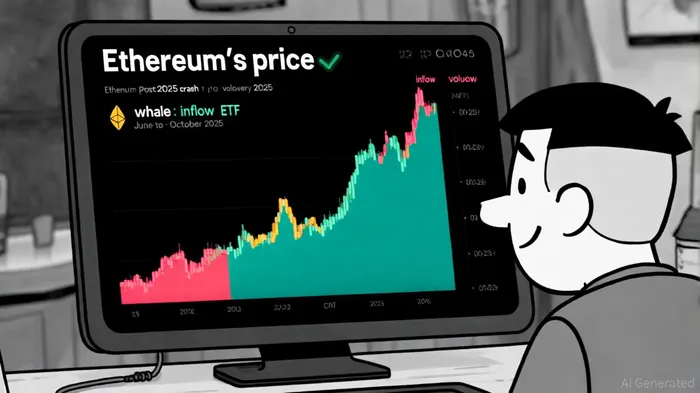
Whale Accumulation: A 2017-Level Buying Frenzy
Post-crash, Ethereum's whale activity mirrored the aggressive accumulation seen during the 2017 bull run. In June 2025, wallets holding 1,000–10,000 ETHETH-- added over 871,000 ETH in a single day-a record inflow since 2017, according to a Gate analysis. Over the following week, these whales pushed their total holdings above 14.3 million ETH, signaling confidence in Ethereum's long-term value.
Notably, a $67.6 million deposit of 20,000 ETH into Kraken in early 2025 underscored strategic positioning by large holders, according to The Currency Analytics. By August, EthereumETH-- whales had collectively accumulated $279.5 million in ETH, with analysts framing these moves as portfolio adjustments rather than bearish signals, per an InvestingCube analysis. This accumulation persisted even as the price dipped below $4,000 in September, with whales injecting $1.6 billion to stabilize the market.
Institutional Sentiment: ETFs and the Great Rebalancing
The approval of spot Ethereum ETFs in late June 2025 catalyzed a $468 million net inflow in a single week, normalizing crypto as a mainstream asset class. Firms like Bit Digital exemplified this shift, reducing BitcoinBTC-- holdings while increasing Ethereum by 100,000 ETH, betting on its smart contract and DeFi dominance.
However, September brought volatility. Ethereum ETFs faced $787.6 million in outflows, as institutions rotated capital into Bitcoin ETFs amid staking restrictions and risk-off sentiment, according to a DeFiDonkey analysis. Despite this, Ethereum's institutional appeal remained robust: its $528.61 billion market cap as of September 2025 reflected resilience, with 26% of ETF assets under management (AuM) allocated to Ethereum.
Macroeconomic and Regulatory Tailwinds
The Federal Reserve's pivot toward accommodative policy and a weakening dollar index bolstered liquidity in crypto markets. Meanwhile, regulatory clarity-such as the SEC's 2025 ruling that protocol staking is not a security-removed a major hurdle for institutional adoption. The GENIUS Act, which established a federal framework for stablecoins, further solidified Ethereum's role in tokenized finance.
Technologically, Ethereum's Dencun upgrade (EIP-4844) slashed rollup costs, enhancing scalability and attracting institutional-grade applications. On-chain metrics, including a nine-year low in exchange-held ETH and a $270 billion DeFi Total Value Locked (TVL) in July 2025, reinforced its utility.
Risks and the Road Ahead
While whale accumulation and institutional interest paint a bullish picture, risks persist. ETF outflows in September highlighted sensitivity to macroeconomic shifts, such as inflation data and Fed policy. Additionally, Bitcoin's dominance spike to 61% in April 2025 raised questions about Ethereum's market share, as noted by Currency Analytics.
Analysts remain cautiously optimistic. Fundstrat's Tom Lee projected Ethereum could reach $10,000 by late 2025 if ETF inflows resume and inflation cools. However, a bearish scenario-triggered by Fed tightening or regulatory setbacks-could see prices test the $3,900 support level.
Conclusion: A Whale-Driven Narrative with Institutional Legs
Ethereum's post-crash recovery is anchored by strategic whale accumulation and institutional reallocation, bolstered by regulatory progress and technical upgrades. While short-term volatility is inevitable, the alignment of on-chain strength, ETF momentum, and macroeconomic tailwinds suggests Ethereum is far from a dead cat. For investors, the question isn't whether Ethereum can rebound-it's how much further it might go.






Comentarios
Aún no hay comentarios