
Ethereum's Path to Sustained Value: Decentralization, Resilience, and the Walkaway Test
Ethereum's journey toward becoming a sustainable, long-term investment hinges on its ability to balance decentralization, network resilience, and user retention. As the blockchain ecosystem evolves, Ethereum's post-Merge transition to Proof-of-Stake (PoS) and subsequent upgrades have reshaped its infrastructure, but the true test of its value lies in its capacity to maintain decentralization while fostering user stickiness. This analysis evaluates Ethereum's progress through three lenses: its decentralized architecture, its resilience to technical and economic challenges, and its performance on the "Walkaway Test"-a metric for assessing user retention in Web3 ecosystems.
Decentralization: A Foundation for Trust
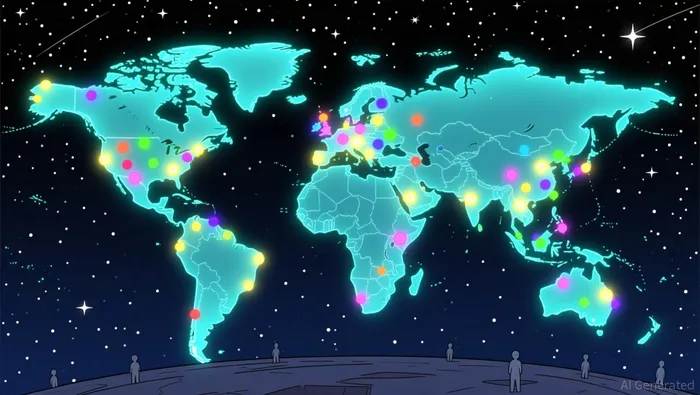
Ethereum's post-Merge decentralization metrics reveal a network increasingly resistant to centralization risks. By mid-2025, the number of active validators had grown to over 1.2 million across 80 countries, significantly enhancing geographic diversity and reducing regional vulnerabilities. The Pectra upgrade introduced validator consolidation, allowing a single validator to manage up to 2,048 ETH, which streamlined operations while maintaining security. This innovation reduced the number of validators but improved efficiency, ensuring that smaller stakers could still participate meaningfully.
Distributed Validator Technology (DVT) further strengthened decentralization by enabling shared validator responsibilities among multiple parties in a trust-minimized framework according to research. Protocols like Rocket PoolRPL-- and Obol Network empowered solo and community stakers to pool resources without sacrificing control, countering the dominance of centralized staking services like Lido and CoinbaseCOIN--. However, challenges persist: major staking platforms still control a significant portion of the network, and Vitalik Buterin has warned against complacency in maintaining Ethereum's decentralized ethos.
Client diversity remains a critical factor. A 2024 arXiv study proposed a framework using verifiable computation and economic incentives to reward minority clients, ensuring no single implementation dominates the network. This approach mitigates the risks of a "monoculture" and reinforces Ethereum's resilience against targeted attacks.
Network Resilience: Upgrades and Institutional Adoption
Ethereum's resilience in 2025 was underscored by transformative protocol upgrades and institutional adoption. The Pectra (Q1) and Fusaka (Q4) upgrades introduced EIP-7251, increasing the maximum effective validator balance to 2,048 ETH, and PeerDAS, which boosted rollup data capacity by 8x. These upgrades reduced network load and improved consensus efficiency, while EIP-7002 automated validator management, minimizing manual intervention.
User experience also saw significant improvements. EIP-7702 enabled universal smart accounts, bridging the gap between standard and smart wallets, and passkeys replaced seed phrases, reducing private key risks. Institutionally, Ethereum's adoption reached new heights, with JP Morgan and Visa deploying live products for stablecoin settlement and tokenized assets. Corporate ETH treasuries became common, treating ETH as a high-yield working capital instrument.
Despite these strides, EthereumETH-- faces balancing acts. Buterin emphasized the need to harmonize usability with decentralization, warning against short-term narratives that prioritize speed over security. Price volatility remains a hurdle, with ETH underperforming relative to network improvements and ETF flows remaining negative.
The Walkaway Test: User Retention and Network Stickiness
Ethereum's user retention metrics highlight both progress and challenges. The "Walkaway Test" evaluates whether users continue engaging with a platform after initial interaction. Data from 2023-2025 shows a decline in Ethereum's 6-month retention rate, dropping from 10.21% in January 2022 to 3.55% in May 2025. This trend contrasts with Solana's high activation rates but low retention, where many users abandon the network after a single transaction.
Ethereum's stickiness ratio-daily active users (DAU) as a proportion of monthly active users (MAU)-improved in May 2023, indicating growing engagement. However, Web3 ecosystems inherently lack the stickiness of Web2 platforms due to the fluidity of capital movement according to analysis. To counter this, Ethereum has adopted strategies like token gating, loyalty NFTs, and tiered reward systems to incentivize long-term participation as research shows.
Cardano's staking model offers a contrasting approach. With 67.3% of ADA staked across 3,200 pools, its decentralized governance and predictable staking yields (3.2–4.1%) foster retention. SolanaSOL--, meanwhile, leverages low fees ($0.00025) and high throughput (65,000 TPS) to attract developers and users, though its "once and done" user base remains a liability.
Comparative Analysis: Ethereum vs. Solana and Cardano
Ethereum's position as a foundational layer for DeFi and real-world assets is unmatched, but it lags behind Solana in transaction speed and CardanoADA-- in staking participation. Solana's 65,000 TPS and $1.6 billion TVL make it a formidable competitor for high-frequency applications, while Cardano's academic rigor and 99.98% uptime roadmap appeal to risk-averse users according to projections.
Ethereum's strength lies in its ecosystem maturity and institutional adoption. Its Layer 2 solutions (e.g., ArbitrumARB--, Starknet) address scalability, and the Fusaka upgrade's PeerDAS protocol positions it to handle growing rollup demand. However, Solana's developer-first approach and Cardano's governance model challenge Ethereum's dominance in specific niches.
Conclusion: A Path Forward
Ethereum's long-term investment potential depends on its ability to sustain decentralization while improving user retention. The Pectra and Fusaka upgrades, combined with growing institutional adoption, signal a resilient network capable of adapting to evolving demands. However, the Walkaway Test reveals vulnerabilities in user stickiness, necessitating innovative strategies like token-based incentives and improved onboarding.
For investors, Ethereum's value proposition remains compelling. Its commitment to decentralization, coupled with institutional adoption and technical upgrades, positions it as a cornerstone of the blockchain ecosystem. Yet, the road to sustained value requires vigilance against centralization risks and a focus on fostering deeper user engagement. As Buterin noted, Ethereum must become a "world computer" that operates independently of individual maintainers-a vision that aligns with its long-term potential.





Comentarios
Aún no hay comentarios