
Ethereum's Path to Sustainable Recovery: Analyzing Accumulation Trends and Derivatives Activity
Ethereum's 2025 resurgence has been nothing short of seismic. From record-breaking ETF inflows to unprecedented derivatives activity, the market structure of the second-largest cryptocurrency is undergoing a transformation that signals both institutional confidence and speculative fervor. This analysis unpacks the interplay between accumulation trends and derivatives-driven sentiment, offering a roadmap for Ethereum's path to sustainable recovery.
Accumulation Trends: Institutional Capital and Whale Dynamics
The cornerstone of Ethereum's 2025 rally lies in its institutional adoption. According to a report by The Currency Analytics, EthereumETH-- ETFs launched by BlackRockBLK--, Fidelity, and Grayscale have attracted $12 billion in Q2 2025 alone, with total assets under management (AUM) surpassing $13.5 billion by mid-July[1]. These inflows have not only bolstered liquidity but also reduced circulating supply through staking and cold storage. For instance, over $1 billion in ETHETH-- was moved to cold storage in Q3 2025, while 170 new wallets now hold over 10,000 ETH each[4].
Whale activity further reinforces this narrative. A single whale transferred 73,000 ETH ($306 million) to Binance in Q3 2025, signaling strategic accumulation amid bullish sentiment[3]. Meanwhile, institutional staking has surged, with 8.3% of Ethereum's total supply now staked—up from 6.1% in early 2025[2]. This shift from circulating supply to locked supply creates upward price pressure, as fewer ETH units are available for trading.
Derivatives Market Dynamics: Volume, Open Interest, and Leverage Risks
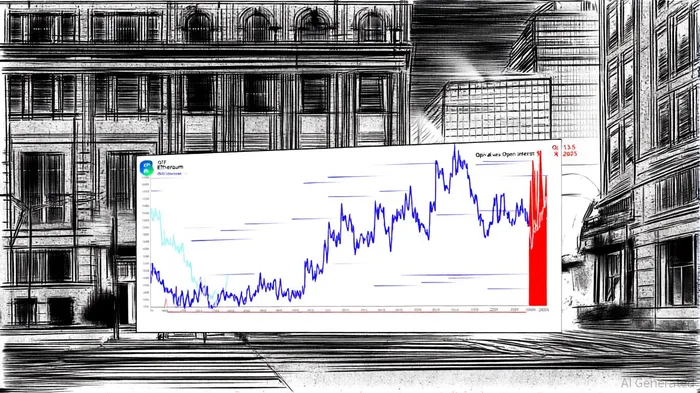
Ethereum's derivatives market has exploded in 2025, reflecting both institutional hedging and retail speculation. On the CME, Ethereum futures volume hit $118 billion in July 2025, while Binance reported a staggering $4 trillion in ETH futures volume for the same period[1]. Open interest for Ethereum futures reached $52.14 billion in August 2025, with Binance alone accounting for $10 billion[3].
However, this growth comes with risks. The Ethereum Leverage Ratio (ELR) climbed to 0.53 in Q3 2025, indicating that a significant portion of trades were leveraged at 50x–1000x[2]. This high leverage exposed the market to volatility: a 15% price correction in August 2025 triggered $4.7 billion in liquidations, with 83% of positions being long[1]. While derivatives activity amplifies market depth, it also introduces fragility, particularly in retail-driven segments.
Institutional Adoption and Staking: A New Ecosystem Paradigm
Ethereum's institutional adoption is not limited to ETFs. Corporations have staked 4.1 million ETH collectively, and DeFi Total Value Locked (TVL) hit $223 billion in Q3 2025[2]. Protocols like EigenLayerEIGEN-- are enabling staked ETH to support multiple services, expanding yield opportunities. Yet, this innovation introduces systemic risks—cascading liquidations or smart contract failures could destabilize the ecosystem.
The interplay between staking and derivatives is also critical. As noted by Coinotag, Ethereum's derivatives open interest ($21 billion in July 2025) aligned with ETF inflows that outpaced new ETH issuance[3]. This suggests institutions are using both spot and derivatives markets for exposure, hedging, and arbitrage. The shrinking circulating supply and rising staking yields (currently averaging 4.5% APY) further incentivize long-term holding over speculative trading[4].
Balancing Confidence and Risk: The Road Ahead
Ethereum's path to sustainable recovery hinges on balancing institutional confidence with retail risk management. While ETF inflows and whale accumulation signal long-term demand, the derivatives market's leverage-driven volatility remains a double-edged sword. A U.S. Federal Reserve rate cut could act as a catalyst, but investors must remain cautious of overleveraged positions and systemic fragility in DeFi protocols[2].
For now, Ethereum's market structure appears resilient. The correlation between ETF flows and derivatives open interest—coupled with shrinking circulating supply—points to a maturing asset class. However, as The Financial Analyst warns, “The key to Ethereum's recovery lies in managing leverage while scaling institutional adoption”[1].





Comentarios
Aún no hay comentarios