
Ethereum's Path to Dominance in 2026: Why It Will Outperform the Broader Crypto Market
Ethereum's ascent in 2026 is not merely a function of market sentiment but a direct consequence of its structural advantages and relentless innovation. As the crypto market grapples with volatility and shifting dynamics, Ethereum's post-2023 upgrades have positioned it to outperform both BitcoinBTC-- and emerging rivals like SolanaSOL--. This analysis examines the technological, economic, and institutional factors driving Ethereum's dominance, supported by data from late 2025.
Structural Upgrades: The Foundation of Scalability and Efficiency
Ethereum's 2024–2025 upgrades have been transformative. The BoLD upgrade in January 2025 decentralized ArbitrumARB-- by eliminating centralized validator whitelists, enhancing security and community participation in Layer-2 ecosystems. This was followed by the Pectra upgrade in May 2025, which improved Layer-1 efficiency and enabled higher Layer-2 throughput, including account abstraction and expanded blob throughput.
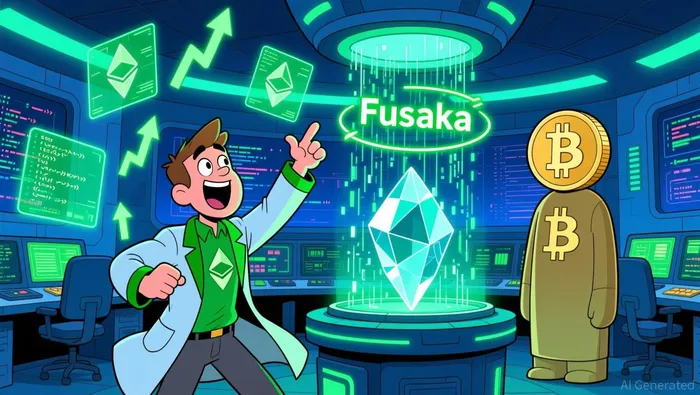
The Fusaka upgrade, activated on December 3, 2025, marked a pivotal leap. It introduced PeerDAS (EIP-7594), a data-availability sampling protocol that reduces bandwidth and storage requirements for nodes by up to 85%, enabling EthereumETH-- to handle 24 blobs per block with a roadmap targeting 128 blobs and 100,000+ TPS across Layer 2. Transaction costs on Layer 2 dropped 40–60% post-upgrade, with further reductions expected as blob limits scale. Additionally, the block gas limit was doubled to 60 million units, boosting Layer 1 throughput. These upgrades have made Ethereum's ecosystem more accessible for applications like gaming, microtransactions, and DeFi, with average fees potentially falling below one cent.
Market Performance: A 120% Surge vs. Bitcoin's Lag
Ethereum's structural improvements have translated into market outperformance. By late 2025, ETH had surged 120% over six months, reaching $4,000, while Bitcoin rose only 20%. This divergence reflects growing institutional and developer confidence in Ethereum's ability to scale. For instance, Ethereum's DeFi ecosystem maintained a total value locked of nearly $99 billion, reinforcing its role as the dominant settlement layer for stablecoins and tokenized treasuries.
The Fusaka upgrade further solidified Ethereum's position. By December 2025, Ethereum's market share in decentralized trading volume stood at 87%, driven by $1 trillion in quarterly DEX volume. Analysts project ETH could reach $7,000–$12,000 by 2026 as the benefits of reduced Layer 2 fees and increased throughput materialize.
Competitive Edge: Ethereum vs. Solana
While Solana's high throughput and low fees (e.g., $0.0011 per transaction) have attracted developers and users, Ethereum's first-mover advantage and institutional adoption remain unmatched. Solana's 2025 upgrades boosted its non-vote TPS to 1,054 and attracted 725 million new wallets. However, Ethereum's modular design and robust developer ecosystem-home to applications like UniswapUNI-- and Polymarket-provide a broader foundation for financial infrastructure.
Ethereum's PeerDAS and Blob Parameter Only (BPO) forks enable incremental scalability without hard forks, ensuring adaptability to growing demand. In contrast, Solana's hybrid PoS/PoH consensus prioritizes speed but faces challenges in decentralization and security. Ethereum's validator distribution and cautious, diversified infrastructure reinforce its resilience, while Solana's focus on real-time applications (e.g., gaming) positions it as a complementary rather than direct competitor.
Future Roadmap: Glamsterdam and Beyond
The Glamsterdam upgrade, scheduled for mid-2026, will introduce enshrined Proposer Builder Separation and Block Level Access Lists, further enhancing execution efficiency and scalability. These upgrades align with Ethereum's long-term vision of 100,000+ TPS across its Layer 2 ecosystem while preserving security and decentralization.
Institutional adoption also bolsters Ethereum's outlook. Its TVL and growing L2 infrastructure have attracted enterprises and treasuries, while Solana's ETFs launched late in Q3 2025 and face regulatory uncertainties. Ethereum's biometric transaction support (via secp256r1) and improved developer tooling (e.g., EOF and CLZ opcodes) further enhance usability for mainstream adoption.
Conclusion: A Network Built for the Long Term
Ethereum's dominance in 2026 is not accidental but the result of deliberate, iterative upgrades that address scalability, cost efficiency, and institutional trust. While Solana and others offer compelling alternatives for specific use cases, Ethereum's structural advantages-rooted in its modular design, robust DeFi ecosystem, and continuous innovation-position it to outperform the broader crypto market. As the Fusaka and upcoming Glamsterdam upgrades unlock new capabilities, Ethereum is poised to cement its role as the foundational platform for decentralized finance and enterprise blockchain applications.






Comentarios
Aún no hay comentarios