
Ethereum News Today: Vitalik Proposes Gas Futures to Stabilize Ethereum Costs, Spur Network Growth
Ethereum's on-chain activity showed signs of volatility on Tuesday, as a net outflow of 5.66k ETH was recorded from centralized exchanges over the past 24 hours. The movement suggests shifting investor sentiment, with traders withdrawing funds from CEXs at a time when broader crypto markets are beginning to show renewed interest. Market participants are also watching developments in Ethereum's ecosystem, where major upgrades and proposals are drawing attention from both developers and institutional actors.
Inflows into crypto exchange-traded products (ETPs) have recently turned positive, with over $1.7 billion flowing into the sector over the last two weeks. This trend contrasts with the sharp outflows seen earlier this year amid market turbulence, indicating a possible stabilization in investor confidence. Meanwhile, Ethereum's gas price remains near historic lows, with retail activity increasingly shifting to Layer 2 solutions like ArbitrumARB-- and Base.
Ethereum's average gas price is now around 0.468 Gwei, or about three cents, a far cry from the peak levels seen during high-traffic periods in previous years. 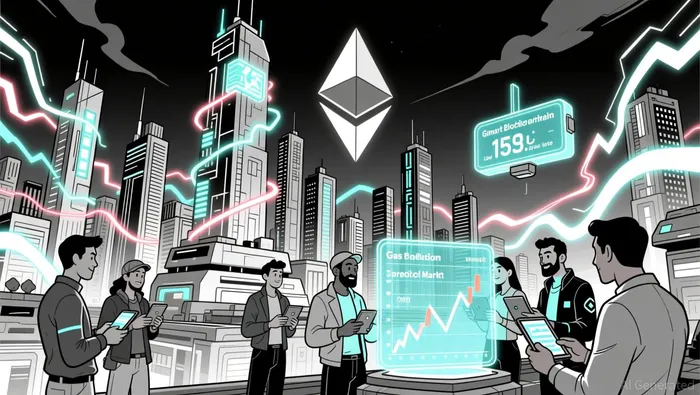 This decline has sparked renewed interest in Ethereum's network utility, even as its role as a settlement layer continues to evolve. Analysts and developers are now considering how to maintain stability and predictability in gas costs, especially as the network prepares for more complex use cases.
Vitalik Buterin Proposes Gas Futures to Stabilize Ethereum's Costs
Vitalik Buterin, Ethereum's co-founder, has proposed a new mechanism to help users anticipate and manage gas costs on the network. His idea centers around a trustless, on-chain prediction market for gas prices. By allowing participants to buy or sell gas commitments tied to future time windows, the system aims to provide a clearer signal of long-term market expectations. Buterin argues that such a market would help developers and heavy users lock in costs and plan more effectively, regardless of spot price fluctuations according to a recent proposal.
The proposal comes as Ethereum's gas price remains unusually low, with many retail users shifting activity to cheaper Layer 2 solutions. Buterin acknowledges that this stability has bred complacency, but he sees it as an opportunity to build a more resilient system. He envisions a market where users can hedge against potential gas price spikes, effectively prepaying for a specific amount of gas in a given time interval. This could help prevent sudden cost shocks during high-traffic events or market surges according to Buterin's vision.
Industry experts have generally welcomed the proposal, viewing it as a structural improvement rather than a short-term fix. A liquid market for gas exposure could allow developers to purchase gas insurance ahead of major events, while heavy users could offset future fee spikes by taking the opposite market position. Some analysts see this as a step toward treating gas as a financial asset, which aligns with Ethereum's broader evolution into a more sophisticated settlement layer according to industry analysis.
Institutional Interest and Regulatory Clarity Boost Ethereum's Outlook
Ethereum's price currently stands at $3,100, with some analysts pointing to technical indicators that suggest a potential rally to $6,800. This optimism is fueled in part by recent regulatory developments. The Commodity Futures Trading Commission (CFTC) has classified EthereumETH-- as a commodity, a move that opens the door for institutional investors like pension funds and banks to trade the asset on regulated exchanges. This classification is seen as a major step toward mainstream adoption and increased market participation according to regulatory filings.
Institutional activity in the crypto space is also showing signs of recovery. CoinbaseCOIN-- Institutional has cited improving liquidity and a shift in macroeconomic conditions as factors that could support a December rebound in crypto markets. With the odds of a Federal Reserve rate cut now priced at 93%, risk assets like BitcoinBTC-- and Ethereum could see renewed inflows. Additionally, the firm noted that a weaker U.S. dollar and a so-called AI bubble could provide further tailwinds for the sector according to Coinbase analysis.
Ethereum's recent Fulu-Osaka hard fork, launched on December 3, has also contributed to a more positive outlook. The upgrade enhanced Peer Data Availability Sampling and raised the gas limit per transaction to 30 million, improving the network's scalability. These improvements are expected to support Ethereum's role as a foundational layer for decentralized applications and cross-chain protocols according to technical analysis.
Market Outlook and Key Watchpoints for Investors
Investors are closely monitoring several factors that could influence Ethereum's near-term trajectory. The success of Buterin's gas futures proposal, if implemented, could reduce volatility in transaction costs and attract more users to the network. At the same time, institutional adoption is gaining momentum, with major players like Vanguard and Bank of America signaling openness to crypto allocations.
The broader macroeconomic environment remains a key variable. With liquidity conditions improving and the Fed poised to ease policy, risk-on sentiment is returning to the markets. Ethereum, as one of the most actively developed and adopted blockchain platforms, stands to benefit from this environment. However, investors should remain cautious, as regulatory clarity and execution of upgrades will play a critical role in determining the asset's long-term success.





Comentarios
Aún no hay comentarios