
Ethereum's Network Cooldown: A Strategic Buying Opportunity in a Maturing Ecosystem
Ethereum's post-Merge evolution has been a tale of two forces: the promise of a more energy-efficient, scalable blockchain and the persistent friction of high transaction costs and centralization risks. Yet, as the network enters a phase of relative cooldown in late 2025, a compelling case emerges for long-term investors. This cooldown-marked by stabilized gas fees, improved staking yields, and a maturing infrastructure-positions EthereumETH-- as a strategic buying opportunity for those seeking to capitalize on its foundational role in the smart contract ecosystem.
The Gas Fee Paradox: Efficiency Gains and Persistent Pain Points
Ethereum's transition to Proof of Stake (PoS) in September 2022 slashed energy consumption by 99.95%, according to a blockchain.news analysis, but it did not immediately resolve the issue of high gas fees. By 2025, however, the Dencun upgrade (March 2024) and EIP-4844 (proto-danksharding) began to reshape the landscape. According to CoinLaw data, average gas fees dropped to $0.37 in 2025, a stark contrast to the $2–$5 range observed earlier in the year. This reduction, driven by Layer 2 rollups like ArbitrumARB-- and OptimismOP--, has made Ethereum more competitive with low-fee chains like SolanaSOL-- and TronTRX--, CoinLaw found.
Despite these gains, volatility remains. During peak DeFi and NFT activity, fees have spiked to $50 per swap, CoinLaw's data show, underscoring the need for continued Layer 2 adoption. For investors, this duality-lower baseline costs with occasional spikes-suggests a network that is maturing but still evolving. The cooldown period offers a window to acquire ETH at a discount, particularly for those who can weather short-term volatility.
Staking Efficiency and Institutional Adoption: A New Era of Yield
Ethereum's staking ecosystem has also seen significant progress. As of September 2025, over 25 million ETH is staked on the Beacon Chain, according to a CCN report, with institutional players like Bit Digital Inc. reporting annualized yields of 3.37% per Bit Digital's report. This figure, while lower than early PoS returns, reflects a more stable and predictable yield stream, which is critical for long-term capital efficiency.
However, centralization risks persist. Platforms like Lido, CoinbaseCOIN--, and Kraken dominate the validator set, the CCN report notes, raising concerns about network security and governance. Decentralized staking solutions and liquid staking derivatives are emerging to address these issues, but their adoption remains uneven. For investors, the key takeaway is that Ethereum's staking model is maturing-offering reliable yields while incentivizing further innovation in capital efficiency.
Transaction Throughput and the Path to Scalability
Ethereum's transaction throughput has improved dramatically. The Dencun upgrade pushed combined TPS (Layer 1 + Layer 2) to over 246 during peak times, a CCN report recorded, a 1,800% increase from Layer 1's 12.87 TPS reported by blockchain.news. While this falls short of the 100,000 TPS long-term goal, it demonstrates the network's ability to scale without compromising security.
Looking ahead, upgrades like Verkle trees and data pruning are expected to further enhance scalability and reduce storage costs, the CCN report adds. These developments will be critical for Ethereum to maintain its leadership in smart contract technology while competing with newer, faster blockchains.
Strategic Implications for Investors
The cooldown period in late 2025 presents a unique opportunity for investors to acquire Ethereum at a discount. With gas fees stabilized, staking yields predictable, and infrastructure upgrades on the horizon, the network is transitioning from a speculative asset to a foundational pillar of Web3.
For capital-efficient investors, the focus should be on:
1. Layer 2 adoption: Allocating capital to projects building on Arbitrum, Optimism, and other rollups to benefit from lower fees and higher throughput.
2. Staking participation: Leveraging institutional-grade staking platforms to generate consistent yields while diversifying validator sets.
3. Long-term hodling: Accumulating ETH during cooldown phases, given its deflationary supply dynamics and growing institutional demand.
Conclusion
Ethereum's post-Merge journey has been one of incremental progress and persistent challenges. Yet, as the network enters a cooldown phase in 2025, its maturation-marked by improved gas efficiency, scalable infrastructure, and institutional adoption-creates a compelling case for long-term investment. For those who recognize the value of a capital-efficient, deflationary asset with a robust roadmap, Ethereum's cooldown is not a warning sign but a strategic entry point.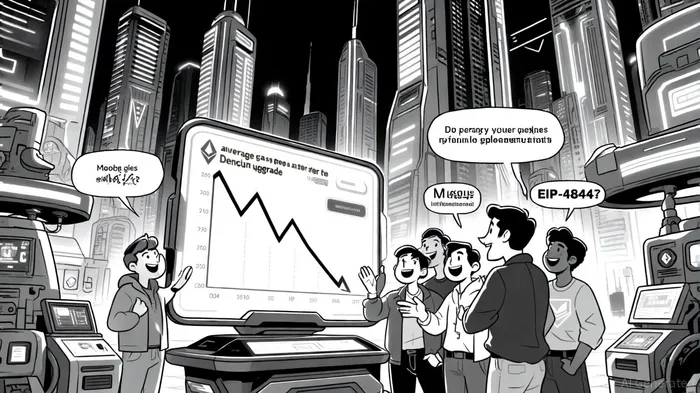





Comentarios
Aún no hay comentarios