
Ethereum's MVRV Divergence and Staking Conviction Signal Accumulation Phase
MVRV Divergence: Stakers vs. Circulating Holders
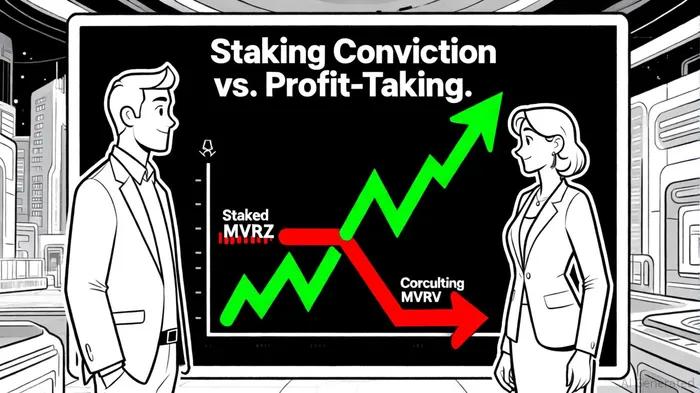
The MVRV ratio-a measure of market value relative to the realized value of all coins-has long been a barometer for crypto market sentiment. As of July 2025, EthereumETH-- stakers hold an MVRV ratio of 1.7, indicating 70% unrealized gains, while circulating supply holders hover at 1.5, reflecting 50% gains, according to a Coinotag article. This 20% gap underscores a key behavioral split: stakers, who lock up their ETHETH-- for yields, are more inclined to hold through volatility, whereas circulating supply holders are more likely to sell at profit-taking opportunities.
The implications are clear. With nearly 30% of the total ETH supply (over 36 million tokens) staked, sell pressure is being systematically reduced, especially at key support levels like $3,680, as noted in that Coinotag article. This dynamic creates a self-reinforcing cycle: higher staking participation tightens supply, while lower circulating MVRV signals a market resetting for potential accumulation.
On-Chain Metrics: A Network in Accumulation
Ethereum's on-chain fundamentals further validate the accumulation narrative. Total Value Locked (TVL) in DeFi protocols has surged to $85.382 billion, with daily decentralized finance (DeFi) volume exceeding $4 billion and active addresses surpassing 519,000, according to Coinotag's Wyckoff piece. These metrics reflect not just user activity but also liquidity inflows and institutional confidence.
Staking activity alone has approached 36.19 million ETH, with over 160,000 ETH staked since the October 2024 price crash, as reported in a Coinotag report. This surge in staking-driven by yields that, while lower than Solana's 7%, remain competitive-signals long-term conviction. As Vincent Liu of Kronos Research notes, "Ethereum's staking dominance is a flywheel effect: higher participation reduces sell pressure, which in turn attracts more capital," a point also discussed in that report.
Structural Market Rotation: Capital Shifting, But Not Leaving
While Ethereum's dominance has risen to 13.2% amid Bitcoin's declining share, the recovery report also highlights that capital rotation is not one-sided. SolanaSOL-- ETFs, for instance, have seen inflows of $44.48 million in a single day, Coinotag reported in a note on ETF flows (https://en.coinotag.com/solana-etf-inflows-may-continue-next-week-amid-bitcoin-and-ether-rotation/). However, this rotation does not negate Ethereum's strength.
Institutional activity tells a more nuanced story. SharpLink's recent $78.3 million ETH purchase was highlighted in the recovery report, underscoring continued demand from large players, even as some capital migrates to altcoins. Meanwhile, Ethereum's TVL and staking metrics suggest it remains the bedrock of the crypto ecosystem. As one analyst puts it, "Solana is a sprint; Ethereum is a marathon," an observation previously noted in the Wyckoff analysis.
The Path Forward: Supercycle or Correction?
Ethereum's on-chain metrics and MVRV divergence point to a prolonged accumulation phase, but risks remain. If macroeconomic volatility disrupts capital flows or if staking yields on other chains outpace Ethereum's, the network could face pressure. However, the current data-particularly the 20% MVRV gap and rising TVL-suggests a structural shift rather than a cyclical correction.
For now, Ethereum's fundamentals are aligned with a bull case. As the network tightens supply through staking and DeFi adoption, the stage is set for a potential retest of $8,000–$10,000 levels, as argued in that Wyckoff piece. Investors who recognize this divergence-and the conviction behind it-may find themselves positioned for the next leg of Ethereum's journey.






Comentarios
Aún no hay comentarios