
Ethereum's Market Chaos: Opportunities in the Wake of a $3.5K Crash
The recent plunge of EthereumETH-- (ETH) to $3,500 in October 2025 has sent shockwaves through the crypto market, driven by geopolitical tensions, macroeconomic uncertainty, and technical breakdowns. Yet, for contrarian investors, this chaos represents a unique inflection point-a moment to dissect the underlying fundamentals and identify asymmetric opportunities.
The Catalysts Behind the Crash
The selloff was precipitated by renewed fears of U.S. President Donald Trump's proposed 100% tariff on Chinese goods, which triggered a global "risk-off" sentiment. As Bitget's analysis shows, this led to over $235 million in leveraged ETHETH-- long positions being liquidated within days, exacerbating the downward spiral. Concurrently, BeInCrypto reports that spot volume and ETF outflows signaled institutional caution, with liquidity drying up as large players retreated. Technically, Ethereum's failure to break above $4,400-a key resistance level-sparked a cascade of stop-loss orders, accelerating the decline, a trend also noted by Bitget.
However, the narrative is not purely bearish. On-chain data reveals a critical nuance: while retail sentiment soured, institutional actors and whales were quietly accumulating.
Institutional Accumulation: A Contrarian Signal
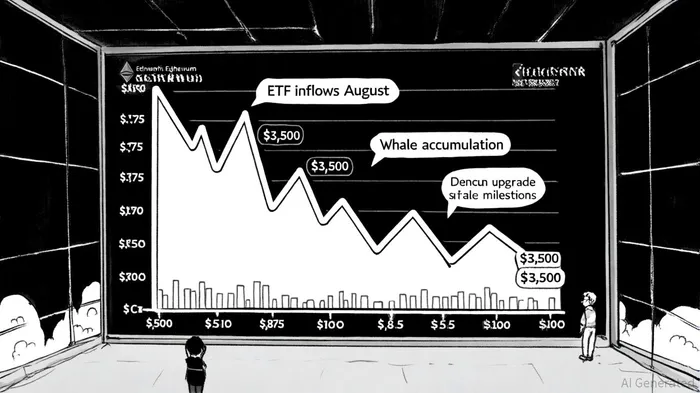
Despite the 20% drop to $3,500, Ethereum's institutional landscape tells a different story. According to Bitget, major players like BitMine ImmersionBMNR-- and SharpLink Gaming added 300,657 ETH and 255,000 ETH to their treasuries, respectively, during the August 2025 correction. These moves were amplified by the SEC's July 2025 reclassification of ETH as a utility token, unlocking staking and ETF demand. By October, Ethereum ETFs had attracted $27.6 billion in inflows, with 29% of the total supply now held in institutional wallets, according to Bitget.
Whale activity further underscores this trend. Cache256 shows that whale wallets now control 22% of the circulating supply, with some offloading 100,000 ETH in three days-a sign of strategic rebalancing rather than panic selling. This accumulation, coupled with Ethereum's Pectra/Dencun upgrades-which slashed gas fees by 90%-positions the network as a deflationary, utility-driven asset, as highlighted by Bitget.
On-Chain Indicators and Undervaluation
Ethereum's on-chain metrics paint a picture of undervaluation. The MVRV Z-Score (1.43) and NVT ratio (37) suggest the market is trading below fair value, with strong institutional conviction, per Bitget. Meanwhile, the burn rate, though reduced due to lower user activity, remains a tailwind for scarcity. As BeInCrypto notes, the breakdown of key support levels has created a buying opportunity for those willing to bet on Ethereum's long-term resilience.
Strategic Entry Points for Contrarians
For investors adopting a contrarian stance, the current environment offers three levers:
1. Staking Derivatives: With staking yields at 3.8%, products like stETH and EigenLayerEIGEN-- provide exposure to Ethereum's value accrual without direct price risk, a strategy discussed in the Bitget analysis.
2. ETF Allocation: Ethereum ETFs (e.g., ETHA) offer diversified, regulated access to institutional-grade accumulation, which Bitget documents as a major demand driver.
3. Dip Accumulation: Buying ETH at $3,500+ leverages historical recovery patterns, where Ethereum has consistently rebounded post-ETF approval and upgrade cycles, a view echoed by BeInCrypto.
Conclusion: Chaos as a Catalyst
Ethereum's $3,500 crash is not a death knell but a recalibration. For contrarians, the interplay of macro-driven selloffs, institutional accumulation, and on-chain strength creates a compelling case for long-term value. As history shows, Ethereum thrives in cycles of chaos-turning fear into fuel for the next bull run.





Comentarios
Aún no hay comentarios