
Ethereum's Long-Term Value Potential: Navigating Structural Upgrades and Macroeconomic Catalysts
Ethereum's journey in 2024–2025 has been defined by a dual narrative: structural innovation and macroeconomic recalibration. While short-term volatility remains a feature of its price action, the blockchain's long-term value proposition is increasingly anchored in its technical roadmap and alignment with global economic trends. This analysis dissects how Ethereum's post-Merge upgrades, deflationary mechanisms, and institutional adoption are converging to create a robust foundation for sustained growth.
Structural Upgrades: The Bedrock of Scalability and Security
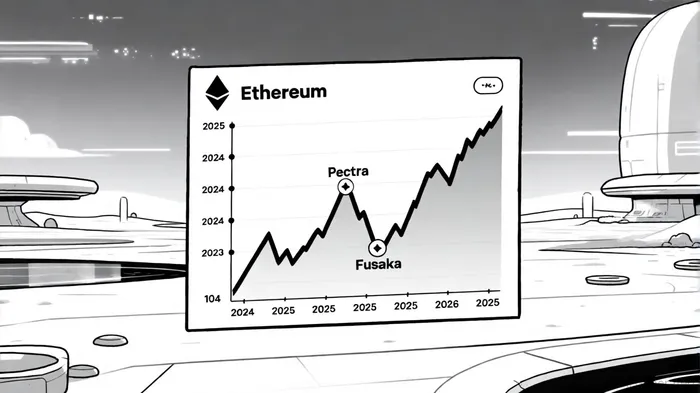
Ethereum's 2025 upgrades, particularly the Pectra and Fusaka hard forks, have redefined its scalability and usability. The Pectra upgrade, activated in May 2025, streamlined staking by raising the individual staking limit from 32 ETH to 2,048 ETH, democratizing participation while reducing operational overhead for validators, according to a Temple ePortfolio analysis. That analysis also noted that this shift, coupled with account abstraction and improved wallet functionality, catalyzed a 26% surge in ETH's value within months.
The Fusaka upgrade, slated for December 2025, will further amplify Ethereum's capacity to handle data. Innovations like Peer Data Availability Sampling (PeerDAS) and Verkle Trees aim to reduce Layer 2 transaction costs by 90% and enhance data verification efficiency, according to a CoinCatch overview. By increasing blob capacity from 6 to 48 blobs per block, Fusaka will enable platforms like ArbitrumARB-- and OptimismOP-- to process transactions at near-zero fees, the CoinCatch piece argues, solidifying Ethereum's dominance in the Layer 2 ecosystem. These upgrades are notNOT-- merely technical fixes but strategic moves to position EthereumETH-- as the backbone of Web3's infrastructure.
Monetary Policy: Deflationary Dynamics and Supply Scarcity
Ethereum's post-Merge economic model, shaped by EIP-1559 and EIP-4844, has introduced a deflationary flywheel. Since 2021, EIP-1559's base fee burning mechanism has destroyed over 4.5 million ETH, equivalent to $15.3 billion at current prices, according to an Ethereum.Tel analysis. While Ethereum remains modestly inflationary (0.82% annual supply growth), the Dencun upgrade (EIP-4844) has shifted activity to Layer 2 rollups, reducing on-chain gas fees and burn rates, the Medium explainer notes. This creates a paradox: as Ethereum scales, its deflationary pressure becomes more pronounced, enhancing scarcity without compromising usability.
The interplay between supply and demand is further amplified by institutional adoption. Spot Ethereum ETFs, mirroring Bitcoin's success, have siphoned billions of ETH from exchanges into regulated portfolios, reducing circulating supply and stabilizing price, as detailed in a Forbes prediction. This trend, combined with Ethereum's growing role in DeFi and tokenized assets, suggests a future where demand outpaces issuance, tipping the balance toward deflation.
Macroeconomic Catalysts: Fed Policy, Inflation, and Correlation with Traditional Markets
Ethereum's price dynamics are increasingly intertwined with macroeconomic forces. The Federal Reserve's monetary policy, particularly its rate decisions, has a direct bearing on investor sentiment. For instance, Ethereum's 11.79% weekly gain in June 2025 coincided with expectations of rate cuts, even as the Fed maintained rates at 4.25%-4.50%, according to a Gate analysis. This highlights Ethereum's sensitivity to liquidity conditions: lower rates reduce the opportunity cost of holding volatile assets, while higher rates drive capital to safer havens.
Inflation data also plays a pivotal role. Ethereum's correlation with the Consumer Price Index (CPI) has strengthened, with price surges often following inflationary spikes, a pattern noted in that Gate analysis. This is partly due to Ethereum's dual role as both a speculative asset and a store of value. Unlike BitcoinBTC--, Ethereum's utility in DeFi and NFTs ties its value to real-world economic activity, making it more responsive to macro trends.
Notably, Ethereum's correlation with traditional equities has risen sharply. It now mirrors the S&P 500 and Nasdaq 100 with a coefficient of 0.77, the Gate article reported, reflecting its transition from a niche crypto asset to a macro-sensitive investment. This alignment could attract institutional capital seeking exposure to growth sectors, further bolstering Ethereum's long-term value.
Challenges and the Path Forward
Despite these positives, Ethereum faces headwinds. Regulatory uncertainty, particularly in the U.S., could delay ETF approvals or impose restrictive frameworks. Additionally, competition from high-performance blockchains like SolanaSOL-- threatens Ethereum's market share in DeFi and NFTs. However, Ethereum's first-mover advantage, coupled with its robust developer ecosystem, provides a buffer against these risks.
The key to Ethereum's long-term success lies in its ability to execute its roadmap. If the Fusaka upgrade delivers on its promises and institutional adoption accelerates, Ethereum could see a sustained price appreciation. Conversely, delays in upgrades or regulatory setbacks could prolong volatility.
Conclusion
Ethereum's long-term value potential is no longer a speculative bet but a function of its structural resilience and macroeconomic alignment. The Pectra and Fusaka upgrades have laid the groundwork for a scalable, secure, and efficient network, while deflationary mechanisms and institutional adoption are creating a scarcity-driven value model. As macroeconomic conditions evolve, Ethereum's role as a bridge between crypto and traditional finance will only deepen, making it a compelling asset for investors with a multi-year horizon.






Comentarios
Aún no hay comentarios