
Ethereum's Long-Term Growth Potential: Macroeconomic and Adoption-Driven Tailwinds
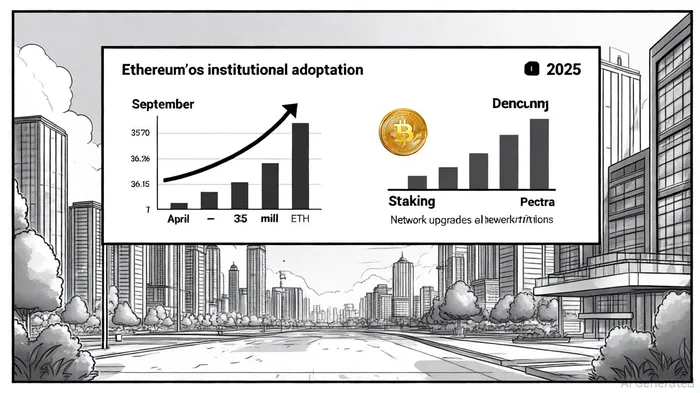
Ethereum's trajectory in 2025 is shaped by a confluence of macroeconomic tailwinds and adoption-driven momentum, positioning it as a cornerstone of the evolving digital asset landscape. From institutional inflows to network upgrades, the factors fueling Ethereum's growth are both structural and cyclical, creating a compelling case for long-term investors.
Macroeconomic Tailwinds: Fed Policy, Inflation, and Credit Expansion
The U.S. Federal Reserve's September 2025 rate cut—lowering the policy rate to 4.00%–4.25%—has provided a modest but meaningful boost to EthereumETH--. While the market largely priced in the move, the easing of monetary policy has reduced borrowing costs, making risk assets like Ethereum more attractive relative to low-yield government bonds[1]. Ethereum's price surged above $4,600 post-announcement, reflecting its sensitivity to liquidity-driven environments[1].
Ethereum's correlation with traditional markets further underscores its macroeconomic exposure. With a 0.77 correlation coefficient to the S&P 500, Ethereum mirrors broader equity market trends while amplifying risk-on sentiment[4]. For instance, a 11.79% weekly gain in late 2025 outperformed the S&P 500's 3.4% rise, highlighting Ethereum's role as a speculative asset during periods of economic uncertainty[2].
Inflationary dynamics also play a critical role. A 0.4% rise in the Consumer Price Index (CPI) in December 2023 triggered a spike in Ethereum's open interest, illustrating how inflation expectations drive speculative activity in crypto markets[2]. Meanwhile, the weakening U.S. dollar—a byproduct of rate cuts—has historically boosted demand for Ethereum as investors seek alternatives to fiat currencies[4].
Credit expansion, driven by central bank liquidity, is another key catalyst. Arthur Hayes, CIO at Maelstrom, argues that Ethereum's role as the backbone of stablecoin infrastructure (50% of the $400 billion stablecoin market) ties it directly to government debt markets[1]. Tether's $120 billion in U.S. Treasury holdings, for example, creates a symbiotic relationship between Ethereum's network and traditional finance[1].
Adoption-Driven Momentum: Institutional Inflows and Network Upgrades
Institutional adoption has surged, with Ethereum holdings doubling since April 2025 to 6.5 million ETH[3]. This growth is amplified by record staking activity—36.15 million ETHETH-- staked—reducing circulating supply and enhancing network security[3]. The launch of U.S. spot ETFs has further legitimized Ethereum as an institutional asset, attracting $29.22 billion in net inflows since July 2024[1].
Network upgrades like the Dencun and Pectra hard forks have unlocked Ethereum's scalability potential, enabling Layer 2 solutions to process over 70 transactions per second[5]. These improvements have bolstered Ethereum's utility in decentralized finance (DeFi), where it hosts over 4,000 decentralized applications and 50% of the stablecoin market[5].
Joseph Chalom, former head of crypto at BlackRock, offers a valuation framework: for every $2 of high-quality assets secured on Ethereum, the market cap rises by $1. If $10 trillion in assets migrate to Ethereum, the price could reach $41,400[3]. This model underscores Ethereum's role as “high-octane money” in tokenized finance[5].
Risks and Uncertainties
Despite these tailwinds, risks persist. Regulatory ambiguity—particularly around stablecoins and ETFs—could disrupt momentum[5]. Macroeconomic volatility, such as persistent inflation or a sharp rise in unemployment, may force the Fed to pause or reverse its easing cycle, introducing uncertainty for risk assets[1]. Additionally, high leverage in crypto futures markets poses a risk of cascading liquidations if momentum stalls[1].
Conclusion: A Bullish Outlook with Caution
Ethereum's long-term growth potential is underpinned by macroeconomic tailwinds and adoption-driven fundamentals. Institutional adoption, network upgrades, and credit expansion create a robust foundation, while its correlation with traditional markets ensures it remains a barometer for risk appetite. However, investors must remain vigilant about regulatory and macroeconomic risks. For those with a multi-year horizon, Ethereum's unique position as both a speculative asset and a foundational layer of tokenized finance offers compelling upside.






Comentarios
Aún no hay comentarios