
Ethereum Leverage Trading Risks in 2025: Navigating Liquidation Triggers and Position Management in Volatile Markets
The EthereumETH-- market of 2025 has been a crucible for leveraged traders, exposing the fragility of positions in an environment marked by geopolitical shocks, regulatory shifts, and cascading liquidations. As volatility became the norm, the interplay between leverage, liquidity, and institutional behavior reshaped risk management paradigms. This analysis examines the key triggers of liquidation events in 2025, the mechanics of cascading sell-offs, and the evolving strategies to mitigate these risks.
The 2025 Liquidation Landscape: Case Studies in Systemic Risk
The year 2025 saw two defining events that underscored the perils of leveraged Ethereum trading. The first was the forced liquidation of $74.5 million in Ethereum by corporate treasury firm ETHZilla, which occurred to meet senior secured debt obligations rather than due to a bearish market outlook according to reports. This event exacerbated downward pressure on Ethereum's price, illustrating what analysts have termed the "Prisoner's Dilemma" of leveraged positions: institutional holders, incentivized to sell first during market stress, accelerated price declines and triggered a feedback loop of panic selling as research shows.
The second, and far more catastrophic, event was the October 2025 "Tariff Nuke," triggered by former President Trump's announcement of 100% tariffs on Chinese imports. Within hours, over $19 billion in leveraged long positions were wiped out, with over $1.23 billion in liquidations alone on Hyperliquid. The collapse was amplified by high open interest, low liquidity during off-hours, and the depegging of stablecoins like Ethena's USDeUSDe--, which fell to $0.65 due to Binance's margin system according to data. These events highlighted how even small price movements in illiquid conditions can trigger a self-reinforcing cycle of selling and further price declines as market analysis indicates.
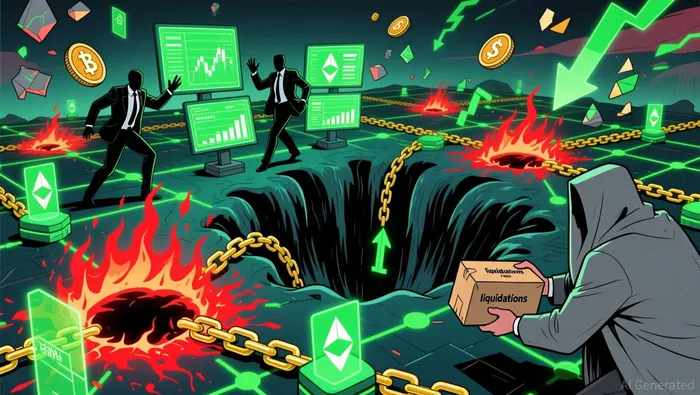
The Five-Stage Cascade: How Liquidations Unfold
The October 2025 crash revealed a structured progression of cascading liquidations, which can be broken into five stages: 1. Leveraged Positioning: High open interest and overexposure to long positions create a fragile equilibrium. 2. Initial Trigger: A macroeconomic or geopolitical shock (e.g., the Tariff Nuke) disrupts this balance. 3. Margin Calls: As prices drop, margin requirements exceed collateral, forcing algorithmic liquidations. 4. Liquidity Drought: Off-hours trading and reduced market depth prevent orderly price discovery, exacerbating slippage. 5. Market Avalanche: The self-reinforcing cycle of selling leads to a full-blown collapse, often accompanied by stablecoin depegging and systemic risk as market data shows.
This framework underscores the importance of proactive position management, as even well-capitalized traders can be caught in a liquidity vacuum.
Position Management Strategies: Beyond HODLing
Traditional "HODL" strategies have proven inadequate in 2025's volatile markets. Instead, traders are increasingly adopting sophisticated tools to mitigate risk: - Derivatives Hedging: Protective puts and bear put spreads are recommended to cap downside risk while retaining upside potential according to research. - Stop-Loss Orders: Automated trailing stops and dynamic stop-loss thresholds help limit losses during rapid price swings as market analysis shows. - Liquidity Buffers: Maintaining sufficient uncollateralized reserves ensures traders can meet margin calls without forced selling during distress scenarios as best practices indicate.
These strategies are not merely defensive but also strategic. For instance, the use of derivatives allows traders to hedge against macroeconomic shocks like the Tariff Nuke, which are often unpredictable but have predictable market impacts according to market analysis.
Regulatory Shifts and Institutional Adaptation
Post-Tariff Nuke, the U.S. government under President Trump introduced policies that reshaped the crypto landscape. The GENIUS Act established a tailored regulatory framework for stablecoins, while the SEC's Project Crypto aimed to clarify token classifications according to policy analysis. These developments fostered innovation but also highlighted the need for institutional integration to navigate political transitions. As Danny Ryan of a leading crypto firm warned, "Policy risks remain acute as the Trump administration nears its end, and institutional players must adapt to avoid being blindsided by regulatory vacuums" as industry experts warn.
Conclusion: Preparing for the Next Volatility Cycle
The 2025 Ethereum liquidation events serve as a stark reminder of the risks inherent in leveraged trading. As markets continue to grapple with geopolitical uncertainty and regulatory evolution, traders must prioritize position management strategies that account for both technical and systemic risks. The lessons from ETHZilla and the Tariff Nuke underscore the need for a proactive, diversified approach-one that balances leverage with liquidity, hedging with adaptability, and innovation with caution.






Comentarios
Aún no hay comentarios