
Ethereum Layer 2s: Post-Crash Resilience and the Path to Dominance
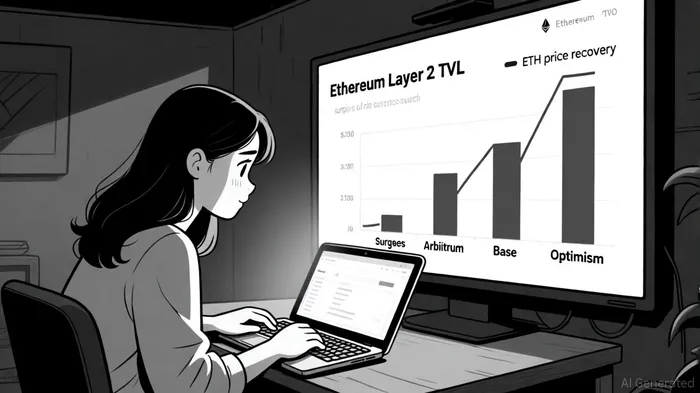
The $19 billion crypto drawdown in late 2025 sent shockwaves through the market, but Ethereum's Layer 2 (L2) ecosystem emerged not just unscathed, but stronger. Total Value Locked (TVL) across L2s surged to $51.5 billion by late 2025, a 205% increase from $16.6 billion in November 2023, according to a CoinMarketCap report. This growth underscores a fundamental shift: investors and developers are prioritizing scalability and cost efficiency over speculative hype.
Post-Crash Outperformance: L2 Tokens vs. ETH and Broader Markets
Ethereum's native token, ETHETH--, rebounded from a low of $2,500 to $3,800 by late 2025, driven by ETF inflows and institutional adoption, according to an Analytics Insight report. However, L2 tokens like ArbitrumARB-- (ARB), OptimismOP-- (OP), and Mantle (MNT) outperformed even this recovery. ARBARB-- surged 89% from $0.25 to $0.45 post-crash, while OPOP-- gained 95% from its mid-2025 low, per an OnChainStandard analysis. Mantle, a L2 solution integrated with Bybit's ecosystem, saw a 31% price rebound and a threefold increase in utility-driven demand, according to a CCN analysis.
In contrast, traditional benchmarks like the S&P 500 and Nasdaq posted modest gains during the same period, highlighting the speculative nature of crypto's L2 tokens. This divergence is no accident: Ethereum's Dencun upgrade (EIP-4844) and Pectra upgrade (EIP-7702) slashed gas fees and improved data availability, making L2s more attractive for both retail and institutional users, as noted in a BeinCrypto article.
Capital Flows and Institutional Adoption: The New Paradigm
Institutional capital has become a cornerstone of Ethereum's L2 growth. By mid-2025, over $1.3 billion flowed into Ethereum-focused ETFs, with firms like BlackRock and Fidelity allocating to L2 infrastructure, according to a Decentralogue post. Arbitrum and Optimism, in particular, capitalized on this trend. Arbitrum's TVL hit $18.3 billion, driven by DeFi protocols and gaming platforms, while Optimism's modular OP Stack attracted institutional partnerships, as noted in a Coinomist overview.
Cross-chain bridges like Hop Protocol and LayerZeroZRO-- further amplified L2 adoption by addressing liquidity fragmentation. These tools enabled seamless asset transfers between L2s, boosting interoperability and user retention; CoinMarketCap also highlighted this dynamic. Meanwhile, zkSyncZK-- Era's focus on ZK-rollup technology-processing 10,000 TPS in early 2025-positioned it as a long-term contender despite lower TVL compared to optimistic rollups, according to a CABCD report.
User Growth and Developer Activity: The Metrics of Adoption
Ethereum's L2 networks now process six times more transactions than the mainnet, with 15.4 million weekly active addresses as of late 2025, per a Currency Analytics article. Base and Unichain led this surge, with 4.76 million and 5.8 million active users, respectively. Developer activity mirrored this trend: the number of active projects on L2s grew by 120% year-over-year, fueled by reduced fees and improved tooling, as reported by Analytics Insight.
However, challenges persist. Optimism's ETH reserves fell 54% since March 2025 due to withdrawal delays and token price weakness, a decline reported by CCN. Similarly, Ethereum's mainnet revenue dropped 95% in 2025 as users migrated to L2s, raising concerns about network security and validator incentives, according to a Currency Analytics report.
Long-Term Adoption: The Road Ahead
Despite these hurdles, Ethereum's L2 ecosystem is poised for dominance. The Dencun upgrade's 10x reduction in data costs, as CoinMarketCap documented, combined with upcoming upgrades like Proto-Danksharding, will further cement L2s as the backbone of decentralized finance. Institutional infrastructure-standardized custody solutions, deep hedging markets, and modular staking protocols-is accelerating this transition, as explored in an Observer analysis.
For investors, the key lies in differentiating between short-term volatility and long-term value. While ARB and OP face tokenomics challenges (e.g., OP's 2% annual inflation, noted by OnChainStandard), their ecosystem growth and strategic partnerships outweigh these risks. Mantle's integration with restaked ETH and Bybit's ecosystem also positions it as a high-growth play, as BeinCrypto covered.
Conclusion
Ethereum's L2 solutions have proven their resilience in the wake of the 2025 drawdown. With TVL surpassing $50 billion, institutional adoption surging, and transaction throughput outpacing the mainnet, these networks are no longer just scalability experiments-they're the future of decentralized infrastructure. For investors, the question isn't whether L2s will succeed, but which ones will dominate the next phase of Ethereum's evolution.






Comentarios
Aún no hay comentarios