
Ethereum's Layer-2 Migration and Its Impact on Long-Term Value
Ethereum's evolution from a monolithic "world computer" to a scalable, secure settlement layerLAYER-- has been one of the most transformative narratives in crypto. The Dencun upgrade in March 2024, which introduced EIP-4844 (Proto-Danksharding), marked a pivotal shift in this journey. By enabling Layer-2 (L2) networks to post transaction data to Ethereum's mainnet at a fraction of the cost, the upgrade fundamentally redefined Ethereum's economic model. Critics initially feared that reduced base-layer fees would undermine Ethereum's price fundamentals. However, the data tells a different story: Ethereum's TVL, institutional adoption, and macroeconomic positioning are now stronger than ever, signaling a maturing infrastructure rather than a decline.
TVL Trends: A Barometer of Confidence
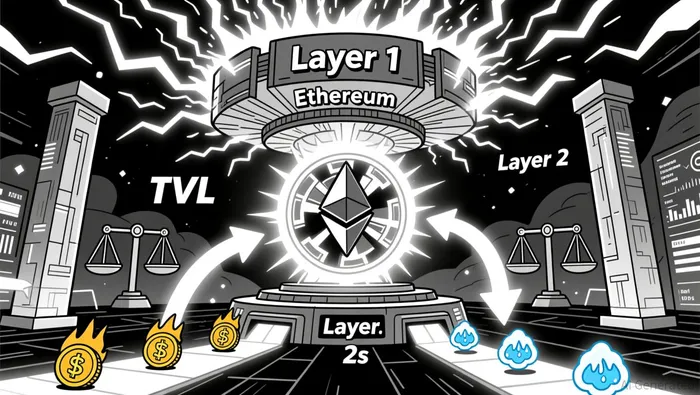
Ethereum's L2 TVL has surged from $16.6 billion in November 2023 to $39.39 billion in 2025, with Arbitrum One and Base dominating the market. By November 2025, Arbitrum's TVL alone reached $16.63 billion, securing a 51% market share, while Base and OptimismOP-- held $10 billion and $6 billion, respectively according to adoption statistics. This growth reflects a critical shift: users and developers are increasingly trusting L2s to handle high-throughput use cases like DeFi, gaming, and social media, while relying on Ethereum's mainnet for finality and security.
The Dencun upgrade directly enabled this transition. By reducing the cost of L2 operations by 10–100x through blob data, Ethereum's base layer became a cheaper, more efficient backbone for a decentralized economy. This isn't a loss of revenue-it's a strategic reallocation of value. As Galaxy notes, L2s now act as "paying customers" for Ethereum's security, creating a flywheel effect where L2 growth drives demand for Ethereum's blockspace and staking infrastructure.
On-Chain Activity: From Congestion to Scalability
Post-Dencun, Ethereum's gas fees plummeted to as low as 0.067 gwei in November 2025, a 95% drop from pre-upgrade levels. While this might seem like a blow to Ethereum's revenue, it's a feature, not a bug. Lower fees democratize access to the network, enabling mass adoption for applications that were previously unviable. For instance, daily transaction volumes on L2s now exceed 1.9 million, with networks like ArbitrumARB-- and Optimism handling use cases ranging from micro-transactions to tokenized real-world assets.
Importantly, Ethereum's role as a settlement layer is more economically robust than ever. As Phemex highlights, the network's health is now measured by TVL and cross-chain bridge volumes rather than Layer-1 transaction counts. This shift aligns with Ethereum's long-term vision: to become a secure, scalable foundation for a global decentralized economy.
Institutional Adoption: A New Era of Legitimacy
Institutional buying has emerged as a cornerstone of Ethereum's price fundamentals. By late 2025, corporate treasuries and ETFs collectively hold over 10 million ETHETH--, valued at $46.22 billion. This surge is driven by Ethereum's proof-of-stake transition, which allows institutions to stake ETH and earn 3–4% annual yields. The approval of U.S. spot EthereumETH-- ETFs has further normalized institutional participation, with inflows often outpacing Bitcoin's according to market analysis.
Regulatory clarity has also played a critical role. The SEC's guidance on staking arrangements and Ethereum's non-security status has reduced legal uncertainty, encouraging large players to allocate capital to ETH. This institutional demand isn't speculative-it's a bet on Ethereum's infrastructure as a foundational layer for DeFi, tokenization, and global finance.
Macroeconomic Headwinds and Resilience
Ethereum's price in 2024–2025 has been influenced by macroeconomic factors like interest rates and liquidity trends. Rising U.S. yields and cooling ETF inflows in 2025 caused a temporary correction, with Ethereum underperforming BitcoinBTC-- amid a hawkish Federal Reserve according to market analysis. However, Ethereum's long-term fundamentals remain intact.
When liquidity tightens, risk assets like crypto face headwinds, but Ethereum's role in tokenization and stablecoin infrastructure provides a buffer. As CoinDnes notes, Ethereum's expanding use cases in real-world asset tokenization and DeFi position it to outperform in a more stable macroeconomic environment. Moreover, the Dencun upgrade's efficiency gains ensure Ethereum remains competitive as a settlement layer, even in a low-fee world.
Conclusion: A Stronger, More Scalable Ethereum
The Dencun upgrade and L2 migration have not weakened Ethereum-they've repositioned it as a dominant, scalable infrastructure layer. Reduced base-layer fees are a deliberate design choice to enable mass adoption, while TVL growth and institutional adoption signal confidence in Ethereum's long-term value. Macroeconomic volatility may cause short-term corrections, but Ethereum's fundamentals-driven by technological innovation, regulatory clarity, and expanding use cases-remain robust.
For investors, this means Ethereum is no longer just a speculative asset. It's a critical backbone of the decentralized economy, with a flywheel of value creation that connects L2s, institutional capital, and global liquidity. The question isn't whether Ethereum's price will rebound-it's how quickly the market will recognize that reduced fees are the key to its dominance.







Comentarios
Aún no hay comentarios